

Missed Lamotrigine Doses: When to Restart From Week 1

Your Patient Missed Lamotrigine for a Week: Can They Restart at the Old Dose, and Why Does Valproate Change the Answer?
A woman who has been well for a year on lamotrigine 200 mg daily ran out while travelling three weeks ago. Her mood has dipped, she has a full bottle at home, and she messages the clinic: "Can I just go back to my 200 mg tonight?" The reflex answer is yes: it is not a new drug for her, and she tolerated it for a year. That reflex is wrong. Exceeding the recommended starting dose is one of the risk factors for serious rash named in the lamotrigine boxed warning, and after a long enough gap the label says to start again from the beginning. Every restart is a new start until proven otherwise.
The 30-second version
- After more than five half-lives off lamotrigine, start again from the beginning. That is the label's instruction: follow the initial dosing recommendations.
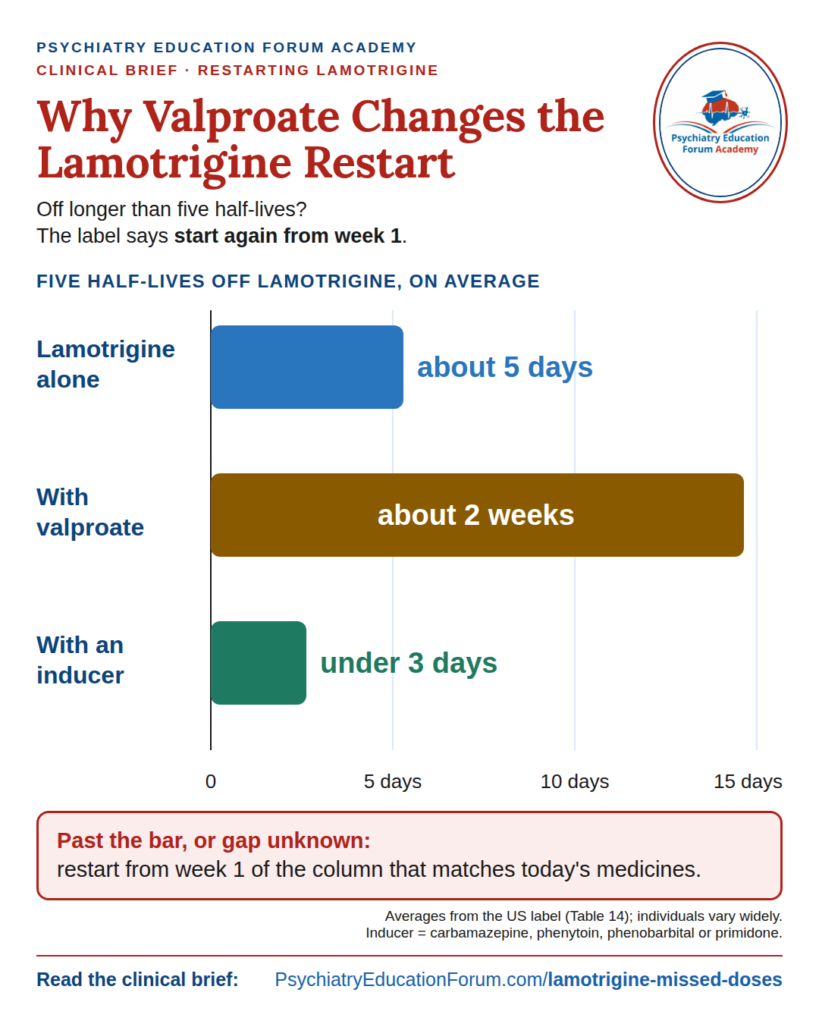
- Five half-lives is not the same for every patient. On the averages in the current label's pharmacokinetic table (Table 14) it is about five days on lamotrigine alone, about two weeks with valproate, and under three days with an enzyme inducer such as carbamazepine.
- Restart from week 1 of the column that matches today's medicines, not the medicines the patient was on before. The label recommends starter kits for restarting as well as starting.
- A dose or two missed is a judgement. The label gives no specific instruction beyond its principle: the longer the gap, the stronger the case for starting again.
- Ask why it stopped before asking how long ago. For any patient who stopped because of a rash, the label recommends not restarting unless the potential benefits clearly outweigh the risks. In the chapter's clinical approach, after SJS, TEN or DRESS lamotrigine is not restarted, and after a rash judged benign a restart is a specialist decision.
Can a patient restart at the old dose?
Not after a long gap. After more than five half-lives off lamotrigine, the label says the initial dosing recommendations should be followed.
With lamotrigine, the titration is the safety measure. The boxed warning lists four factors that may increase the risk or severity of lamotrigine rash, and two of them are about the dose itself: exceeding the recommended initial dose, and exceeding the recommended dose escalation. A patient who restarts at home at the old dose, without a prescriber, recreates the conditions the boxed warning describes.
The label's restarting advice has three parts:
| Part | What the label says |
|---|---|
| 1 · Any restart | If a decision is made to restart, the need to restart with the initial dosing should be assessed. |
| 2 · The longer the gap | The greater the interval since the previous dose, the greater the consideration that should be given to restarting with the initial dosing. |
| 3 · More than five half-lives | If the patient has been off lamotrigine for more than five half-lives, the initial dosing recommendations should be followed. |
Lamotrigine is the mood stabilizer patients most often stop on their own. They also restart on their own, usually at the dose they were on.
How long is "five half-lives"?
It depends on the other medicines: about five days on lamotrigine alone, about two weeks with valproate, and under three days with an enzyme inducer, on average.
The label adds that the half-life is affected by other medicines: valproate decreases the clearance of lamotrigine and inducers increase it. So the same calendar gap counts for more in a patient taking an inducer than in one taking valproate. The pharmacokinetic table in the label (Table 14) puts numbers on this.
| Patient is taking | Mean half-life | Five half-lives, roughly |
|---|---|---|
| Lamotrigine alone | About 25 hours (healthy volunteers, repeated dosing) | About five days |
| Lamotrigine with valproate | About 70 hours (healthy volunteers, repeated dosing) | About two weeks |
| Lamotrigine with an enzyme-inducing anticonvulsant | About 13 hours (patients with epilepsy) | Under three days |
The valproate row is the one that surprises people. A patient on valproate who has been off lamotrigine for a week is still inside five half-lives on average; a patient on carbamazepine who has been off for three days is already past it.
Where does the restart begin?
At week 1 of the column that matches the patient's current medicines, not the medicines they were on before.
The label's escalation regimen for adults with bipolar disorder has three columns, set by the patient's other medicines:
Valproate decreases the clearance of lamotrigine, so its column is the slowest.
No valproate and no enzyme inducer.
Carbamazepine, phenytoin, phenobarbital and primidone increase clearance. The label adds that rifampin and lopinavir/ritonavir should be treated like those inducers.
| Week | Taking valproate | Taking neither valproate nor an inducer | Taking an inducer, not valproate |
|---|---|---|---|
| Weeks 1 and 2 restart here | 25 mg every other day | 25 mg daily | 50 mg daily |
| Weeks 3 and 4 | 25 mg daily | 50 mg daily | 100 mg daily, divided |
| Week 5 | 50 mg daily | 100 mg daily | 200 mg daily, divided |
| Week 6 | 100 mg daily | 200 mg daily | 300 mg daily, divided |
| Week 7 | 100 mg daily | 200 mg daily | Up to 400 mg daily, divided |
The US label's escalation regimen for adults with bipolar disorder (Table 5). Check the current label before prescribing.
The patient may have started or stopped valproate, an inducer or a contraceptive while off lamotrigine, which moves them into a different column or changes the eventual maintenance dose. Before restarting, work through the same steps every time:
- Ask why lamotrigine stopped.The reason decides whether to restart at all; a rash changes everything (see below).
- Ask when the last dose was.The gap decides where to restart.
- Take today's medicine list.Valproate, an inducer, or neither; and any estrogen-containing contraceptive or HRT starting or stopping.
- Choose the column, and start at week 1 if the gap is long or unknown.Use a starter kit where available.
- Write it down.The column used and why, each step with its dates, what to do about a missed dose, and that a rash, mouth sores or fever mean stop and call.
| Changed while off lamotrigine | What it changes |
|---|---|
| Valproate started | Moves the patient into the slowest column, with a target of 100 mg/day. |
| An inducer started, without valproate | Moves the patient into the inducer column. |
| Estrogen-containing contraceptive started or stopped | Does not change the starting schedule, but changes the maintenance dose. In women not taking an inducer: starting it, the maintenance dose will in most cases need to be increased by as much as two-fold over the usual target; stopping it, the maintenance dose will in most cases need to fall by as much as 50%. |
| Progestin-only pill | Progestin-only pills had no effect on lamotrigine levels. |
What if only a dose or two was missed?
The label gives no specific instruction for a short gap. It leaves it to judgement: the longer the gap, the stronger the case for starting again.
In practice that gives a simple rule for the long gap and a judgement for the short one:
Restart from week 1 of the right column.
Weigh the gap against the patient's other medicines. The same calendar gap counts for more in a patient taking an inducer than in one taking valproate.
Does it matter why lamotrigine stopped?
More than the gap does. If it stopped because of a rash, that decides whether to restart at all.
The label says lamotrigine is contraindicated in patients who have shown hypersensitivity to it, giving rash, angioedema, acute urticaria, extensive pruritus and mucosal ulceration as examples. Its dosing section recommends that lamotrigine not be restarted in patients who stopped it because of a rash unless the potential benefits clearly outweigh the risks. That applies to any rash: the label does not divide rashes into benign and serious. The table below is the chapter's clinical approach within that rule, not label wording.
| Why lamotrigine stopped | Restart? (clinical approach) | If so, how |
|---|---|---|
| SJS, TEN or DRESS, or a rash with mouth sores, blisters, fever or swollen glands | No | Record lamotrigine as contraindicated and choose another treatment. |
| A rash judged benign | Only if the benefits clearly outweigh the risks: a specialist decision | A deliberate, documented decision, made with the patient once the rash has fully settled, starting from the beginning of the schedule and never faster than the label's column. |
| Never a rash: ran out, travelled, forgot, felt well | Yes | From week 1 of the right column if the gap is longer than five half-lives or unknown. |
For a rash judged benign, the evidence allows a restart in selected patients, but not a casual one:
| Evidence | What it found |
|---|---|
| Prospective case series 27 patients rechallenged after a rash | Five stopped again because of rash or inflammation; none developed SJS or TEN. |
| Systematic review 106 published rechallenges | Most successful, but only three of the first rashes had been confirmed by a dermatologist. |
Both used schedules slower than usual. Neither is a trial.
Is there a catch?
Two. The day counts are averages, and the short gap is a judgement.
- The day counts are averages.The ranges around each mean half-life are wide, so "about five days" is a guide for the typical patient, not a guarantee for the one in front of you. When in doubt, the label's own principle points one way: the longer the gap, the stronger the case for starting again.
- The label does not say what to do after one or two missed doses.That part is clinical judgement, which is why the plan is best agreed in advance.
One more point. The label says no therapeutic plasma concentration range has been established, so the dose is set by response, not by a level.
The full chapter is free in Section 4, live now.
Chapter 13 of Managing Mood Stabilizer Adverse Events gives you a two-minute bedside panel, a restart triage, the three titration columns, what to do when valproate, an inducer or a contraceptive starts or stops, a counselling script for the restart and a copy-paste EMR note. It is free to read. Section 4 also covers the lamotrigine rash that must be triaged the same day, and the rarer systemic reactions.
Read Chapter 13 free → Members: Chapter 12, lamotrigine rash →Table of contents
Chapters 1, 5 and 13 are free to read. The rest are included with Academy membership.
- 1Lithium Toxicity: Recognition, Severity and When to Send to the ED Free · read now
- 2Unexpected Lithium Levels: Interactions, Sick-Day Rules and Level Troubleshooting Members
- 3Neurologic Symptoms on Lithium: Toxicity, Encephalopathy, Serotonin Syndrome and NMS Members
- 4Lithium Polyuria and Nephrogenic Diabetes Insipidus Members
- 5Lithium and Declining Kidney Function: CKD, Proteinuria and When to Reconsider Treatment Free · read now
- 6Lithium Thyroid, Calcium and Parathyroid Abnormalities Members
- 7Lithium Tremor, Cognitive Effects, Weight Gain and Skin Problems Members
- 8Valproate Liver Injury, Pancreatitis and Serious Hypersensitivity: When to Stop Members
- 9Valproate Hyperammonemia: When to Check Ammonia and When to Stop Members
- 10Valproate Thrombocytopenia and Bleeding: CBC, Procedures and Dose Decisions Members
- 11Valproate Weight Gain, Metabolic Effects and Hair Loss Members
- 12Lamotrigine Rash: When to Stop and How to Recognize SJS/TEN and DRESS Members
- 13Starting and Restarting Lamotrigine: Titration, Valproate and Missed Doses Free · read now
- 14Systemic Illness on Lamotrigine: HLH, Aseptic Meningitis and Blood Dyscrasias Members
- 15Carbamazepine/Oxcarbazepine Rash: SJS/TEN, DRESS, HLA Testing and Cross-Reactivity Soon
- 16Carbamazepine/Oxcarbazepine Hyponatremia: When to Monitor, Reduce or Stop Soon
- 17Carbamazepine Blood and Liver Toxicity: When to Stop Soon
- 18Carbamazepine/Oxcarbazepine Drug Interactions: Induction, Autoinduction and Toxicity Soon
- 19Mood Stabilizers and Cardiac Conduction: Lithium, Lamotrigine and Other Sodium-Channel Blockers Soon
- 20Stopping Mood Stabilizers: Tapering and Reducing Recurrence Risk Soon
- 21Quick-Reference Monitoring and Management Grid Soon
Every chapter, every series, one membership.
Academy membership opens every chapter in this course and the rest of the Academy library, written for prescribers at the point of care.
See membership plans →
Responses