

How Long Should Patients Stay on an Antidepressant After Remission? A Decision Model Puts a Number on It

How Long Should Patients Stay on an Antidepressant After Remission? A Decision Model Puts a Number on It
A patient has been well for months on an SSRI after her first episode of depression, and she asks the question every clinician hears: how long do I stay on this? Discontinuation trials offer one answer: about 44% relapsed within a year after stopping, against 22% who stayed on treatment. But those trials enrolled patients with a mean of about 4–5 prior episodes, not patients like her, and they don’t tell her what matters most: how much time on medication buys how much time free of depression. A new decision model tries to answer that, and the answer depends heavily on how many episodes she has had.
The 60-second read
- The question: after remission and 8 months of continuation treatment, stay on the antidepressant, or stop it and restart if depression returns (“active monitoring”)?
- The method: a computer model built from trial and cohort data, run over 5 years. It did not follow new patients.
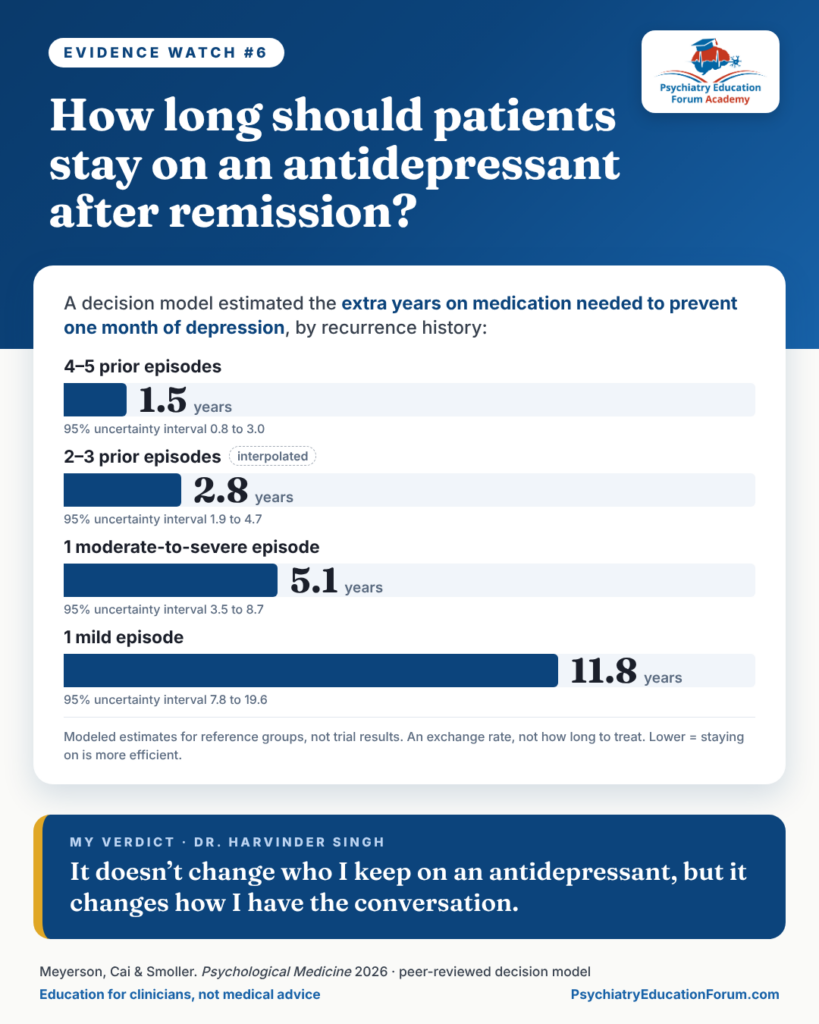
- The headline: extra years on an antidepressant needed to prevent one month of depression were 1.5 after 4–5 prior episodes, 2.8 after 2–3, 5.1 after one moderate-to-severe episode and 11.8 after one mild episode.
- What drives it: 82.3% of the extra depression after stopping came from episodes that weren’t prevented, not from longer episodes.
- The catch: these are modeled estimates. The 2–3 episode group was interpolated, not measured, and the “years a patient would accept” thresholds are illustrative.
- My verdict: It doesn’t change who I keep on an antidepressant, but it changes how I have the conversation.
What did the study actually do?
It built a model of patients in remission and compared two strategies over 5 years, using published trials and cohorts as inputs. No new patients were studied.
The study at a glance
| Design | Decision-analytic microsimulation; no new patients |
| Who | Adults in remission after an 8-month continuation phase |
| Compared | Continuous maintenance vs active monitoring (check every 3 months, restart on relapse) |
| Horizon | 5 years |
| Effect of staying on | Composite hazard ratio 0.470 (0.420 to 0.530), from a meta-analysis |
| Groups | Four recurrence-risk reference groups (High, Moderate, Low, Very Low) |
| Outcome | Extra medication-years per severity-weighted depression-month averted |
| Uncertainty | 1,000 parameter draws × 10,000 simulated patients per group; 95% uncertainty intervals |
The model starts after an 8-month continuation phase. Under continuous maintenance, patients stay on the antidepressant for all 5 years. Under active monitoring, they stop, are reviewed every 3 months in the base case, and restart if depression returns, continuing for 8 months after remission before stopping again.
Two sources anchor the model. A meta-analysis of 35 double-blind discontinuation trials in 9,442 adults with recurrent depression (Kishi 2023) found 12-month relapse of about 44% after stopping and 22% with maintenance; those patients had a mean of about 4–5 prior episodes. A cohort of 301 patients followed after a first episode (Bukh 2016) found recurrence of 9.0% at 1 year and 31.5% at 5 years. The model uses four reference groups based on recurrence risk: one mild episode, one moderate-to-severe episode, about 2–3 prior episodes and about 4–5 prior episodes. The 2–3 episode group’s recurrence probability was interpolated between the lower-risk and higher-risk anchors.
The outcome is a ratio: extra years on an antidepressant needed to avert one month of depression. It compares the extra time on medication under continuous maintenance with active monitoring, per severity-weighted month of depression prevented over 5 years. It is an exchange rate, not the number of years a patient must stay on treatment; that is why it can exceed the 5-year horizon. Depression months are severity-weighted, so lingering residual symptoms count for less than a full episode.
What did it find?
Staying on the antidepressant reduced time depressed in every group, but the cost in years on medication varied nearly eightfold with how many episodes the patient had had.
| Recurrence history | Months depressed over 5 years (monitor vs stay on) | Years on medication (monitor vs stay on) | Extra years per month of depression averted (95% UI) |
|---|---|---|---|
| 4–5 prior episodes | 6.0 vs 3.4 | 1.2 vs 5 | 1.5 (0.8 to 3.0) |
| 2–3 prior episodes interpolated | 3.4 vs 1.8 | 0.7 vs 5 | 2.8 (1.9 to 4.7) |
| One moderate-to-severe episode | 1.9 vs 1.0 | 0.4 vs 5 | 5.1 (3.5 to 8.7) |
| One mild episode | 0.9 vs 0.4 | 0.2 vs 5 | 11.8 (7.8 to 19.6) |
The last column was calculated within each simulation run and then averaged, so it will not match the first two columns divided by hand (Table 2 note).
Read across the bottom row. After one mild episode, staying on the antidepressant for 5 years instead of about 0.2 years cut modeled depression from 0.9 to 0.4 months. After 4–5 episodes, the same strategy cut it from 6.0 to 3.4 months. In both groups, staying on means 5 years on medication; what those years buy differs.
Where does the extra depression come from?
Mostly from episodes that maintenance would have prevented, not from episodes lasting longer once they start.
That matters for the counseling conversation: in this model, the case for staying on rests mainly on preventing a new episode. Longer episodes after stopping were a small share.
How should this change the conversation?
It gives you a way to ask the patient a concrete question: how much time on medication would you accept to avoid one month of depression?
The authors frame each group’s ratio as a break-even point. If a patient would accept at least that many extra years on medication to avoid one month of depression, the model favors staying on; if not, it favors stopping with monitoring. At an illustrative threshold of 2 years, maintenance was favored only in the 4–5 episode group. At 3 years, it was favored in that group and reached break-even in the 2–3 episode group, with uncertainty that overlapped zero.
| If the patient would accept… | 4–5 prior episodes | 2–3 prior episodes | 1 moderate–severe episode | 1 mild episode |
|---|---|---|---|---|
| 1 year | Monitoring | Monitoring | Monitoring | Monitoring |
| 2 years | Staying on | Monitoring | Monitoring | Monitoring |
| 3 years | Staying on | Break-even; uncertain | Monitoring | Monitoring |
Preferred strategy at the paper’s three illustrative thresholds (Results). “Break-even; uncertain”: maintenance reached break-even, but the uncertainty interval overlapped zero. The paper does not spell out Low and Very Low at 3 years; both follow from Table 2, where their lower bounds are above 3.
The paper’s own example: a 26-year-old graduate student, several months past remission from a first moderately severe episode, might decide she would stay on medication through the 2 years left of her program, but not through her 20s.
That puts her threshold at about 2 to 4 years, below the break-even of about 5 for her group, so the model favors stopping with monitoring. After several relapses, the same preference would favor staying on.
And if her one episode had included a suicide attempt, and she had since recovered insight and capacity for treatment decisions, the authors write that it would be consistent with the framework for the clinician to explore whether her stated preference reflects what another episode could mean for her.
The thresholds are not measured patient preferences. The authors call them “illustrative preference parameters,” and how to elicit them in clinic is untested.
What can’t a model tell you?
Several things that matter at the bedside. The model is only as good as its inputs, and the authors are clear about the gaps.
- The middle group was interpolated. The 2–3 episode group, where guidance is less clear, was interpolated between the first-episode cohort and the highly recurrent trial populations.
- Withdrawal may look like relapse. The inputs come from discontinuation trials with heterogeneous and often incompletely reported tapering. Gradual tapering, especially with relapse-prevention psychotherapy, may make stopping look better than the model shows.
- The “years you’d accept” are hypothetical. No patient was asked; the 1, 2 and 3-year thresholds are illustrations.
- Episode history isn’t the whole patient. The model separates one mild from one moderate-to-severe episode, but it does not estimate how severe, long or disabling a future episode would be for this patient. Factors such as prior suicidality, hospitalization or side effects can enter through the patient’s preference. Comorbidity and adherence are not in the model at all.
- Mixed inputs. Trials, meta-analyses and cohorts with different patients, definitions and follow-up were combined, which limits precision.
What do current guidelines say?
All four major guidelines tie longer treatment to recurrence risk. They disagree on where “higher risk” starts, and the current UK guideline sets no fixed duration at all.
| Guideline | After remission, everyone | Higher-risk patients |
|---|---|---|
| CANMAT 2023 (Canada) | A minimum of 6–12 months | 2 years or more with risk factors for recurrence, such as more previous episodes, persistent residual symptoms or more severe episodes |
| VA/DoD 2022 (U.S.) | At least 6 months at the therapeutic dose | Two or more prior episodes is its example of high risk: offer CBT, IPT or MBCT. Its discussion adds: consider at least 12 months, possibly indefinitely |
| American Psychiatric Association 2010 | Continuation for 4–9 months | Maintenance after 3 or more prior episodes or chronic depression; consider it with other risk factors; for many, indefinite |
| NICE NG222 2022 (UK) | Treatment “might need to be taken for at least 6 months after the remission of symptoms,” with regular review | No fixed duration. Shared decision; consider continuing the antidepressant at the dose that led to remission, group CBT or MBCT, or both; review at least every 6 months |
The patient with 2–3 prior episodes is where they split. VA/DoD names two or more prior episodes as high risk; the American Psychiatric Association’s maintenance cut-off is three. A patient with two prior episodes meets VA/DoD’s example of higher risk but not the American Psychiatric Association’s three-episode criterion, although that guideline also says to consider maintenance when other risk factors are present. That is the group where the authors say this framework “may be particularly useful,” with a break-even of about 2.8 years.
Does this change practice?
It doesn’t change who I keep on an antidepressant, but it changes how I have the conversation. Recurrence history still sets my default. After several episodes I recommend staying on. After one episode, I discuss stopping once continuation treatment is done. What this model adds is a number I can put in front of the patient.
The direction is no surprise; it is broadly consistent with guideline logic, as the authors say. The value is in the middle: the patient with 2–3 episodes, where guidance is less clear and a break-even of about 2.8 years gives us a starting point. But these are modeled estimates, the 2–3 episode group was interpolated, and the thresholds are illustrative. So I’ll use the numbers to structure the conversation, not to settle it.
What I’m doing differently: I’ll ask the patient a time question: “Thinking back to your last depression, how many more years on this medication would you accept to avoid one month like that?” Then I’ll document the answer.
The full breakdown of this paper, for members
- An interactive break-even tool: pick a recurrence history, set your patient’s threshold, see where the model lands
- How the model was built, and what each input can and can’t support
- The details a quick read misses, line by line
- The four guidelines side by side, with the model’s groups mapped onto them
- Three patients to talk through on Monday
Every chapter, every series, one membership.
Academy membership opens every chapter in the Academy library, written for clinicians at the point of care, plus The Fine Print.
See membership plans →Vote before the evidence drops
Every Evidence Watch starts as a “Predict the finding” poll in our private group for verified clinicians. Join to vote on the next one, see how colleagues answered, and bring your own cases.
Join the Facebook group →Source. Meyerson WU, Cai T, Smoller JW. Antidepressant maintenance versus active monitoring after depression remission: a decision analysis and framework linking recurrence probability and patient preferences. Psychological Medicine. 2026;56:e318, 1–9. doi:10.1017/S0033291726106321. Peer-reviewed; open access (CC BY 4.0). Figures are redrawn from published values.
Funding and disclosures. No dedicated external funding; one author reports scientific advisory board membership and stock options with Sensorium Therapeutics, consulting fees from Tempus, and grant support from Biogen.
Guideline sources. Lam RW et al, Can J Psychiatry 2024;69(9):641–687 (CANMAT 2023); VA/DoD Clinical Practice Guideline for MDD, version 4.0, 2022; Gelenberg AJ et al, American Psychiatric Association Practice Guideline for MDD, 3rd ed., 2010; NICE NG222, 2022.
Please note. These are modeled estimates for reference groups, not predictions for an individual patient. Educational content for licensed clinicians and clinicians in training; it is not a substitute for clinical judgment or the current prescribing information. Psychiatry Education Forum Academy is not a CME provider.


Responses