

Hydroxyzine & QTc Risk

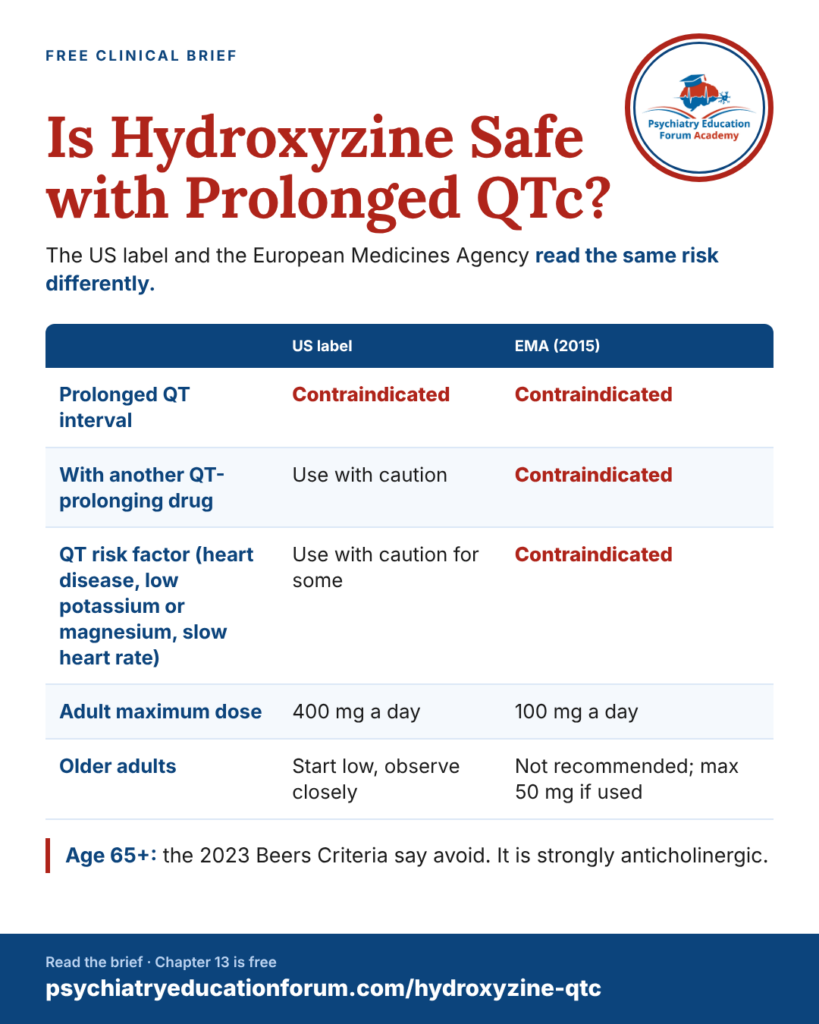
Is Hydroxyzine Safe with Prolonged QTc?
Hydroxyzine is often chosen because it is not a benzodiazepine and not a controlled substance. The reflex is to treat it as a mild, safe add-on for anxiety or sleep. That reflex misses what is in its own label: QT prolongation and torsade de pointes have been reported, and a prolonged QT interval is a contraindication. It ends up alongside antipsychotics, citalopram, methadone and opioids, and in older adults, where the risks stack up. Not controlled does not mean low risk.
The 30-second version
- A prolonged QT interval is a contraindication. QT prolongation and torsade de pointes have been reported, mostly in patients with other risk factors: heart disease, electrolyte imbalance or other QT-prolonging drugs.
- Check the QT list before you add it. The US label names antipsychotics such as ziprasidone, iloperidone, clozapine, quetiapine and chlorpromazine; citalopram and fluoxetine; methadone; ondansetron; and several antibiotics.
- Europe goes further than the US. The European Medicines Agency contraindicates it with other QT-prolonging drugs and with any known QT risk factor, and limits adults to 100 mg a day. The US label allows 50 to 100 mg four times a day for anxiety.
- Avoid it in older adults. The 2023 Beers Criteria advise avoiding it: it is strongly anticholinergic, and its clearance falls with age.
- Overdose can cause QT prolongation too. A suspected overdose needs emergency care and ECG monitoring, even if the patient seems well.
Why is hydroxyzine a QT risk at all?
Because QT prolongation and torsade de pointes have been reported with it after marketing, mostly in patients who already had another risk factor. The US label contraindicates it with a prolonged QT interval.
The risk is in the label, not in the folklore. Most reported cases occurred in patients with pre-existing heart disease, an electrolyte imbalance or another drug that can cause arrhythmia. That is exactly the patient psychiatry tends to see: someone already on an antipsychotic or an antidepressant, sometimes with a diuretic and a low potassium.
| Point | What the US label says |
|---|---|
| Reports | QT prolongation and torsade de pointes reported after marketing; most occurred in patients with other risk factors: pre-existing heart disease, electrolyte imbalance or other arrhythmogenic drugs. |
| Contraindication | Prolonged QT interval. |
| Use with caution | Congenital long QT syndrome, a family history of long QT, other conditions that predispose to QT prolongation and ventricular arrhythmia, recent myocardial infarction, uncompensated heart failure and bradyarrhythmias. |
| QT-prolonging drugs it names | Class 1A antiarrhythmics (such as quinidine and procainamide) and class III (such as amiodarone and sotalol); antipsychotics such as ziprasidone, iloperidone, clozapine, quetiapine and chlorpromazine; antidepressants such as citalopram and fluoxetine; antibiotics such as azithromycin, erythromycin, clarithromycin, gatifloxacin and moxifloxacin; and methadone, ondansetron, droperidol and pentamidine. |
| Overdose | May cause QT prolongation and torsade de pointes; ECG monitoring is recommended. |
The US and Europe disagree. Which rules should I follow?
With other QT-prolonging drugs, the US label advises caution, while the European Medicines Agency contraindicates the combination. The European dose limits do not bind US prescribing. Our view: 100 mg a day is the more conservative ceiling for a US patient in whom hydroxyzine remains appropriate after risk assessment.
After a 2014–2015 review that confirmed the known risk, the European Medicines Agency contraindicated hydroxyzine both with other QT-prolonging drugs and in patients with any known QT risk factor, and set a lower daily limit to reduce the risk of QT prolongation. It found that most cases involved other risk factors, electrolyte abnormalities or other treatments that may have contributed.
| Question | US label | European Medicines Agency, 2015 |
|---|---|---|
| Prolonged QT interval | Contraindicated | Contraindicated (acquired or congenital) |
| With another QT-prolonging drug | Use with caution | Contraindicated |
| QT risk factor | Use with caution with congenital or family history of long QT, recent myocardial infarction, uncompensated heart failure and bradyarrhythmias | Contraindicated with cardiovascular disease, significant low potassium or magnesium, family history of sudden cardiac death or significant bradycardia |
| Adult dose | Anxiety: 50 to 100 mg four times a day (up to 400 mg a day) | No more than 100 mg a day |
| Older adults | Start at the low end of the dosing range and observe closely | Not recommended; if it is used, no more than 50 mg a day |
| Routine ECG schedule | None set | None set |
Our view, from the chapter: for a US patient in whom hydroxyzine remains appropriate after risk assessment, 100 mg a day is the more conservative ceiling. A lower dose does not make it appropriate with a prolonged QT interval, or with the QT risk factors and QT-prolonging drugs that the European Medicines Agency contraindicates. And because neither source sets a routine ECG schedule, our approach is simple: before prescribing it to a patient with a risk factor or another QT-prolonging drug, check an ECG and electrolytes, or choose another option.
What should I check before prescribing it?
Five things, in about a minute: every QT-prolonging drug, the heart history, the patient's age and anticholinergic load, every other sedating drug, and any rash.
- List every QT-prolonging drug. Including antipsychotics, citalopram, fluoxetine, methadone and ondansetron. Many are added by other prescribers, so ask about medicines for nausea, infections and pain.
- Ask about the heart. Fainting, palpitations, an abnormal heart rhythm, a family history of long QT or sudden death when young, and anything that could lower potassium or magnesium.
- In a patient 65 or older, count every anticholinergic drug. Hydroxyzine adds to the load.
- List every CNS depressant, including opioids and alcohol. Hydroxyzine potentiates their effects. The US label advises against using other CNS depressants at the same time, says their doses should be reduced when they are given together, and warns that the effects of alcohol may be increased.
- Ask about any rash since starting it. Hydroxyzine can rarely cause acute generalized exanthematous pustulosis (AGEP). Stop it at the first sign of a rash, and do not restart it if AGEP is suspected.
| Situation | What to do |
|---|---|
| Fainting, palpitations or a prolonged QT interval | Emergency care for fainting or a seizure. ECG, potassium and magnesium. Stop hydroxyzine and review every other QT-prolonging drug. |
| Another QT-prolonging drug or a QT risk factor | Review the prescription now. Our approach: check an ECG and electrolytes before prescribing, or choose another option. |
| An opioid or other CNS depressant | Review now; reduce the dose of the other CNS depressants if they are combined (US label). |
| Daily dose above 100 mg | Review the dose against the patient's QT risk. |
| None of these | Lowest effective dose for the shortest possible time; reassess its usefulness periodically. |
What about older adults?
The 2023 Beers Criteria advise avoiding hydroxyzine in older adults: it is strongly anticholinergic and its clearance falls with age. The European Medicines Agency does not recommend it in older adults.
Beers lists first-generation antihistamines, including hydroxyzine, as drugs to avoid (moderate evidence, strong recommendation), and notes that cumulative anticholinergic exposure is associated with falls, delirium and dementia. It also advises avoiding more than one drug with anticholinergic properties. The US label lists dry mouth as its only anticholinergic adverse reaction, which is one reason the risk is missed. In an older adult, confusion, constipation, urinary retention or a fall after starting hydroxyzine is a reason to review it, not to call it aging.
| Source | What it says for older adults |
|---|---|
| 2023 AGS Beers Criteria | Avoid first-generation antihistamines, including hydroxyzine. Avoid anticholinergics with delirium, dementia or cognitive impairment, and, unless safer alternatives are not available, with a history of falls or fractures. |
| European Medicines Agency, 2015 | Not recommended; if it is used, no more than 50 mg a day. |
| US label, geriatric use | Start at the low end of the dosing range; sedating drugs may cause confusion and oversedation in the elderly; observe closely. |
What does this look like in practice?
Usually like this: an older patient, a QT-prolonging antidepressant, a diuretic, and hydroxyzine added for anxiety.
The case from Chapter 13: a 71-year-old woman with generalized anxiety takes citalopram and was started on hydroxyzine 25 mg three times a day a month ago. She also takes furosemide, and her potassium last week was 3.2 mmol/L. Her daughter says she has been confused in the evenings and nearly fell getting up at night. She has had no fainting or palpitations.
- Her age. Beers advises avoiding hydroxyzine; the European Medicines Agency does not recommend it in older adults, and allows at most 50 mg a day if it is used. She takes 75 mg.
- Citalopram. It is named in the US label as a QT-prolonging drug. Under the European restrictions, the combination is a contraindication.
- Her potassium. Low potassium is a QT risk factor that needs correcting.
- Her confusion and near-fall. They fit the label's warning that sedating drugs may cause confusion and oversedation in the elderly.
In the chapter, hydroxyzine is stopped. An ECG is checked, her potassium and magnesium are measured and corrected if low with her primary care clinician, her other medicines are reviewed for anticholinergic and QT effects, and her anxiety treatment is reviewed without adding another anticholinergic or sedating drug.
Is there a catch?
Four. The regulators differ, neither sets a routine ECG schedule, long-term effectiveness has not been systematically assessed beyond four months, and neither gives tapering instructions.
- The two regulators read the same risk differently. The US label asks for caution with other QT-prolonging drugs; the European Medicines Agency contraindicates the combination. The European limit does not bind US prescribing. Using it as the ceiling is our view, not a US rule.
- Neither source sets a routine ECG schedule. Checking an ECG and electrolytes before prescribing to a patient with a risk factor or another QT-prolonging drug is our approach, not a regulatory requirement.
- Long-term effectiveness has not been assessed. The US label says its effectiveness as an anxiolytic for more than 4 months has not been assessed in systematic clinical studies, and its usefulness should be reassessed periodically.
- There are no tapering instructions. Neither the label nor the European Medicines Agency says how to stop it, so how to stop it is clinical judgment.
Chapter 13 is free to read, and the full course is live today.
Chapter 13 of Managing Anxiolytic & Hypnotic Adverse Events gives you a two-minute bedside panel, a red, amber and green triage, a situation lookup, the QT, older-adult, sedation, skin and overdose detail, a patient script and a copy-paste EMR note. The other 16 chapters cover benzodiazepines, Z-drugs, orexin antagonists and the other anxiolytics and hypnotics.
Read Chapter 13 free → Join for all 17 chapters →Table of contents
Chapters 6 and 13 are free to read. The rest are included with Academy membership.
- 1Benzodiazepine Overdose and Opioid Co-Exposure: Respiratory Depression, Naloxone and Flumazenil Risks Members
- 2Benzodiazepine Withdrawal: Seizures, Delirium and When to Admit Members
- 3Paradoxical Agitation and Disinhibition on Benzodiazepines Members
- 4Dependence, Misuse or Use Disorder: Telling Them Apart Members
- 5Tapering Long-Term Benzodiazepines: Rate, Substitution and Protracted Withdrawal Members
- 6Benzodiazepines and Dementia Risk: What the Evidence Shows and What to Tell Patients Free · read now
- 7Benzodiazepines in Older Adults: Falls, Fractures, Delirium and When to Taper Members
- 8Complex Sleep Behaviors on Zolpidem, Eszopiclone and Zaleplon: When to Stop for Good Members
- 9Long-Term Z-Drug Use: Continue, Taper or Switch to a DORA? Members
- 10Orexin Antagonists: Sleep Paralysis, Hallucinations, Cataplexy-Like Events and Worsening Depression Members
- 11Gabapentinoids for Anxiety: Respiratory Depression, Misuse and Withdrawal Members
- 12Propranolol for Anxiety: Overdose Toxicity, Contraindications and Stopping Safely Members
- 13Hydroxyzine for Anxiety: QT Prolongation, Anticholinergic Burden and Sedation Free · read now
- 14Buspirone: Serotonin Syndrome, MAOI Contraindication and CYP3A4 Interactions Members
- 15Low-Dose Doxepin, Ramelteon and Melatonin: Adverse Effects of the “Gentler” Hypnotics Members
- 16Off-Label Sedatives for Sleep: Sedating Antihistamines, Low-Dose Antipsychotics and Mirtazapine Members
- 17Next-Day Impairment and Driving Across Anxiolytics and Hypnotics, with a Quick-Reference Grid Members
Every chapter, every series, one membership.
Academy membership opens every chapter in this course and the rest of the Academy library, written for clinicians at the point of care.
See membership plans →
Responses