
ADHD Medication Raised Blood Pressure or Heart Rate: When to Reduce or Stop, and Why One Reading Isn’t Enough

When Should You Reduce or Stop an ADHD Medication for Raised Blood Pressure or Heart Rate, and Why Is One High Clinic Reading Not the Answer?
A 14-year-old on lisdexamfetamine reads 136/84 at a routine visit. An adult on atomoxetine has a resting pulse of 104. The reflex is to blame the medicine and stop it, or to shrug and carry on. Both are wrong for the same reason.
The 30-second version
- Small average, real outliers. The stimulant labels report average rises of about 2 to 4 mm Hg in blood pressure and 3 to 6 beats per minute in heart rate, and say some patients have larger increases.
- No red flags? Confirm before you change anything. Our view: one high clinic reading, with no symptoms and below the urgent thresholds, is a reason to recheck, not to stop. Repeat it rested, with the right cuff, and confirm on a second occasion.
- Reduce the dose and refer for a sustained resting heart rate above 120 or systolic pressure above the 95th percentile (or a clinically significant rise) on 2 occasions, or an arrhythmia (NICE).
- Emergency department for a child or adolescent with a stage 2 reading and symptoms, or a reading more than 30 mm Hg above the 95th percentile (above 180/120 in an adolescent) (AAP); for an adult with systolic above 180 or diastolic above 120 and signs of acute organ damage (AHA/ACC); and the same day for exertional chest pain, unexplained fainting, or palpitations with chest pain or breathlessness (Chapter 4).
- Atomoxetine and viloxazine are not an escape route. Atomoxetine raises heart rate and blood pressure; viloxazine raises heart rate and diastolic pressure.
In this brief
How much do ADHD medicines raise blood pressure and pulse?
A little on average, and more in some patients, which is why every patient is monitored.
The stimulant labels describe the class effect as an average rise of about 2 to 4 mm Hg in blood pressure and about 3 to 6 beats per minute in heart rate. The same labels say some patients have larger increases and that all patients should be monitored for hypertension and tachycardia. The non-stimulants are not all alike: two raise these numbers and two lower them.
| Medicine | Effect on blood pressure and heart rate | Source |
|---|---|---|
| Stimulants (methylphenidate and amphetamine products) | Raise blood pressure by about 2 to 4 mm Hg and heart rate by about 3 to 6 beats per minute on average; some patients have larger increases | Product labels (class statement) |
| Atomoxetine | In short-term trials, heart rate rose by 20 beats per minute or more at some point in 23% of children (against 12% on placebo) and 22% of adults (against 8%). Across controlled and uncontrolled pediatric trials, about 5 to 10% of children had a potentially clinically important rise in heart rate or blood pressure | Product label |
| Viloxazine | Raises heart rate and diastolic pressure | Product label |
| Guanfacine extended-release and clonidine extended-release | Lower both blood pressure and heart rate | Product labels |
Is this reading real?
If there are no symptoms and the reading is below emergency levels, not until you have repeated it properly and seen it on a second occasion.
NICE asks for heart rate and blood pressure to be measured with an appropriately sized cuff, compared with the normal range for age, before and after each dose change and every 6 months. The AAP grades blood pressure by percentile under age 13 and by adult cutoffs from 13, confirms a high oscillometric reading by auscultation, and diagnoses hypertension only after readings at the hypertensive level for age (the 95th percentile under 13, 130/80 from 13) on 3 different visits. By those adolescent cutoffs, the 14-year-old at 136/84 is at stage 1: the AAP asks for lifestyle advice and a recheck in 1 to 2 weeks, not a medicine change. If the recheck is still at that level, that is 2 occasions above the hypertensive threshold for age, which is NICE's trigger to reduce the dose and refer (our reading: from age 13, the AAP's 130/80 stands in for the 95th percentile). The adult with a resting pulse of 104 is below NICE's 120 threshold: recheck rested and compare with the baseline. For adults, the 2025 AHA/ACC high blood pressure guideline classifies blood pressure from the average of at least 2 readings on at least 2 occasions.
Chapter 8 turns this into five questions to ask before you touch the prescription:
- What was the reading before treatment? A rise from baseline matters, not just the number.
- Was it measured properly? NICE asks for an appropriately sized cuff; in our view rest and posture change the reading too.
- How long after the dose? In a single-dose study of Adderall XR in adolescents, systolic rises peaked 2 to 4 hours after the dose.
- Any symptoms? Headache, vision change, chest pain or fainting change the urgency.
- Anything else raising it? Caffeine, energy drinks, decongestants, pain and anxiety (our view).
The reframe
The question is not "is this number high?" It is "is this a sustained rise from this patient's baseline, measured properly, with nothing else explaining it?" Without a baseline reading on file you cannot answer that, so record pulse and blood pressure before the first dose.
When do I act, and how fast?
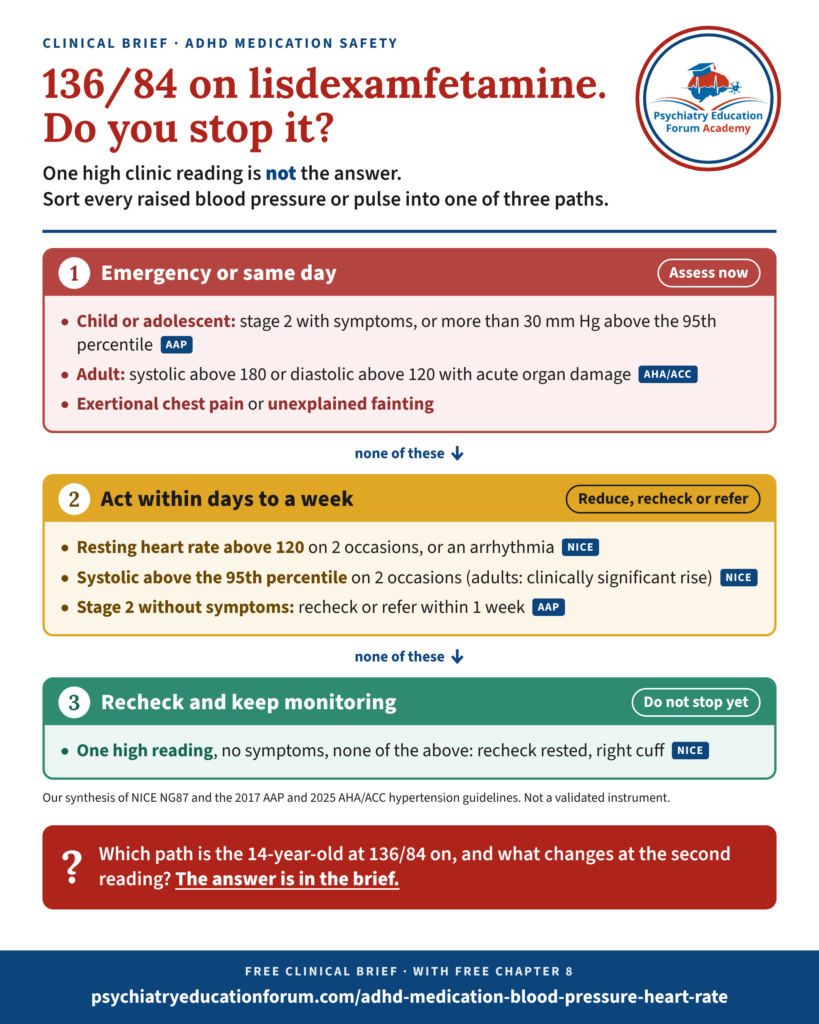
Sort the patient into one of three paths: emergency or same day, act within days to a week, or recheck and keep monitoring.
Conceptual triage. Our synthesis of NICE NG87, the 2017 AAP pediatric hypertension guideline and the 2025 AHA/ACC high blood pressure guideline; not a validated instrument.
The same thresholds, with what each one asks you to do:
| Finding | Action | Source |
|---|---|---|
| Child or adolescent: stage 2 with symptoms, or more than 30 mm Hg above the 95th percentile (above 180/120 in an adolescent) | Immediate source of care, such as an emergency department | AAP |
| Adult: systolic above 180 or diastolic above 120 with acute organ damage | Hypertensive emergency. Our view: hold the stimulant until reviewed | AHA/ACC guideline |
| Exertional chest pain, unexplained fainting, or palpitations with chest pain or breathlessness | Emergency or same-day assessment; see Chapter 4 | Stimulant labels; Chapters 4 and 8 |
| Adult: systolic above 180 or diastolic above 120 without acute organ damage | Restart or intensify oral treatment, preferably as an outpatient, without aggressive short-term lowering; lowering or stopping the stimulant as well is our application | AHA/ACC guideline |
| Sustained resting heart rate above 120 or systolic above the 95th percentile (or a clinically significant rise) on 2 occasions, or an arrhythmia | Reduce the dose and refer to a pediatric hypertension specialist or adult physician | NICE |
| Child or adolescent at stage 2 without symptoms | Recheck within 1 week, or refer to subspecialty care within 1 week | AAP |
| Child or adolescent at stage 1 without symptoms | Lifestyle counseling and recheck in 1 to 2 weeks; if still stage 1, recheck in 3 months; after 3 visits at stage 1, ambulatory monitoring, evaluation and treatment, and consider referral. On ADHD medicine, a second reading at this level also meets NICE's 2-occasion trigger (our reading) | AAP; NICE |
| Child or adolescent at the elevated level | Lifestyle advice and repeat in 6 months | AAP |
| One high reading, no concerning symptoms, and none of the criteria above | Recheck rested, then on another day; keep monitoring | NICE; our view |
The AAP does not define "symptomatic". Our view: count headache, vision change, confusion, chest pain or breathlessness with a stage 2 reading as symptomatic. NICE's percentile applies to children, so in adults the test is a clinically significant rise (our reading).
Reduce, switch or stop?
Once emergencies are ruled out and a rise meets NICE's criteria, reduce the dose and refer. Consider stopping if the dose cannot be lowered enough or the rise persists despite adjustment.
The 2025 AHA/ACC high blood pressure guideline, which covers adults, lists amphetamines, including lisdexamfetamine, and methylphenidate among drugs that raise blood pressure. It advises stopping them or lowering the dose, and considering behavioral therapy or a nonstimulant such as guanfacine. The options, in the order the chapter works through them:
| Option | What to know |
|---|---|
| 1. Remove other causes | Ask about caffeine, energy drinks and decongestants before changing the prescription |
| 2. Lower the dose | NICE's step once the rise is confirmed on 2 occasions |
| 3. Switch to guanfacine extended-release | Lowers blood pressure and heart rate. Taper it when stopping; never stop it abruptly. Intuniv's ADHD trials were in ages 6 to 17, and its US approval covers that age range, so adult use is off-label |
| 4. Switch to atomoxetine or viloxazine | Atomoxetine raises heart rate and blood pressure, and viloxazine raises heart rate and diastolic pressure, so they are not a reliable way around the problem |
| 5. Continue the stimulant and add or intensify an antihypertensive | The AHA/ACC guideline considers this reasonable when the stimulant is needed or is the best option. We found no trial of it for a stimulant-related rise, so in our view it is a specialist decision |
| 6. Stop | Consider it when the dose cannot be lowered enough or the rise persists (AHA/ACC guideline; our judgment). In an emergency, hold the stimulant until reviewed (our view) |
What about adults and the long term?
Use the adult definitions, confirm outside the clinic, and read the long-term data as association, not proof.
The AHA/ACC guideline defines stage 1 hypertension as 130 to 139 systolic or 80 to 89 diastolic, and stage 2 as 140 systolic or 90 diastolic and above, from the average of at least 2 readings on at least 2 occasions. For an adult with a clinically significant rise, arrange home or ambulatory readings to confirm hypertension.
Two observational findings frame the long-term question:
- In a Swedish case-control study, 3 to 5 years of ADHD medicine use was associated with higher odds of a hypertension diagnosis than no use (adjusted odds ratio 1.72), and more than 5 years with 1.80. An association like this does not prove cause.
- In 10-year follow-up of children in the MTA study, the authors found no evidence that stimulant treatment increased the risk of hypertension, but heart rate stayed higher while treatment continued.
Is there a catch?
Yes. The guidelines leave gaps, and this brief fills some of them with judgment.
- The triage is a synthesis. It combines NICE, the AAP and AHA/ACC guidelines. It is not a validated instrument.
- "Clinically significant rise" is not defined. NICE uses the phrase without a number, so the adult threshold rests on your judgment and the patient's baseline.
- Adding an antihypertensive to a stimulant is untested. We found no trial of it for a stimulant-related rise.
- The long-term evidence is observational. The Swedish study shows an association; the MTA follow-up did not find an increased risk of hypertension.
- Missed guanfacine or clonidine doses are a separate problem. A high reading in a patient on an alpha-2 agonist may be rebound, which the course covers in Chapter 5.
The full chapter adds the label data for each product, the AAP staging table, a family script and a copy-paste EMR note. Read Chapter 8 free.
Sources
- National Institute for Health and Care Excellence. Attention deficit hyperactivity disorder: diagnosis and management (NICE guideline NG87). 2018, updated 2019.
- Flynn JT, Kaelber DC, Baker-Smith CM, et al. Clinical practice guideline for screening and management of high blood pressure in children and adolescents. Pediatrics. 2017.
- Jones DW, Ferdinand KC, Taler SJ, et al. 2025 AHA/ACC/AANP/AAPA/ABC/ACCP/ACPM/AGS/AMA/ASPC/NMA/PCNA/SGIM guideline for the prevention, detection, evaluation, and management of high blood pressure in adults. J Am Coll Cardiol. 2025.
- Zhang L, Li L, Andell P, et al. Attention-deficit/hyperactivity disorder medications and long-term risk of cardiovascular diseases. JAMA Psychiatry. 2024.
- Vitiello B, Elliott GR, Swanson JM, et al. Blood pressure and heart rate over 10 years in the Multimodal Treatment Study of Children With ADHD. Am J Psychiatry. 2012.
- US prescribing information for the methylphenidate and amphetamine products, atomoxetine (Strattera), viloxazine (Qelbree), guanfacine extended-release (Intuniv) and clonidine extended-release.
Every source, with section numbers, is in the reference list of Chapter 8.
Emergencies and Urgent Stops
- Stimulant Overdose or Accidental Ingestion: When Is Emergency Evaluation Needed? Members
- Guanfacine, Clonidine or Other Non-Stimulant Overdose or Accidental Ingestion: When Is Emergency Evaluation Needed? Members
- New Psychosis or Mania During ADHD Treatment: When to Stop and Can You Rechallenge? Members
- Chest Pain, Palpitations or Syncope During ADHD Treatment: When to Stop and Refer Urgently? Members
- Rebound Hypertension After Stopping Guanfacine or Clonidine: How Urgently to Act? Members
Common Side Effects: Adjust the Regimen
- Appetite Suppression, Weight Loss and Growth on ADHD Medication: When to Adjust Treatment? Members
- Insomnia After ADHD Medication: Change Timing, Dose or Formulation? Members
- Sustained Blood Pressure or Heart Rate Rise on ADHD Medication: When to Reduce or Stop? Free
- Anxiety or Panic on a Stimulant: Reduce, Change or Stop? Members
- Irritability, Wear-Off Rebound or Emotional Blunting: How Should the Stimulant Change? Members
- New or Worsening Tics During Stimulant Treatment: Continue, Reduce or Switch? Free
- Nausea, Abdominal Pain, Constipation or Headache on ADHD Medication: Adjust or Investigate? Members
Non-Stimulant Safety Problems
- Suicidal Thinking on Atomoxetine or Viloxazine: Continue, Reduce or Stop? Members
- Sedation, Dizziness, Hypotension or Bradycardia on a Non-Stimulant: Reduce, Retitrate or Switch? Members
- Urinary or Sexual Adverse Effects on Atomoxetine: Reduce, Evaluate or Switch? Members
Misuse, Interactions and Restarts
- Suspected Misuse, Diversion or Substance-Use Relapse: Continue, Restrict or Stop? Members
- Uncommon Serious Reactions to ADHD Medication: Which Need Immediate Evaluation or Stopping? Members
- Suspected Drug-Interaction Toxicity: Which Medication to Hold or Stop? Members
- Adverse Effects After Missed Doses, Restarting or Switching Formulations: When to Retitrate? Members
Rapid Triage Summary
- ADHD Medication Adverse Events: Rapid Triage, Dose Changes and Stopping Rules Members
Join Psychiatry Education Forum Academy
Membership opens all 20 chapters of this course, the other four Rapid-Decision adverse events series, and the rest of the Academy library.
See Membership PlansThis brief is educational material for licensed prescribers and prescribers in training. It is not a substitute for clinical judgment, local protocols or the current prescribing information. Psychiatry Education Forum Academy is not a CME provider and this brief does not carry CME credit.
Responses