Antidepressants in pregnancy and the child’s development: does treatment add risk beyond the depression itself?

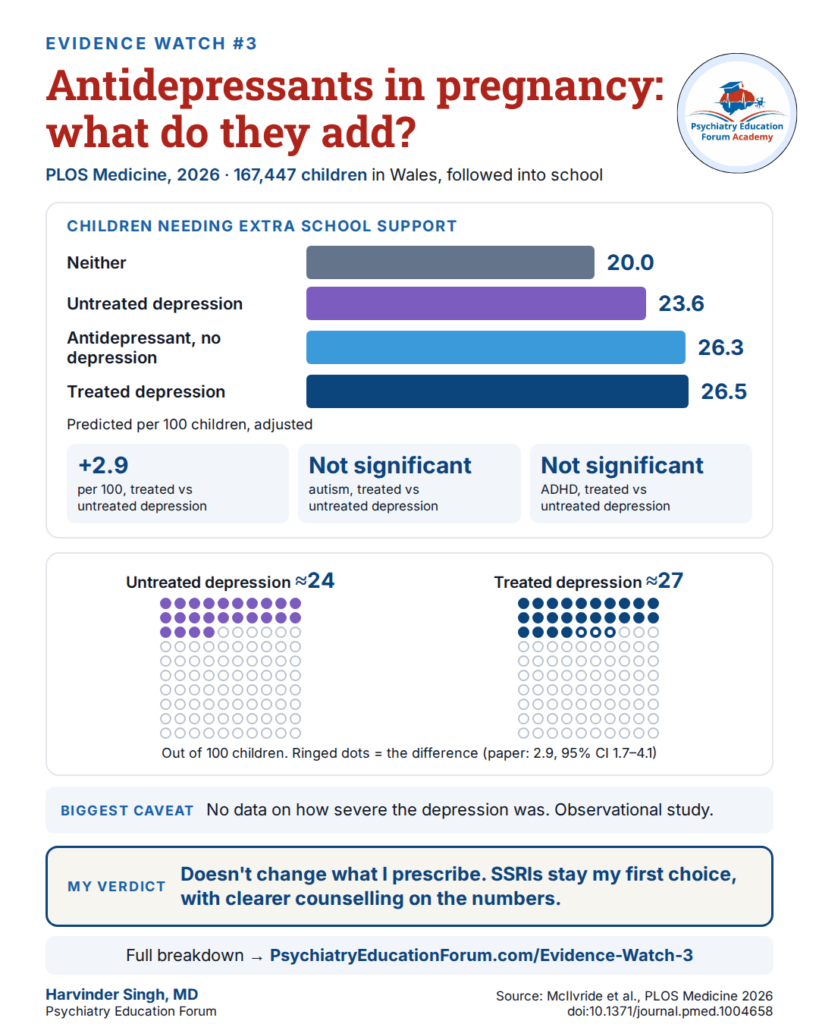
Antidepressants in pregnancy and the child's development: does treatment add risk beyond the depression itself?
A Wales-wide study of 167,447 children, read for the prescriber: the answer first, then the questions you'd ask.
Harvinder Singh, MD · Board-certified psychiatrist · Psychiatry Education Forum
McIlvride S, Rao N, Singh S, Nelson SM, Pell JP, Fleming M. Prenatal exposure to maternal depression and antidepressants and neurodevelopmental outcomes: A population cohort study. PLoS Medicine. 2026;23(9):e1004658. Published September 29, 2026. PMID 42809515 · doi:10.1371/journal.pmed.1004658 · Open access
The 60-second read
Peer-reviewed · Observational- Applies toCounselling a pregnant patient with depression about starting or continuing an antidepressant, mostly an SSRI
- Biggest caveatNo data on how severe the depression was. Women given antidepressants were probably more unwell, and the study cannot separate the drug from the illness
- Second caveat"Exposed" means one prescription or more in pregnancy or the month before, based on prescription records, not confirmed use. No trimester, dose or duration
- Our poll100% chose "Yes, I'll mention a small added risk in school support"
1Who this is about, and who it isn't
About
| Children | 167,447 born in Wales 2009–2016 and attending state-funded schools (Table 1; the results text says 167,477) |
|---|---|
| Groups | Four, by mother's depression diagnosis and antidepressant prescription (shown below) |
| Outcomes | Special educational need (SEN) in the yearly school census, its causes, and ADHD |
| Follow-up | To 2022; mean age 5.68 years. ADHD estimated to age 12 |
| Data | Linked primary care, maternity and school records (SAIL Databank) |
| Drugs | SSRIs were 83.4% of antidepressant prescribing |
Not about
| Severity | How ill the mother was: not recorded |
|---|---|
| Timing | Trimester, dose or how long the drug was taken; prescriptions, not confirmed use |
| After birth | Breastfeeding and postnatal depression: not recorded |
| Other illness | Anxiety, bipolar disorder or psychosis without depression or an antidepressant (excluded) |
| Private school | About 6% of Welsh children are not in the school data |
If your question is one of these, this study can't answer it.
2The numbers, made usable
Read these as predicted probabilities from the model, not as raw counts. The first figure is my subtraction from Table 3; the paper does not report a confidence interval for it.
| Outcome | Treated vs untreated | 95% CI | Result |
|---|---|---|---|
| Any SEN | +2.9 per 100 | 1.7 to 4.1 | Significant |
| Learning difficulties | +1.3 per 100 | 0.4 to 2.2 | Significant |
| Behavioral-emotional-social | +1.1 per 100 | 0.4 to 1.8 | Significant |
| Autism | +0.3 per 100 | −0.2 to 0.7 | Not significant |
| ADHD by age 12 | +0.53 per 100 | −0.15 to 1.22 | Not significant |
| Drug (exclusive use) | Extra per 100 | 95% CI | Result |
|---|---|---|---|
| All antidepressants | +2.9 | 1.7 to 4.1 | Significant |
| SSRI only | +2.0 | 0.7 to 3.2 | Significant |
| Citalopram only | +2.1 | 0.4 to 3.8 | Significant |
| Fluoxetine only | +2.6 | 0.4 to 4.8 | Significant |
| Sertraline only | +1.2 | −1.7 to 4.0 | Not significant Small group |
| TCA only | +8.8 | 3.2 to 14.4 | Significant Small group |
| SNRI only | +8.8 | 2.6 to 15.0 | Significant Small group |
Treated vs untreated depression, all-cause SEN (Tables 3 and 5). The paper did not formally test one drug against another, and the sertraline, TCA and SNRI groups were small. Treat this table as exploratory.
3The detail the abstract leaves out
The abstract leads with antidepressant exposure aOR 1.46 (1.38–1.56). That number compares exposed children with children of mothers who had neither a recorded depression diagnosis nor an antidepressant. It is not the comparison you face when a depressed patient asks whether to take a medicine.
(5.2–7.4)
(1.7–4.1)
The model also includes an interaction between depression and antidepressant exposure: aOR 0.81 (0.73–0.88) for all-cause SEN (Table 2). In plain terms, the two exposures don't add up. The association with antidepressant exposure was smaller when depression was also recorded. This is a statistical association, not a measured drug effect; the authors attribute it to the higher baseline risk in the depression group. The single model with an interaction term was introduced in response to peer review (Methods).
| Outcome | Antidepressant vs neither exposure (interaction model) | Treated vs untreated depression |
|---|---|---|
| Any SEN | aOR 1.46 (1.38–1.56) | +2.9 per 100 (1.7–4.1) |
| Autism | aOR 1.59 (1.31–1.92) | +0.3 per 100 (−0.2 to 0.7) |
| ADHD (age 12) | aHR 1.89 (1.57–2.27) | +0.53 per 100 (−0.15 to 1.22) |
One more detail for anyone quoting the absolute numbers. Table 1 shows the share of children ever recorded with SEN: 27.0% of unexposed children and 37.7% with treated depression. The model's predicted probabilities (20.0 and 26.5 per 100) come from yearly school-census records, so the two sets of figures measure different things and should not be mixed in one sentence.
4How this fits the existing evidence
The authors place their result alongside earlier work:
- A recent meta-analysis they cite (Chan and colleagues) reported pooled risk ratios of 1.69 (1.24–2.30) for autism and 1.35 (1.24–1.47) for ADHD after any antidepressant exposure. After analyses addressing confounding by indication, the authors summarize it as finding a significant association only for TCAs. The meta-analysis itself names two tricyclics, amitriptyline and nortriptyline, with no significant association for specific SSRIs or SNRIs.
- Sibling-comparison studies have generally found the associations are no longer significant, with one exception, and confounding can remain between pregnancies.
- The authors note that in the UK, SSRIs are recommended first-line for depression in pregnancy.
| Evidence | Design | What it adds |
|---|---|---|
| This study (McIlvride 2026) | Population cohort with an untreated-depression group | Absolute risks; broad school outcomes beyond autism and ADHD |
| Chan meta-analysis (as cited) | Pooled observational studies | In Chan's analyses, associations largely accounted for by confounding by indication, except amitriptyline and nortriptyline; residual confounding not ruled out |
| Sibling studies (as cited) | Within-family comparison | Associations generally no longer significant within families |
5What the authors concluded vs what the data support
"Offspring of mothers with depression have a higher risk of SEN that cannot be attributed solely to antidepressant exposure. Prenatal exposure to antidepressants may confer a small additional absolute risk, but findings may partly represent confounding by depression severity. Further research is needed."
The data are consistent with the first sentence: untreated depression was associated with a higher predicted risk than no depression. The second sentence is appropriately hedged. Three gaps limit how far it goes:
- No severity measure, so "treated" may simply mean "sicker".
- No comparison with women who stopped their antidepressant early, which is the closest thing to the decision in clinic.
- No data on alcohol, drug use, paternal or postnatal depression, or maternal ADHD and autism.
6What it doesn't answer
- Whether timing matters: first trimester vs late pregnancy.
- Whether dose or duration matters.
- Whether stopping in pregnancy changes the child's risk.
- Whether one SSRI is safer than another. The sertraline group was too small to say.
- Outcomes after age 12, or outcomes outside school support.
- Whether it applies to more diverse populations. The cohort was mostly White.
Does this change practice?
This study does not change what I prescribe. SSRIs remain my first choice for depression in pregnancy, but I'll be more specific about what the risk numbers mean.
The comparison that matters in clinic is treated vs untreated depression, not antidepressant vs no depression. On that comparison, the added risk of school support was small (2.9 more children per 100), and autism and ADHD showed no significant difference. Untreated depression was itself associated with more school support, and the broader evidence, including the meta-analysis and sibling studies discussed above, suggests that much of the association may reflect the illness and family factors, though the drug's contribution can't be ruled out. I'll continue to follow that body of evidence.
What I'm doing differently: when a pregnant patient asks about her child's development, I'll say that some studies show a small difference in school support. I'll also say it may reflect how unwell the mother was rather than the medicine, and that untreated depression carries risks of its own.
Become an Academy member
Full access to every course and Rapid Decision Guide, including the Perinatal Psychopharmacology series.
Sources
- McIlvride S, Rao N, Singh S, Nelson SM, Pell JP, Fleming M. Prenatal exposure to maternal depression and antidepressants and neurodevelopmental outcomes: A population cohort study. PLoS Medicine. 2026;23(9):e1004658. doi.org/10.1371/journal.pmed.1004658. PMID 42809515. Peer-reviewed, open access. Observational population cohort (SAIL Databank, Wales). Funded through Health Data Research UK and Medical Research Scotland; the authors declare no competing interests.
- Chan JKN, Zhong AHF, Lam JYH, Wong CSM, Solmi M, Correll CU, Chang WC. Maternal and paternal antidepressant use before and during pregnancy and offspring risk of neurodevelopmental disorders: a systematic review and meta-analysis. Lancet Psychiatry. 2026;13(6):472–484. doi.org/10.1016/S2215-0366(26)00089-1. PMID 42134364. Peer-reviewed systematic review and meta-analysis. Pooled risk ratios are as reported by McIlvride et al.; the amitriptyline and nortriptyline finding is from the meta-analysis abstract. Sibling-study results are as summarized by McIlvride et al.

Responses