

When Should You Check Ammonia on Depakote, and Why Don’t Normal Liver Tests and a Level in Range Rule It Out?

When Should You Check Ammonia on Depakote, and Why Don't Normal Liver Tests and a Level in Range Rule It Out?
A patient on Depakote becomes slow, sleepy and flat, and vomits twice. Her liver tests were normal last week and her valproate level was in range. The reflex reading is relapse: depression after the mania, perhaps catatonia, perhaps a reason to increase the dose. On valproate, that reflex is dangerous. Hyperammonemic encephalopathy produces exactly that picture, with liver tests that are often normal and a drug level that may be in range. The only test that distinguishes it is an ammonia level, and nobody orders it unless they think of it.
The 30-second version
- Check ammonia when there is a reason, not routinely. The label's trigger is unexplained lethargy, vomiting or any change in mental status in a patient on valproate. Do not screen well patients.
- Normal liver tests do not exclude it. The label warns that hyperammonemia may be present despite normal liver function tests. Valproate raises ammonia mainly by interfering with its removal, not by damaging the liver.
- A valproate level in range rules nothing out. Encephalopathy can occur with a level in the usual range, and the level does not necessarily track the ammonia.
- Topiramate is the combination to know. Added to valproate, it can cause hyperammonemia in patients who tolerated either drug alone.
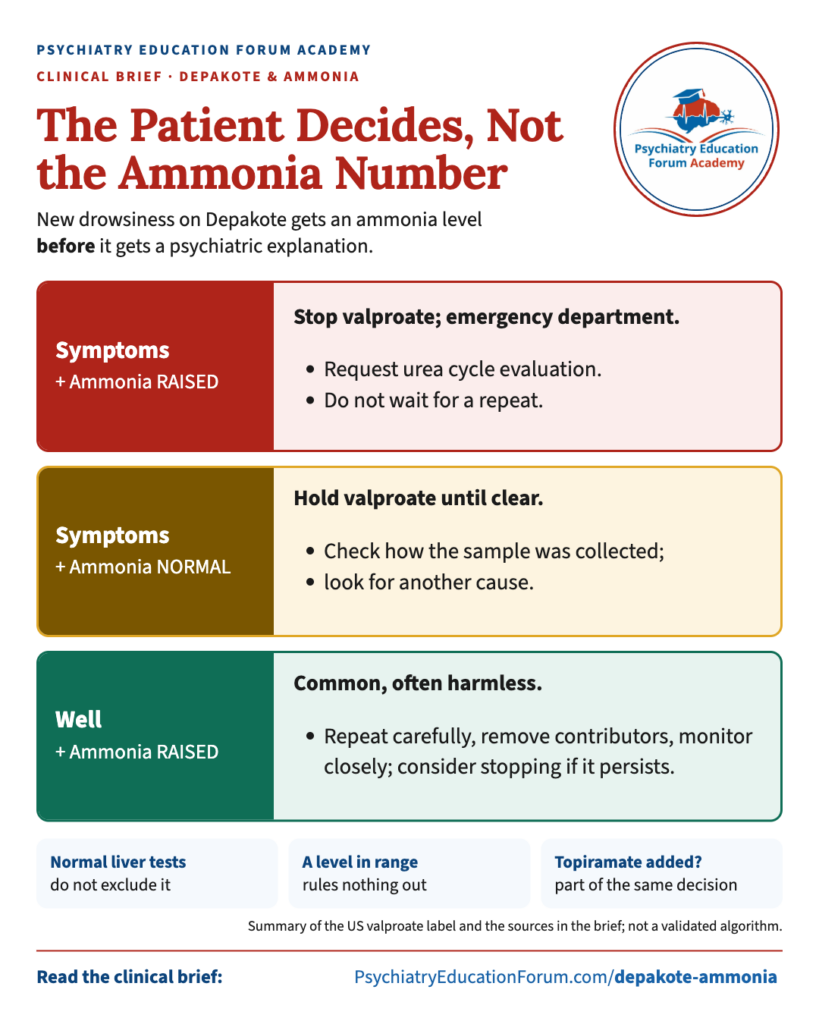
- Raised with symptoms means stop valproate. Refer urgently and investigate for a urea cycle disorder. Do not wait for a repeat. Recovery is usually within days.
- Raised in a well patient is common. Repeat it with careful collection, remove contributors and monitor closely. Stopping a valproate that is working well because of one raised number in a well patient is rarely the right first step; if the elevation persists, the label says to consider stopping.
Why does ammonia rise on Depakote when the liver tests are normal?
Because valproate mainly interferes with how ammonia is cleared, not with the liver itself. Most raised ammonia on valproate causes no symptoms; the minority who develop encephalopathy need valproate stopped.
A critical-care review describes two routes: valproate metabolites inhibit carbamoyl phosphate synthetase I, the first enzyme of the urea cycle, and valproate depletes carnitine, which further reduces the cycle's capacity. That is why the label warns that hyperammonemia may be present despite normal liver function tests.
LiverTox describes the clinical picture: progressive confusion that can reach coma, with a raised ammonia but normal or near-normal liver tests, developing within weeks to months, and resolving within days of stopping valproate. A case series makes the same point about drug levels: the valproate level may be normal and does not necessarily correlate with the ammonia or the severity of symptoms.
Raised ammonia without symptoms is common. The label says asymptomatic elevations are more common than symptomatic ones, and a 2025 study of psychiatric inpatients on valproate found raised ammonia frequent, linked to taking several other medicines and to alcohol use disorder, and not to the valproate dose or level. The clinical task is not to find raised ammonia but to recognize the patient whose brain is affected by it.
| What you see | Why it misleads |
|---|---|
| Normal liver tests | Liver tests are often normal in hyperammonemia on valproate. |
| A valproate level in range | The level may be in range and does not track the ammonia. |
| Drowsiness and slowing | They look like depression, sedation or catatonia. |
| A raised ammonia | Raised ammonia without symptoms is common, so a raised result can be dismissed even when the patient is unwell. |
When should I check it?
Whenever a patient on valproate has unexplained lethargy, vomiting or any change in mental status, whatever the liver tests and the level show. Not as a routine screen.
The label's trigger is clear: in patients who develop unexplained lethargy and vomiting or changes in mental status, hyperammonemic encephalopathy should be considered and an ammonia level measured. Its topiramate warning describes the same picture, and adds that hypothermia can be a manifestation of hyperammonemia.
| Situation | Check ammonia? | Why |
|---|---|---|
| New drowsiness, slowing, confusion or disorientation | Yes, the same day | The label's trigger; easily mistaken for depression or catatonia |
| Lethargy with vomiting | Yes, the same day | The label's trigger |
| Low body temperature | Yes | The label describes hypothermia with and without hyperammonemia |
| Seizure pattern changing in a patient with epilepsy | Consider it, and always if alertness has changed too | Not one of the label's named triggers; the EEG in the encephalopathy typically shows generalized slowing |
| Topiramate added, patient well | Not routinely; ask about symptoms and check if any appear | The combination can cause hyperammonemia in patients who tolerated either drug alone |
| Well patient, routine review | No | No recommendation for screening asymptomatic patients; asymptomatic elevations are common |
Five questions separate the patient who needs an ammonia level from the one who does not:
- Is this a change from the patient's usual mental status?New drowsiness, slowing, confusion or disorientation, even mild.
- Has there been vomiting or lethargy?The label's other triggers.
- What was started or increased recently?Topiramate especially; also other anticonvulsants and the valproate dose itself.
- Is the patient cold, or unusually slow to respond?Hypothermia can be a sign of hyperammonemia.
- Any history of unexplained encephalopathy, cyclical vomiting, or a family history of urea cycle disorder or unexplained infant death?These suggest an underlying urea cycle disorder.
How do I get a result I can trust?
Ammonia rises in the tube. Ask for careful venipuncture, minimal tourniquet, and prompt delivery to the laboratory under your lab's conditions.
Ammonia is one of the most handling-sensitive tests in routine use. A laboratory study of sample stability notes that plasma ammonia increases in the tube over time and may be falsely raised if handling is delayed or the sample is not processed under the right conditions. Conditions vary by laboratory, so follow your own lab's instructions on tube type, chilling and time to analysis.
| Step | What to ask for |
|---|---|
| Collection | Careful, non-traumatic venipuncture with minimal tourniquet. |
| Handling | Follow your own lab's instructions on tube type, chilling and time to analysis. |
| Delivery | Prompt delivery to the laboratory; plasma ammonia increases in the tube over time. |
| Raised, patient well | Repeat with careful collection before acting; a falsely high result can lead to an unnecessary stop. |
| Raised, patient symptomatic | Stop valproate and repeat the test, rather than waiting for the repeat to decide. |
This cuts both ways. A falsely high result in a well patient can lead to an unnecessary stop. But a symptomatic patient with a raised ammonia should not be dismissed as "probably a bad sample": stop valproate and repeat the test, rather than waiting for the repeat to decide.
Who is at risk?
Patients also taking topiramate or other anticonvulsants, those on several medicines, those with alcohol use disorder, those also on olanzapine or quetiapine, and anyone with an undiagnosed urea cycle disorder.
| Risk | What the sources say |
|---|---|
| Urea cycle disorder | Hyperammonemic encephalopathy, sometimes fatal, has followed the start of valproate; valproate is contraindicated. Evaluate before starting if there is unexplained encephalopathy or coma, cyclical vomiting and lethargy, or a family history of urea cycle disorder or unexplained infant deaths. |
| Topiramate | Associated with hyperammonemia, with or without encephalopathy, in patients who tolerated either drug alone. |
| Other anticonvulsants | A case series notes phenobarbital and phenytoin may increase ammonia in patients on valproate. |
| Several concurrent medicines; alcohol use disorder | Associated with raised ammonia in psychiatric inpatients on valproate. |
| Olanzapine or quetiapine with valproate | Linked to higher reporting of the encephalopathy in an analysis of US adverse-event reports; an association, not proof of cause. |
Dose and level are not reliable guides. Studies disagree on how much they matter, but they share one bedside point: encephalopathy can occur with a valproate level in the usual range. A level in range rules nothing out.
The ammonia is high. What now?
It depends on the patient more than the number. Raised with symptoms: stop valproate and refer. Raised in a well patient: repeat it carefully and monitor.
When the patient has symptoms and the ammonia is raised, the label's instruction is direct: valproate should be discontinued, appropriate treatment for hyperammonemia started, and the patient investigated for an underlying urea cycle disorder.
- Hold valproate, and decide on topiramate in the same step.If topiramate was added recently, it is part of the same decision; agree it with whoever prescribed it.
- Send to the emergency department and call ahead.Valproate start date, dose, recent changes and latest level; topiramate or other anticonvulsants and when they started; the change in mental status and when it began; recent liver tests; and that hyperammonemic encephalopathy is suspected.
- Make sure the urea cycle evaluation is requested.The label asks for it.
- Agree mood-stabilizer cover the same day.Stopping valproate leaves the mood disorder untreated.
- Record the reaction precisely.If topiramate was involved, record the combination as the reaction, not either drug alone.
- Do not restart valproate by default.If it is ever reconsidered, that is a specialist decision after urea cycle evaluation, with the episode documented.
Recovery after stopping is usually quick: LiverTox describes resolution within days, and a case series describes complete recovery generally over one to a few days. A patient who does not improve as expected needs the diagnosis reconsidered.
Is there a catch?
Three. A raised ammonia in a well patient is common, a normal ammonia does not entirely clear valproate, and the evidence for treatments beyond stopping is thin.
- The incidental high ammonia is common, and usually not an emergency.The label says asymptomatic elevations require close monitoring, and if the elevation persists, stopping valproate should be considered. Repeat the test with careful collection, look for contributors you can remove (topiramate, other anticonvulsants, alcohol), and agree with the patient which symptoms mean an urgent call. Stopping a valproate that is working well because of one raised number in a well patient is rarely the right first step.
- A normal ammonia does not entirely clear valproate.The label itself reports encephalopathy without raised ammonia, without a raised valproate level and without neuroimaging changes, reversing partially or fully after valproate was stopped. In a symptomatic patient, hold valproate until another cause is found, even when the ammonia is normal.
- Treatments beyond stopping are the treating team's decision.L-carnitine is used on the basis of case reports and small uncontrolled studies, and a retrospective study in critically ill patients found no difference in how far ammonia fell with levocarnitine, lactulose or both. The psychiatrist's role is to stop the drug, get the patient assessed, pass on the drug history, and plan mental-health care.
One more point of framing. In an analysis of US adverse-event reports, reports of the encephalopathy were less frequent, not more, when valproate was prescribed for a psychiatric disorder than for epilepsy. The case for vigilance in psychiatry is about recognition, not risk: the picture is easily read as relapse.
The full chapter is in Section 3, live today.
Chapter 9 of Managing Mood Stabilizer Adverse Events gives you a two-minute bedside panel, a red, amber and green triage for mental-state change on valproate, a result lookup, the risk table, what to do after the episode, a script for the family and a copy-paste EMR note. Section 3 also covers liver injury and pancreatitis, low platelets and bleeding, and weight, metabolic effects and hair loss.
Join to read Chapter 9 → Members: open Chapter 9 →Table of contents
Chapters 1 and 5 are free to read. The rest are included with Academy membership.
- 1Lithium Toxicity: Recognition, Severity and When to Send to the ED Free · read now
- 2Unexpected Lithium Levels: Interactions, Sick-Day Rules and Level Troubleshooting Members
- 3Neurologic Symptoms on Lithium: Toxicity, Encephalopathy, Serotonin Syndrome and NMS Members
- 4Lithium Polyuria and Nephrogenic Diabetes Insipidus Members
- 5Lithium and Declining Kidney Function: CKD, Proteinuria and When to Reconsider Treatment Free · read now
- 6Lithium Thyroid, Calcium and Parathyroid Abnormalities Members
- 7Lithium Tremor, Cognitive Effects, Weight Gain and Skin Problems Members
- 8Valproate Liver Injury, Pancreatitis and Serious Hypersensitivity: When to Stop Members
- 9Valproate Hyperammonemia: When to Check Ammonia and When to Stop Members
- 10Valproate Thrombocytopenia and Bleeding: CBC, Procedures and Dose Decisions Members
- 11Valproate Weight Gain, Metabolic Effects and Hair Loss Members
- 12Lamotrigine Rash: When to Stop and How to Recognize SJS/TEN and DRESS Soon
- 13Starting and Restarting Lamotrigine: Titration, Valproate and Missed Doses Soon
- 14Systemic Illness on Lamotrigine: HLH, Aseptic Meningitis and Blood Dyscrasias Soon
- 15Carbamazepine/Oxcarbazepine Rash: SJS/TEN, DRESS, HLA Testing and Cross-Reactivity Soon
- 16Carbamazepine/Oxcarbazepine Hyponatremia: When to Monitor, Reduce or Stop Soon
- 17Carbamazepine Blood and Liver Toxicity: When to Stop Soon
- 18Carbamazepine/Oxcarbazepine Drug Interactions: Induction, Autoinduction and Toxicity Soon
- 19Mood Stabilizers and Cardiac Conduction: Lithium, Lamotrigine and Other Sodium-Channel Blockers Soon
- 20Stopping Mood Stabilizers: Tapering and Reducing Recurrence Risk Soon
- 21Quick-Reference Monitoring and Management Grid Soon
Every chapter, every series, one membership.
Academy membership opens every chapter in this course and the rest of the Academy library, written for prescribers at the point of care.
See membership plans →
Responses