
Elunetirom (ABX-002): A First-in-Class CNS Thyroid Hormone Receptor Agonist for Bipolar Depression — Clinical Intelligence Brief

Elunetirom (ABX-002)
An investigational, brain-penetrant TRβ agonist in Phase 2 for bipolar depression and MDD. What the mechanism is, what the early data do and don't show, and where to set expectations.
- Agent
- Elunetirom (ABX-002, MA-JD21); prodrug of active LL-340001
- Class
- Thyromimetic — CNS-penetrant, TRβ-selective agonist
- Mechanism
- Activates brain TRβ → bioenergetic & neuroplastic gene programs (PGC-1α, NRF2, BDNF)
- Target use
- Adjunctive bipolar I / II depression; also MDD
- Dosing
- Oral, once daily, morning, empty stomach (per protocol)
- Stage
- Phase 2 (AMPLIFY-BD bipolar; AMPLIFY MDD)
- Regulatory
- FDA Fast Track, 26 May 2026 (bipolar depression)
- Developer
- Autobahn Therapeutics, San Diego
At-a-Glance
Elunetirom is the first antidepressant candidate to act through brain thyroid-receptor signalling rather than monoamines — the reason it's worth watching. The catch: the only human efficacy signal comes from a single-arm, open-label study of ~30 patients with no placebo. Novel mechanism plus uncontrolled data is a hypothesis, not a near-term treatment.
Mechanism: CNS-Selective TRβ Agonism
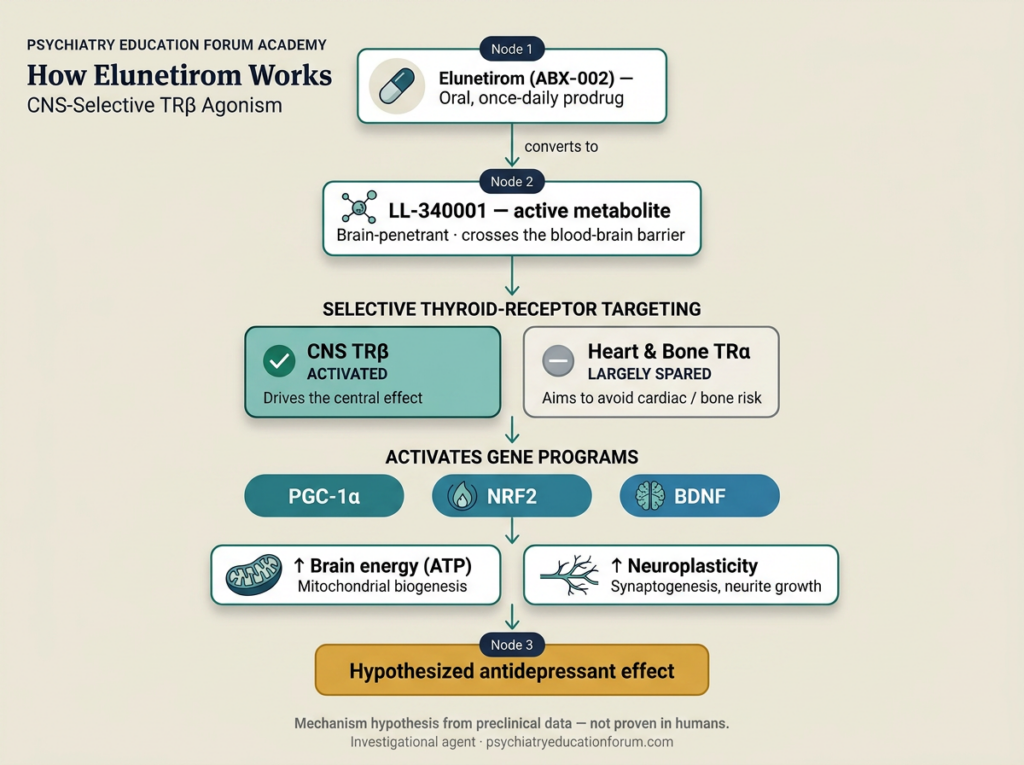
Existing antidepressants and adjuncts work on monoamines or D2/5-HT targets. Elunetirom works somewhere new: it selectively activates thyroid hormone receptor β (TRβ) in the brain to drive energy metabolism and neuroplasticity.

- TRβ vs TRα — the precise version. Contrary to a common shorthand, TRα is actually the dominant thyroid receptor in the brain (~70–80% of brain TR), as well as in heart and bone; TRβ predominates in liver and kidney and is present in the brain only as the minority isoform. Elunetirom is engineered to hit TRβ specifically — the point is to spare TRα-mediated cardiac and skeletal effects, even though TRβ is not the brain's main receptor. The proposed antidepressant action is hypothesized to run through TRβ, not overall thyroid-receptor abundance.
- Prodrug. Elunetirom is converted to the active, brain-penetrant LL-340001.
- Downstream. Drives PGC-1α (mitochondrial energy), NRF2 (cytoprotection), and BDNF (plasticity).
- Preclinical readouts. ↑ neurogenesis, neurite outgrowth, synaptogenesis — labelled "psychoplastogenic" (company-derived term) and reportedly preserved under cellular stress.
If it holds clinically, this is the first antidepressant strategy acting through brain energy metabolism and neuroplasticity via thyroid signalling — a different lever from monoamines, glutamate, or D2/5-HT. Genuinely novel, and entirely unproven in humans.
This bioenergetic / neuroplasticity framework derives largely from work by the originators of this thyromimetic class — including Thomas Scanlan, a scientific co-founder of Autobahn — so the mechanistic narrative is not independent of the sponsor.
From T3 Augmentation to Brain-Targeted Thyromimetics
Clinicians already know one version of thyroid-for-depression: T3 augmentation has decades of modest-evidence use, and supraphysiologic thyroid hormone has been tried in rapid-cycling bipolar illness. The limit was always that these used non-selective hormone, hitting cardiac and skeletal TRα — the dose-limiting problem (arrhythmia risk, bone loss).
Elunetirom's pitch: brain-targeted TRβ keeps the central effect and drops the peripheral cost. Whether that selectivity holds cleanly in humans is the open question, not a settled property.
Think of it as T3 augmentation aimed at brain TRβ instead of flooding the body — the central benefit without the peripheral cost. Promise, not proof.
Pharmacology & Dosing Profile
Public data come mainly from a Phase 1 study in healthy volunteers (randomized, double-blind, placebo-controlled, single/multiple ascending dose): safe and well tolerated, no serious adverse events, dose-proportional PK, and CNS target engagement. Those results set Phase 2 dosing.
| Property | Reported |
|---|---|
| Route / frequency | Oral, once daily |
| Administration | Morning, empty stomach (per AMPLIFY-BD protocol) |
| Prodrug | Yes — active moiety LL-340001 |
| PK (Phase 1) | Dose-proportional exposure |
| Target engagement | CNS thyroid effect demonstrated |
No approved dose exists; trial doses are not clinical guidance.
The Clinical Evidence to Date
Three tiers — weakest where it matters most:
- Phase 1 (healthy volunteers). Randomized, double-blind, placebo-controlled. Solid — but a safety/PK study, not efficacy.
- Phase 2 AMPLIFY-BD (bipolar, NCT06869187). The efficacy headline (table below).
- Preclinical. The neuroplasticity work from Section 2.
| Timepoint | Mean HAMD-17 reduction | Reported p |
|---|---|---|
| Week 2 | 9.7 points | p<0.001 |
| Week 4 | 13.7 points | p<0.001 |
| Week 6 (primary) | 16.8 points | p<0.001 |
The sponsor reports significance on the primary and all key secondary endpoints, a favourable safety profile, and a "rapid, robust, durable" effect. Full results: a medical conference in 2H 2026.
These are within-group changes from baseline in an open-label, single-arm study — not differences versus placebo. Section 6 explains why that's the whole ballgame.
Critical read: The Phase 2 Data
This section governs how much weight to give everything above. Per ClinicalTrials.gov, AMPLIFY-BD is single-arm, open-label, ~30 adults, all on background mood stabilizers and/or antipsychotics. No placebo, no randomization. That caps the numbers:
- No comparator = no drug-effect estimate. The 16.8-point drop bundles true drug effect, expectancy, natural recovery, regression to the mean, and background meds.
- Placebo response in bipolar depression is large — pooled placebo response rates run near 40% in controlled trials, with correspondingly big within-group score drops. Much of an uncontrolled 16.8-point change could be placebo and natural recovery, not drug.
- "Significant on all endpoints" is weak here — it means change-from-baseline differs from zero, not better-than-placebo.
- N ≈ 30, unblinded. Small and open-label — both inflate apparent effect.
Right reading: "scores fell 16.8 points in an uncontrolled cohort — consistent with, but not proof of, a drug effect." Hypothesis-generating. The decisive test is a randomized, placebo-controlled trial, which hasn't read out.
None of this means it fails. It means we don't yet know, and the "rapid, robust, durable" language outruns the design that produced it.
Regulatory Status: What Fast Track Actually Means
On 26 May 2026 the FDA granted Fast Track for adjunctive bipolar I/II depression. It's routinely over-read.
| Fast Track does | Fast Track does NOT |
|---|---|
| Enable more frequent FDA contact | Approve the drug |
| Allow early talks on trial design | Confirm efficacy |
| Permit possible rolling review later | Confirm safety |
| Signal a serious, unmet-need condition | Guarantee approval |
It's procedural — a willingness to engage early, not a verdict on whether the drug works. Read it as "may move faster," not "works."
Safety & Tolerability Watch-List
Tolerability looks favourable so far, but a 30-patient, 6-week open-label study can't answer the questions that matter for a chronic thyromimetic in bipolar patients. Track:
- Cardiac. The TRα-sparing thesis — watch for tachycardia, arrhythmia, or BP signals at scale; that's where imperfect selectivity shows first.
- Thyroid axis. TSH, free T4/T3, chronic-dosing effects.
- Bone. Thyroid excess drives bone loss; no long-term data exist.
- Liver — class precedent. TRβ selectivity is no guarantee of safety: eprotirome (KB2115), an earlier TRβ-selective agonist, was halted after liver-enzyme elevations in humans and cartilage damage in dogs. Resmetirom (Rezdiffra/MGL-3196), the first FDA-approved TRβ agonist (MASH, 2024), is liver-targeted and carries hepatic monitoring — a useful real-world reference point. Watch liver enzymes.
- Affective switch. Any antidepressant-acting adjunct raises hypomania/mania and cycling risk — uncharacterizable in 6 weeks at N≈30.
- Interactions. With mood stabilizers, antipsychotics, and thyroid-relevant drugs — undefined.
"Well tolerated in ~30 patients over 6 weeks" is a start, nothing more — it says little about rare events, long-term thyroid/bone effects, or switch risk, and the thyromimetic class carries prior cardiac, cartilage, and liver signals, so selectivity alone isn't reassurance.
Where It Might Fit — and the Honest "Ifs"
Keep every clause conditional. If an RCT confirms a real effect and tolerability holds, elunetirom slots in as an adjunct — added to mood stabilizers/antipsychotics, not monotherapy. The appeal is theoretical, based on mechanism rather than head-to-head data: a profile that might avoid the weight, metabolic, and movement liabilities driving discontinuation of current adjuncts, plus a distinct lever for partial responders. No comparative trial has shown any of this yet. Plausible niches: patients intolerant of antipsychotic adjuncts, partial responders, possibly anergic or cognitive presentations. All contingent on data that don't exist yet.
If a patient raises it after press coverage: a promising new mechanism in early testing, not shown to beat placebo, not approved, realistically years away. Enthusiasm fine; commitment premature.
What's Next
- Full AMPLIFY-BD results — conference, 2H 2026. Methods, secondaries, and safety detail the topline omits.
- AMPLIFY (MDD, NCT06633016) — topline Q3 2026; a key read-through to the larger population.
- The hurdle — a randomized, double-blind, placebo-controlled trial reproducing the signal. Until then, unproven.
Any randomized/blinded component; response, remission, and dropout rates; signals on thyroid labs, cardiac measures, and affective switch; whether the MDD data (possibly placebo-controlled) match the bipolar signal.
Clinical Bottom Line
Elunetirom is mechanistically novel — the first antidepressant candidate targeting CNS thyroid signalling for bioenergetics and neuroplasticity. Real, and worth following.
The evidence isn't persuasive yet. The efficacy headline is a single-arm, open-label, ~30-patient study with no placebo, where much of the 16.8-point HAMD-17 gain could be placebo and natural recovery. Fast Track adds momentum, not proof.
For now: a mechanism to watch, an unproven effect, a pipeline asset — not a bedside option. Reassess when an RCT reads out.
Sources & Evidence Disclosure
- Autobahn Therapeutics. FDA Fast Track designation for elunetirom (bipolar depression). Press release, 26 May 2026.
- Autobahn Therapeutics. Positive Phase 2 AMPLIFY-BD topline data. Press release, June 2026.
- ClinicalTrials.gov: AMPLIFY-BD (NCT06869187, single-arm/open-label, ~30 adults, HAMD-17 at Week 6); AMPLIFY MDD (NCT06633016, topline Q3 2026).
- Autobahn Phase 1 (randomized, double-blind, placebo-controlled SAD/MAD); ACNP/ASCP preclinical presentations (PGC-1α / NRF2 / BDNF).
- Chemistry/identifiers: elunetirom (ABX-002), prodrug of LL-340001; TRβ-selective thyromimetic.
- Class context: eprotirome (KB2115) Phase 3 (AKKA) halted — hepatotoxicity in humans, cartilage findings in dogs; resmetirom (Rezdiffra/MGL-3196), first FDA-approved TRβ agonist (MASH, March 2024), liver-targeted reference point.
- Bipolar-depression placebo response: meta-analyses of controlled trials (pooled placebo response ~40%).
- Secondary coverage: Psychiatric Times, Psychiatry Advisor, Patient Care Online (May–June 2026).
Two-layer attribution & evidence tier: all efficacy figures originate from company topline press releases, not peer-reviewed or fully presented data — a weaker tier than primary literature. The mechanistic (bioenergetic/neuroplasticity) framework derives substantially from work by this thyromimetic class's originators, including an Autobahn scientific co-founder (T. Scanlan), so it is not independent of the sponsor. Trial design, identifiers, and chemistry were verified against the ClinicalTrials.gov registry and public chemical databases; the efficacy interpretation (Section 6) is standard methodological appraisal. For clinician education; not medical advice.
Interested in Access to This & Other Clinically Relevant Content?
Join Psychiatry Education Forum
Academy Membership

- Best Value
- Maximum Saving
- Committed Learners
- Most Popular