
Your transplant patient is depressed. Which antidepressant won’t cost the graft?

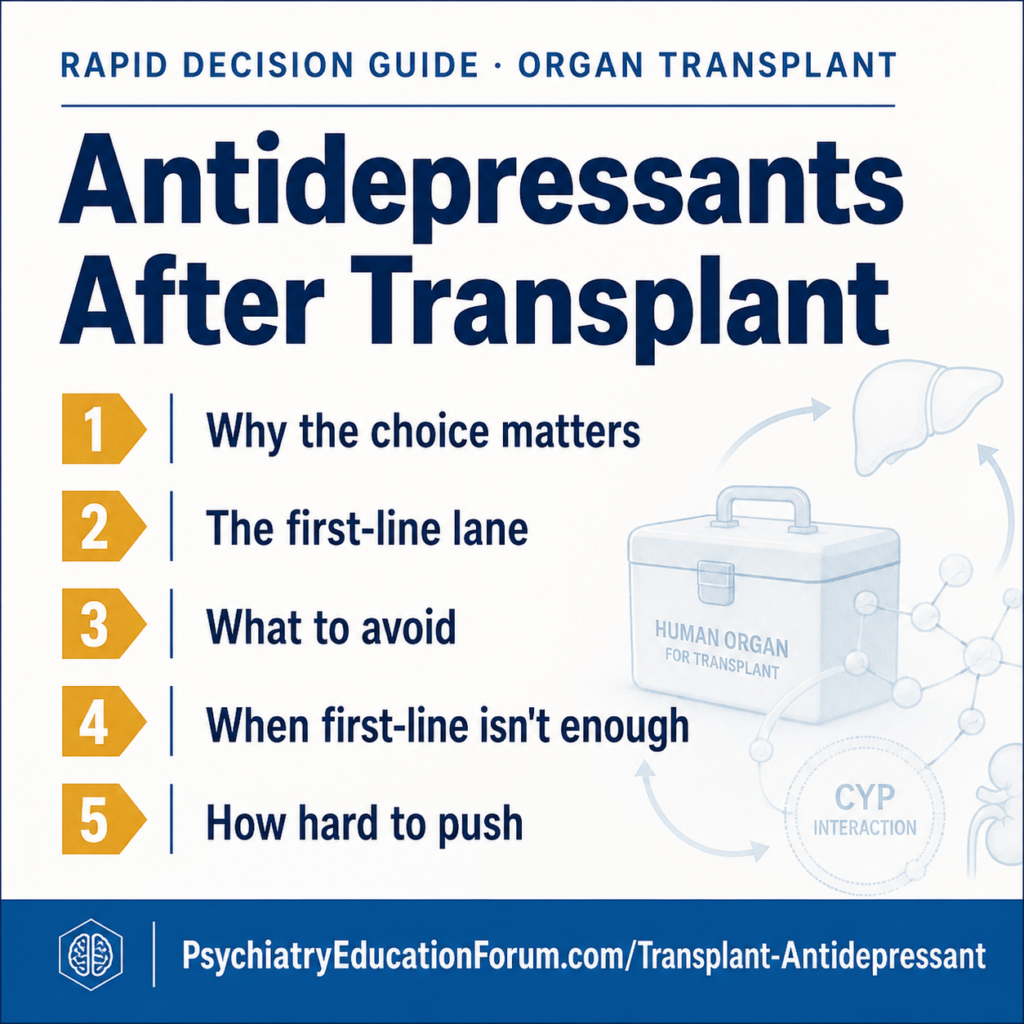
Your transplant patient is depressed. Which antidepressant won’t cost the graft?

The 30-second version
- Reach for sertraline, escitalopram, or mirtazapine. All three are guideline first-line and leave the calcineurin-inhibitor level essentially untouched.
- Avoid nefazodone and fluvoxamine. Both raise the tacrolimus/cyclosporine trough toward toxicity — and nefazodone is hepatotoxic on top of it. Skip TCAs and MAOIs too.
- The bigger risk is undertreating. Post-transplant depression drives nonadherence and carries roughly a 65% higher mortality risk — and adequately treated depression isn’t associated with that excess risk.
- So treat it, and treat it properly. Interaction fear is not a reason to underdose, because the clean-lane agents let you leave the immunosuppressant alone.
A transplant recipient screens positive for depression, and the reflex hesitation kicks in: everything interacts with tacrolimus — what’s safe? The good news is that antidepressants are one of the easier problems in transplant psychopharmacology. The agents you’d reach for first happen to be the ones that don’t move the immunosuppressant level at all. Here’s the point-of-care version.
Why does the antidepressant choice matter so much here?
Because in transplant, the downside of a psychotropic isn’t a side effect — it’s the graft.
Tacrolimus and cyclosporine are metabolized through CYP3A4 with a narrow therapeutic window. An antidepressant that inhibits CYP3A4 raises the trough and pushes toward toxicity; one that induces it drops the trough toward rejection. So the first question about any antidepressant isn’t “does it work” — it’s “does it move the trough.” Fortunately, most don’t.
Which antidepressants are first-line?
Sertraline, escitalopram, and mirtazapine — the agents that don’t meaningfully perturb CYP3A4.
The Academy of Consultation-Liaison Psychiatry’s 2023 best-practice guidance names these as first-line precisely because they leave the calcineurin inhibitor alone. Citalopram belongs in the same clean lane, with one dosing caveat noted below.
| Agent | Effect on the trough | Note |
|---|---|---|
| Sertraline | Negligible | A first-choice workhorse |
| Escitalopram | Negligible | A first-choice workhorse |
| Mirtazapine | Negligible | Useful when insomnia, nausea, or poor appetite dominate |
| Citalopram | Negligible | Fine within its QT dose cap (below) |
What about the QT question with citalopram?
Citalopram is fine — within its dose cap, and with the electrolytes minded.
Keep citalopram at or below 40 mg per day, and at or below 20 mg in patients over 60, those with hepatic impairment, or CYP2C19 poor metabolizers. The QT point matters more than usual in transplant because tacrolimus itself can prolong QT and calcineurin inhibitors waste magnesium and potassium — so in a tacrolimus patient, replete magnesium and potassium and respect the cap. This is a dosing detail, not a reason to avoid the drug.
Which antidepressants should I avoid?
Nefazodone and fluvoxamine, plus TCAs and MAOIs — cleaner options exist.
| Avoid | Why |
|---|---|
| Nefazodone | Strong CYP3A4 inhibitor that raises the trough — and hepatotoxic on top of it |
| Fluvoxamine | Moderate CYP3A4 inhibitor (also potent CYP1A2) — nudges the trough up |
| TCAs | Cardiac conduction and QT effects, anticholinergic burden, overdose lethality |
| MAOIs | Hypertensive-crisis and serotonin-syndrome danger in a heavy-polypharmacy patient |
A note on two common SSRIs: fluoxetine and paroxetine are both potent CYP2D6 inhibitors, and fluoxetine has also been flagged in transplant reviews for CYP3A4 effects that can nudge the calcineurin-inhibitor level — so neither is a first choice when sertraline and escitalopram sit right there.
What if a first-line agent isn’t enough?
There are reasonable second-line options — each with one caveat to check first.
| Second-line | Check first |
|---|---|
| Bupropion | Screen for calcineurin-inhibitor neurotoxicity first (seizure-threshold context) |
| Venlafaxine / desvenlafaxine | Dose-dependent hypertension — unhelpful in a patient already hypertensive from the CNI |
| Duloxetine | Reasonable if not a liver recipient |
How hard should I push treatment?
Hard. Undertreating depression is its own graft risk — and the clean lane means interaction fear is no excuse to underdose.
Post-transplant depressive disorders are associated with graft dysfunction, poorer adherence, worse quality of life, and roughly a 65% higher mortality risk — Dew and colleagues’ 2015 meta-analysis put both mortality and death-censored graft loss at a relative risk of about 1.65. And the reassuring counterpart comes from separate liver-transplant data (Rogal and colleagues, 2013, with similar findings from DiMartini’s group): adequately treated depression is not associated with that excess risk, while inadequately treated depression carries markedly worse survival. The goal isn’t to tiptoe around antidepressants out of interaction anxiety — it’s to treat the depression properly using agents that leave the immunosuppressant alone. And because depression drives the nonadherence that costs grafts, treating it well is itself graft-survival work.
From the course
Psychopharmacology in Organ Transplant
This post distills the antidepressant chapter of the full 14-chapter Rapid Decision Guide — the point-of-care system for prescribing psychotropics without risking the graft. Two chapters are free.
- 1The Transplant Decision FrameworkFree
- 2Know Your ImmunosuppressantsMembers
- 3Inducers That Cost the GraftMembers
- 4Inhibitors That Cause CNI ToxicityMembers
- 5Antidepressants in the Transplant RecipientFree
- 6Antipsychotics in the Transplant RecipientMembers
- 7Mood StabilizersMembers
- 8Sleep, Anxiety & StimulantsMembers
- 9Immunosuppressant NeurotoxicityMembers
- 10Steroid-Induced Psychiatric IllnessMembers
- 11Post-Transplant DeliriumMembers
- 12The Pre-Transplant Psychiatric EvaluationMembers
- 13Adherence & Substance UseMembers
- 14Quick-Reference TableMembers
Part of the Rapid Decision Guide series — psychopharmacology by medical condition, built for the point of care.
Explore the series →Not a member yet? Academy membership unlocks all 14 chapters and the full series.
Educational use only. This article summarizes guidance from the Organ Transplant course, which cites its primary sources; it supports, and does not replace, individual clinical judgment and current prescribing information. This post discusses depression; if you or someone you know is in crisis, seek local emergency or crisis support.