

“How long after an antidepressant before you can start an MAOI?”

How long after an antidepressant before you can start an MAOI?
And why there is no single answer — it runs from five days to five weeks, set entirely by the drug you are stopping.
A referral arrives: stop the fluoxetine, start tranylcypromine in two weeks. It reads like a normal plan, because two weeks is the number attached to almost every antidepressant on almost every label.
It is the wrong number for this particular drug, by three weeks. And the reason it is wrong is the reason there is no single right number: going into an MAOI the interval belongs to the agent you are stopping, and across the common antidepressants it varies sevenfold.
The 30-second version
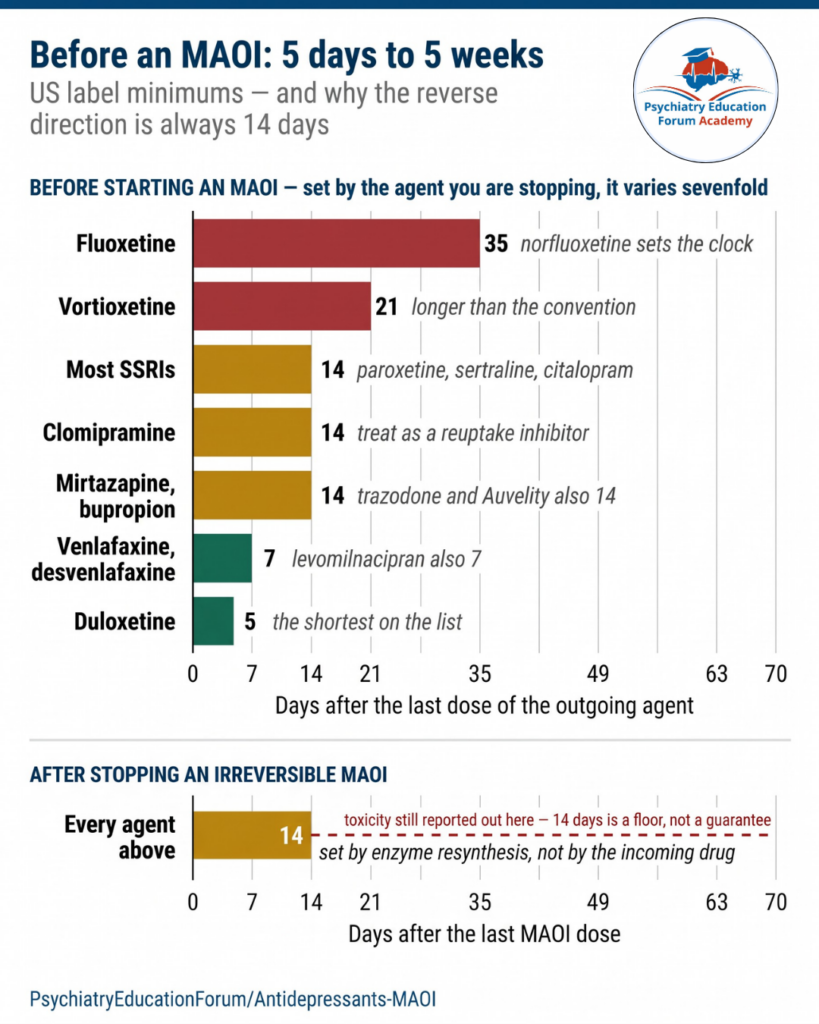
- Going into an MAOI, the interval is set by the drug you are stopping and varies sevenfold: duloxetine 5 days, venlafaxine and desvenlafaxine 7, most SSRIs 14, vortioxetine 21, fluoxetine 35. There is no general answer, only an agent-by-agent one.
- Fluoxetine is the outlier that catches people: at least five weeks, because the clock runs on norfluoxetine, its long-lived active metabolite, rather than on fluoxetine itself. Applying the 14-day default here shortens a five-week interval to two.
- Vortioxetine is the quieter outlier at 21 days — longer than the convention, and easy to miss precisely because it is close to it.
- Coming out of an MAOI it is 14 days for every agent, because that interval is set by enzyme resynthesis rather than by drug elimination. Nothing about the incoming drug changes it.
- Fourteen days is a floor, not a guarantee. Serotonin toxicity has been reported up to ten weeks after an irreversible MAOI was stopped, and human brain MAO-A recovery has never been directly measured.
- Linezolid and intravenous methylene blue are MAOIs for interaction purposes, and they arrive from outside psychiatry. Urgent linezolid is not delayed for a washout: the antidepressant is stopped and the patient monitored.
How long, and why does it depend on the agent?
Washout intervals are not a courtesy period. They are an elimination calculation, and the calculation runs on whichever active moiety lasts longest — which for fluoxetine is not fluoxetine.
Read the top panel as a single claim: there is no such thing as “the washout before an MAOI.” There are seven of them and they differ by a factor of seven. The 14-day figure most prescribers carry is the modal value, not the rule — it is correct for the middle three rows, too long for the bottom two, and dangerously short for the top two.
| Interval | Stopping this | What sets it |
|---|---|---|
| 5 weeks | Fluoxetine | Norfluoxetine, roughly 4–16 days, against a parent half-life of 1–6 days |
| 21 days | Vortioxetine | A 66-hour half-life. Longer than the convention, and easy to miss for exactly that reason |
| 14 days | Paroxetine, sertraline, citalopram, escitalopram, fluvoxamine | The modal figure, and the one that gets over-generalised to the two rows above |
| 14 days | Clomipramine | The most serotonergic TCA. Treat it as a reuptake inhibitor for every switching purpose |
| 14 days | Mirtazapine, bupropion, trazodone, dextromethorphan-bupropion | Not all serotonergic. Bupropion's contraindication with MAOIs is hypertensive rather than serotonergic |
| 7 days | Venlafaxine, desvenlafaxine, levomilnacipran | Short half-lives with no long-lived active metabolite |
| 5 days | Duloxetine | The shortest interval on the list |
The reframe
Five half-lives is a reasonable rule for eliminating a drug and a misleading one for planning a switch, because it silently assumes the parent compound is the thing being eliminated. Two exceptions break it and both are common: an active metabolite that outlasts the parent, and enzyme inhibition that outlasts both.
Fluoxetine is the first exception. The MAOIs are the second. Together they account for most of the interval errors worth worrying about.
One caveat the label does not carry. Norfluoxetine elimination is prolonged in hepatic impairment and may be slower in older adults and after high doses, and no label or guideline specifies a longer interval for high-dose fluoxetine. Waiting longer after 40 mg taken for years is clinical judgement — defensible, and worth documenting as judgement rather than presenting as a rule.
Why is it 14 days in the other direction, for every drug?
This is the part that makes the asymmetry make sense, and it is usually taught as two unrelated facts to memorise rather than as one mechanism with two consequences.
| Into an MAOI | Out of an MAOI | |
|---|---|---|
| What has to happen | The outgoing drug and its active metabolites have to clear | The body has to build new monoamine oxidase |
| What sets the clock | The pharmacokinetics of the drug you are stopping | The rate of enzyme synthesis |
| So it varies with | Which agent, its metabolites, hepatic function, age, dose | Nothing you can see or measure at the bedside |
| Which gives | 5 days to 5 weeks, by agent | 14 days, for every agent |
Phenelzine, tranylcypromine and isocarboxazid are irreversible, and selegiline is too at antidepressant doses. Their plasma half-lives are short and entirely beside the point: the drug is gone long before the enzyme is back. That is why the interval after an MAOI is longer than its pharmacokinetics would ever suggest, and why no amount of knowing the incoming agent lets you shorten it.
Is 14 days actually safe?
The honest position here is uncomfortable, and worth stating rather than smoothing over, because the number most often quoted in teaching is not measuring the thing that matters.
| What is claimed | Monoamine oxidase recovers with a half-time of about 40 days, so 14 days is a sensible practical floor |
| What is wrong with it | That 40-day figure is for MAO-B. Serotonin toxicity depends mainly on MAO-A, and human brain MAO-A recovery after irreversible inhibition has never been directly measured |
| What is actually known | Toxicity has occurred as late as ten weeks after stopping. That is a clinical report, not a pharmacokinetic prediction, and it is the only direct evidence about the tail |
| What to do with it | Treat 14 days as the earliest permissible date rather than a safe one. Some expert sources advise 2–3 weeks, and dietary and over-the-counter restrictions continue for at least 14 days after the last dose regardless |
None of that is an argument for inventing your own interval. It is an argument for knowing that the label figure is a regulatory minimum built on an extrapolation, and for not reassuring a patient on day fifteen that the risk has gone to zero.
Two drugs on this list that are not antidepressants
Everything above assumes you know an MAOI when you see one. Two of them are prescribed by other specialties, for patients whose antidepressant nobody has reviewed. Linezolid is a reversible, non-selective MAOI. Intravenous methylene blue is a potent reversible inhibitor. Both carry FDA drug safety communications about serotonergic psychiatric drugs, and bupropion is named in the linezolid warning too.
The washout logic does not transfer neatly. For urgent linezolid the antidepressant is stopped and the patient monitored rather than the antibiotic being delayed — for 2 weeks, or 5 weeks if fluoxetine was taken, or until 24 hours after the last linezolid dose, whichever comes first. For elective linezolid the label sets no pre-start washout at all, so any interval you apply there is pharmacokinetic extrapolation rather than a label rule. After intravenous methylene blue, observe for central nervous system toxicity for up to 4 hours.
What this post is not certain about
Every interval here is a US label figure. Labels are revised, availability and wording are market-specific, and an interval read from a blog post is not an interval read from a label. Check the current one for your market before it reaches a patient.
The ten-week toxicity report tells you the tail exists. It does not tell you how long to wait, and nobody knows, because the enzyme recovery that would answer it has not been measured in human brain.
And this post covers one decision only: how long to wait. Whether to switch at all, which method to use for a pair that does not need a washout, and what to do when symptoms appear during the transition are separate questions with separate answers, and the choice of switch method has never been tested in a randomised comparison.
Switching & Cross-Taper Safety
This post answers one question: how long to wait. The chapter answers the rest of the switch — which method to use, which pairs must never overlap, what carries over when no washout is needed, and how to tell serotonin toxicity from withdrawal on the day-four phone call.
What is in the chapter
- 1Why switches fail or harm
- 2Half-life and washout logic
- 3Choosing the switch method
- 4Cross-tapering as a method, not a milligram table
- 5High-risk pairs
- 6Serotonin toxicity during a switch
- 7Discontinuation, rebound, or relapse
- 8Interactions that change the plan
- 9Special situations
- 10Where teaching outruns the evidence
- 11Action ladder
- 12Case resolution
- 13Pearls & red flags
Plus the full switch-method decision matrix across thirteen agent pairings, the high-risk pairs set out one by one, a cross-taper method that works for any permitted pair, a counselling script, a copy-paste EMR note with the washout calculation built into it, and 38 references.
Open the chapter →The complete series
Thirty-one point-of-care chapters across seven parts, complete by 30 September. Every chapter opens with the bottom line, works the differential, and closes with an action ladder, a counselling script, and a copy-paste EMR note.
- 1Serotonin SyndromeMembers
- 2Activation Syndrome & Treatment-Emergent SuicidalityMembers
- 3Antidepressant-Induced AkathisiaMembers
- 4Treatment-Emergent Mania & the Bipolar SwitchFree
- 5Tremor & MyoclonusMembers
- 6Bruxism & Jaw ClenchingMembers
- 7Dystonia, Parkinsonism & Tardive DyskinesiaMembers
- 8Nausea, Dyspepsia, Diarrhea & Dry MouthMembers
- 9Insomnia, Vivid Dreams & REM Sleep EffectsMembers
- 10Sedation & Daytime SomnolenceMembers
- 11Emotional Blunting, Apathy & Cognitive EffectsFree
- 12Weight Gain & Appetite ChangeMembers
- 13Sexual Dysfunction & PSSDMembers
- 14Falls, Fractures & Bone HealthMembers
- 15QTc Prolongation, Tachycardia & Cardiac ConductionMembers
- 16SNRI-Associated HypertensionMembers
- 17Orthostatic Hypotension & DizzinessMembers
- 18Antidepressant-Induced Excessive Sweating (ADIES)Members
- 19Urinary Retention & IncontinenceMembers
- 20Bleeding Risk: GI, Perioperative & Anticoagulant Co-PrescriptionFree
- 21Hyponatremia & SIADHMembers
- 22Transaminitis & Drug-Induced Liver InjuryMembers
- 23Discontinuation Syndrome & Hyperbolic TaperingMembers
- 24Switching & Cross-Taper SafetyMembers
- 25The Bupropion SetSoon
- 26The Mirtazapine SetSoon
- 27The Serotonin Modulator SetSoon
- 28The TCA SetSoon
- 29The MAOI SetSoon
- 30Rare but Serious ConditionsSoon
- 31Quick-Reference MatrixSoon
Join the Academy
One membership covers this series and the entire Academy library — psychopharmacology lessons, case discussions and clinical pearls, with new content added monthly.
- All 31 chapters of Managing Antidepressant Adverse Events, complete by 30 September
- The finished Managing Antipsychotic Adverse Events series — 21 chapters
- Counselling scripts and copy-paste EMR notes in every chapter
- Every future rapid-decision course at no additional cost
Selected references
- US prescribing information, current versions: fluoxetine, paroxetine, sertraline, citalopram, escitalopram, fluvoxamine, vilazodone, vortioxetine, venlafaxine, desvenlafaxine, duloxetine, levomilnacipran, clomipramine, mirtazapine, bupropion, trazodone, phenelzine, tranylcypromine, isocarboxazid, selegiline transdermal, dextromethorphan-bupropion, linezolid, methylene blue. Every interval in this post is drawn from these.
- Chamberlain SR, Baldwin DS. Monoamine oxidase inhibitors (MAOIs) in psychiatric practice: how to use them safely and effectively. CNS Drugs. 2021;35(7):703–716.
- Tipton KF. 90 years of monoamine oxidase: some progress and some confusion. J Neural Transm (Vienna). 2018;125(11):1519–1551.
- Naoi M, Maruyama W, Shamoto-Nagai M, Riederer P. Type A monoamine oxidase; its unique role in mood, behavior and neurodegeneration. J Neural Transm (Vienna). 2025;132(3):387–406.
- Dunkley EJC, Isbister GK, Sibbritt D, Dawson AH, Whyte IM. The Hunter Serotonin Toxicity Criteria. QJM. 2003;96(9):635–642.
- Boyer EW, Shannon M. The serotonin syndrome. N Engl J Med. 2005;352(11):1112–1120.
- US Food and Drug Administration. Drug Safety Communication: serious CNS reactions possible when linezolid is given to patients taking certain psychiatric medications. 2011.
- US Food and Drug Administration. Drug Safety Communication: serious CNS reactions possible when methylene blue is given to patients taking certain psychiatric medications. 2011.
- Bangert MK, Hasbun R. Neurological and psychiatric adverse effects of antimicrobials. CNS Drugs. 2019;33(8):727–753.
- Simon GE, Moise N, Mohr DC. Management of depression in adults: a review. JAMA. 2024;332(2):141–152.
- Mohamed S, Johnson GR, Chen P, et al. Effect of antidepressant switching vs augmentation on remission among patients with major depressive disorder unresponsive to antidepressant treatment: the VAST-D randomized clinical trial. JAMA. 2017;318(2):132–145.
- Hayasaka Y, Purgato M, Magni LR, et al. Dose equivalents of antidepressants: evidence-based recommendations from randomized controlled trials. J Affect Disord. 2015;180:179–184.



Responses