

What is the maximum daily dose of bupropion?

What is the maximum daily dose of bupropion?
And why that is the wrong first question — the ceiling is set by the product and the indication, and a daily total can be perfectly correct while two other rules are broken.
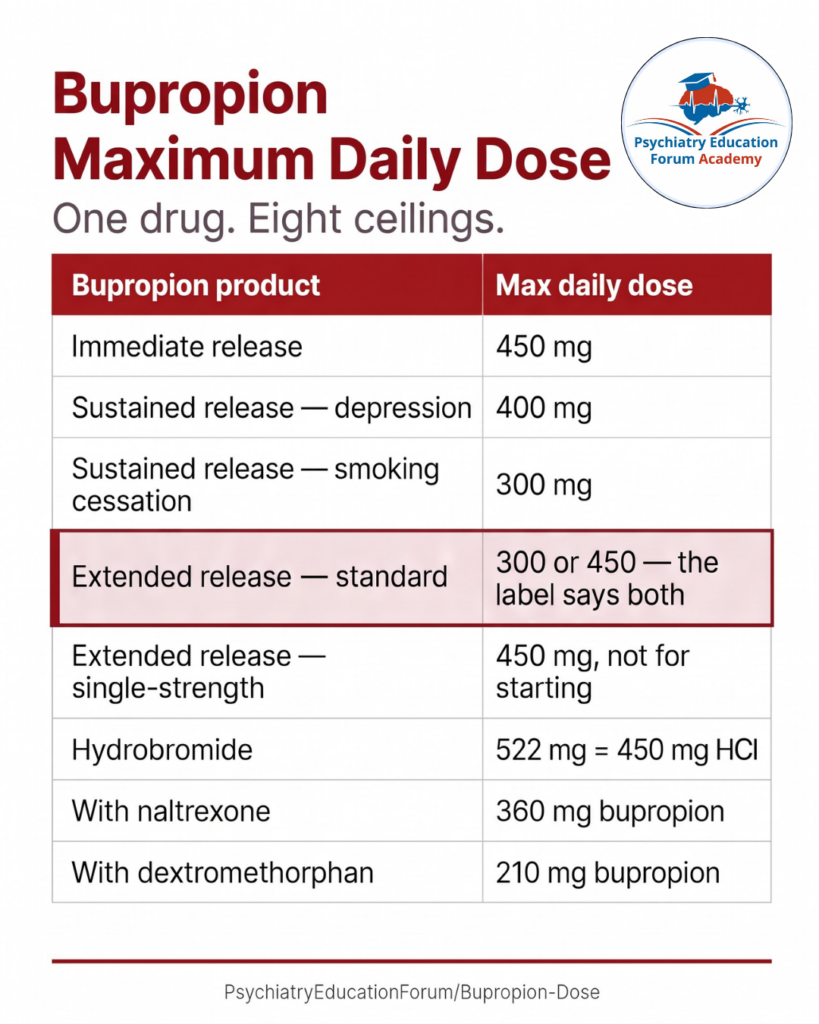
Ask a room of prescribers the maximum daily dose of bupropion and most will say 450. It is a reasonable answer. It is also the printed maximum on only two of the eight lines in the table below, and the wrong one for the formulation most of your patients are actually taking.
The deeper problem is that the daily ceiling is only one of three rules, and it is the only one anybody checks. A patient can be inside the daily maximum and still have broken the other two that morning. That is a dosing error rather than a judgement error, which means it is the kind that gets caught by a system rather than by clinical acumen.
The 30-second version
- Three rules govern every bupropion prescription: the maximum daily dose, the maximum amount in any single administration, and the minimum interval between administrations. Only the first is usually checked.
- There is no single ceiling to remember. US labelling carries eight, and one of them is not a single number.
- Immediate release: 450 mg/day, with no single dose above 150 mg and at least six hours between doses on the three-times-daily schedule.
- Sustained release: 400 mg/day for depression, as 200 mg twice daily. The same salt in the same formulation caps at 300 mg/day when the indication is smoking cessation.
- Extended release is the contested one. Current labels open the seizure section by saying the dose should not exceed 300 mg once daily, while a single-strength 450 mg product is dosed at exactly 450 and is labelled not to be used to start treatment.
- Bupropion hydrobromide is written in different units: 522 mg of the hydrobromide is equivalent to 450 mg of the hydrochloride. The largest number in the set is not the largest dose.
- Bupropion also arrives inside two products that are not called bupropion — a naltrexone combination delivering 360 mg/day and a dextromethorphan combination delivering 210 mg/day.
- The commonest real-world error is a correct daily total with a broken single-dose or interval rule: two strengths dispensed together, a missed dose taken alongside the next, or a schedule consolidated for convenience.
How many rules are there, and which one gets missed?
Three. The daily total is the one everyone checks; the single-dose limit and the minimum interval are the two that a double-up or a consolidated schedule quietly breaks.
Every bupropion product carries all three, and each has its own values for each. The reason this matters more for bupropion than for most antidepressants is mechanistic: seizure risk with this drug tracks peak concentration, not just total exposure. A patient who takes their whole day's dose in one administration has the same daily total on the chart and a substantially different peak.
That is why the two unchecked rules are the clinically interesting ones. The three commonest ways they break are worth naming, because none of them looks like an error at the time:
- Two strengths dispensed together, and the patient takes both at once rather than at separate times.
- A missed morning dose taken alongside the evening one, which is what most patients do by default unless told otherwise.
- An immediate-release schedule consolidated from three or four administrations into fewer, usually to make it easier to remember or to fit around work.
All three produce a correct daily total. None of them is visible on a medication list.
So what is the maximum daily dose?
It depends on the product and on the indication. There are eight answers in US labelling, not one.
The table below is the whole argument. Read down the first column, find the product actually in front of you, and read across. The point is not to memorise it — it is that memorising a single number is what produces the error.
| Product | Maximum daily dose | Maximum single dose | Minimum interval |
|---|---|---|---|
| Immediate release | 450 mg/day | 150 mg — no single dose may exceed it | At least 6 hours on the three-times-daily schedule. The label states no interval for the four-times-daily schedule; it constrains that one by the single-dose limit instead |
| Sustained release, depression | 400 mg/day, as 200 mg twice daily | 200 mg | At least 8 hours |
| Sustained release, smoking cessation | 300 mg/day, as 150 mg twice daily | 150 mg | At least 8 hours |
| Extended release, standard products | Contested within one label. The seizure section opens at 300 mg once daily; Highlights and that section’s own incidence paragraph both name 450 mg once daily. See below — this row cannot be read in isolation | The daily dose, since it is given once | Not applicable — once daily |
| Extended release, single-strength 450 mg product | 450 mg once daily; labelled not to be used to initiate treatment | The daily dose, since it is given once | Not applicable — once daily |
| Bupropion hydrobromide, extended release | 522 mg of the hydrobromide, equivalent to 450 mg of the hydrochloride | The daily dose, since it is given once | Not applicable — once daily |
| Naltrexone–bupropion | 360 mg bupropion/day, with 32 mg naltrexone, as two tablets twice daily | 90 mg bupropion per tablet | Morning and evening at maintenance, reached over a four-week escalation |
| Dextromethorphan–bupropion | 210 mg bupropion/day, as one tablet twice daily | 105 mg bupropion per tablet | At least 8 hours |
Two things in that table are worth pausing on. The first is the third row: the same salt, in the same formulation, carries a lower ceiling when it is prescribed for smoking cessation than when it is prescribed for depression. Formulation alone does not determine the maximum. The second is the sixth row, which is the one most likely to be misread on a reconciliation list.
Why does the extended-release ceiling have two numbers?
Because it genuinely differs between marketed products, and because the standard label's own seizure section names two figures a few lines apart.
Current standard extended-release labels — brand and generic alike — open the seizure subsection with an instruction that the dose should not exceed 300 mg once daily. That is not the only figure the label gives, and it is not the most prominent one.
The Highlights section at the top of the label, which is the part most prescribers actually consult, states that the risk of seizure can be reduced by limiting the daily dose to 450 mg. The incidence paragraph inside the seizure subsection says the same, a few lines below the 300 mg instruction. In Highlights, 300 mg appears only as the usual target dose — not as a ceiling at all.
So one label names two different ceilings in two different places, and the more prominent placement carries the higher number. Whether the opening imperative or the Highlights figure governs is not something this post can settle, and it is not something a table cell can carry. It is the reason the row above says the ceiling is contested rather than picking one.
Meanwhile a single-strength 450 mg extended-release product exists, is dosed at exactly 450 mg once daily because that is its only available strength, and is labelled not to be used to start treatment — patients are titrated on another bupropion product first. Its own seizure subsection, consistent with having one strength, states no numeric ceiling at all.
So a clinician who carries “extended release goes to 450” will over-dose one product, and a clinician who carries “extended release caps at 300” will under-treat on another. The number cannot be recalled. It has to be read off the product in hand.
What about the bupropion that is not called bupropion?
Two combination products deliver substantial bupropion, and neither is filed mentally as a bupropion prescription by the clinician writing it.
A naltrexone–bupropion combination licensed for weight management delivers 360 mg of bupropion hydrochloride a day at maintenance, as two tablets twice daily, each containing 90 mg. A dextromethorphan–bupropion combination licensed for depression delivers 210 mg a day, as one tablet twice daily at least eight hours apart.
The clinical consequence is a stacking problem rather than a dosing problem. A patient started on the weight-management combination by one clinician and given bupropion for depression by another is receiving both, and neither prescriber sees a bupropion duplication on their own list. Bupropion labelling is explicit that other bupropion-containing products are among the medications that lower the seizure threshold. Asking “are you on anything else with bupropion in it?” is a different question from reading the medication list, and it is the one that finds this.
Does any of this actually change seizure risk?
Yes, and unusually for an adverse effect, the labels quantify it.
Sustained release runs at approximately 0.1% — one in a thousand — at doses up to 300 mg/day, and approximately 0.4%, four in a thousand, at its 400 mg/day ceiling. That is a fourfold rise inside a single formulation and entirely within licence. Immediate release sits at approximately 0.4% at doses up to 450 mg/day, and the estimated incidence rises almost tenfold between 450 and 600 mg/day.
Those figures are worth holding precisely because they are unusual. Most of what we counsel patients about carries no number at all. Here the dose–risk relationship is on the label, which means the difference between a correct and an incorrect ceiling is not theoretical.
The reframe
Stop asking what the maximum dose of bupropion is. The question has no answer, and the version of it that does have an answer is more useful anyway: which product is this, and what is it being prescribed for?
Those two facts determine all three ceilings. Neither of them is reliably visible on a medication list that reads “bupropion 150 mg”, which is why the question has to be asked out loud rather than inferred.
What would I actually do differently on Monday?
Three things, none of which takes longer than a few seconds.
- When bupropion appears on a list, establish the formulation and the indication before you consider the number. “Bupropion 150 mg” is not enough information to know whether it is correct.
- Tell the patient explicitly what to do about a missed dose. The default behaviour — take it with the next one — is the single most common way the single-dose rule gets broken, and it is prevented by one sentence at the first visit.
- Ask directly about other bupropion-containing products, including anything prescribed for weight. The medication list will not answer this for you.
What this post does not settle
These are US labelling figures, and they are the values as the labels read at the time of writing. The extended-release disagreement is not a matter of old labels versus new ones: it is live and internal to a single current document, which gives the lower figure in the seizure section and the higher one in Highlights, while a separate single-strength product is dosed at the higher figure outright. Check the product in front of you rather than this table, and check more than one section of its label.
This post also deliberately stops at the dose rules. Who is at higher risk independent of dose, what raises bupropion levels pharmacokinetically, the three contraindications that function as screening questions rather than judgement calls, and what to do if a seizure actually happens are all separate questions with their own answers. They are covered in the chapter this post is drawn from.
The Bupropion Set: Seizure Risk & Lowered Seizure Threshold
This post answers one question: what the ceiling is, and why there is no single one. The chapter answers the rest of the drug — who is at higher risk before any dose is chosen, what raises the level pharmacokinetically, the three contraindications that are screening questions rather than judgement calls, and what to do on the day a seizure actually happens.
What is in the chapter
- 1Why dose is the whole story
- 2What the incidence figures are attached to
- 3Formulation, ceiling and the single-dose rule
- 4The contraindications that are screening questions
- 5Who is actually at higher risk
- 6What stacks with it
- 7The pharmacokinetics that raise the level
- 8When a seizure happens, and what overdose adds
- 9Bupropion outside the antidepressant label
- 10Beyond bupropion: the rest of the class
- 11Where teaching outruns the evidence
- 12Action ladder
- 13Case resolution
Plus eleven tables, a pearls set, a red-flag list, a counselling script, a copy-paste EMR note with the product and indication check built into it, and 28 references.
Open the chapter →The complete series
31 chapters · 7 parts · Point-of-care reference for prescribers · 3 chapters free to read
- 1Serotonin SyndromeMembers
- 2Activation Syndrome & Treatment-Emergent SuicidalityMembers
- 3Antidepressant-Induced AkathisiaMembers
- 4Treatment-Emergent Mania & the Bipolar SwitchFree
- 5Tremor & MyoclonusMembers
- 6Bruxism & Jaw ClenchingMembers
- 7Dystonia, Parkinsonism & Tardive DyskinesiaMembers
- 8Nausea, Dyspepsia, Diarrhea & Dry MouthMembers
- 9Insomnia, Vivid Dreams & REM Sleep EffectsMembers
- 10Sedation & Daytime SomnolenceMembers
- 11Emotional Blunting, Apathy & Cognitive EffectsFree
- 12Weight Gain & Appetite ChangeMembers
- 13Sexual Dysfunction & PSSDMembers
- 14Falls, Fractures & Bone HealthMembers
- 15QTc Prolongation, Tachycardia & Cardiac ConductionMembers
- 16SNRI-Associated HypertensionMembers
- 17Orthostatic Hypotension & DizzinessMembers
- 18Antidepressant-Induced Excessive Sweating (ADIES)Members
- 19Urinary Retention & IncontinenceMembers
- 20Bleeding Risk: GI, Perioperative & Anticoagulant Co-PrescriptionFree
- 21Hyponatremia & SIADHMembers
- 22Transaminitis & Drug-Induced Liver InjuryMembers
- 23Discontinuation Syndrome & Hyperbolic TaperingMembers
- 24Switching & Cross-Taper SafetyMembers
- 25The Bupropion SetMembers
- 26The Mirtazapine SetMembers
- 27The Serotonin Modulator SetMembers
- 28The TCA SetMembers
- 29The MAOI SetMembers
- 30Rare but Serious ConditionsMembers
- 31Quick-Reference MatrixMembers
Join the Academy
One membership covers this series and the entire Academy library — psychopharmacology lessons, case discussions and clinical pearls, with new content added monthly.
- All 31 chapters of Managing Antidepressant Adverse Events, complete by 30 September
- The finished Managing Antipsychotic Adverse Events series — 21 chapters
- Counselling scripts and copy-paste EMR notes in every chapter
- Every future rapid-decision course at no additional cost
Sources
- US prescribing information for bupropion hydrochloride immediate-release tablets. Source of the 450 mg/day ceiling, the 150 mg maximum single dose, the six-hour interval on the three-times-daily schedule, the 100 mg four-times-daily option, the 0.4% figure at doses up to 450 mg/day and the almost-tenfold rise between 450 and 600 mg/day. Read on two independent hosts.
- US prescribing information for bupropion hydrochloride sustained-release tablets. Source of the 400 mg/day depression ceiling as 200 mg twice daily, the 200 mg single-dose limit, the eight-hour interval, and the 0.1% and 0.4% incidence figures. DailyMed set id cbc8c074-f080-4489-a5ae-207b5fadeba3, read alongside a second independent host.
- US prescribing information for bupropion hydrochloride sustained-release tablets, smoking-cessation product. Source of the 300 mg/day ceiling as 150 mg twice daily. Read on two independent hosts.
- US prescribing information for bupropion hydrochloride extended-release tablets. Source of the instruction that the dose should not exceed 300 mg once daily, and of the higher figure appearing later in the same seizure subsection. Read on the brand label and on two distinct generic labels, DailyMed set ids c71f18b7-36a3-4489-96b4-e8fbec4f73a1 and df923448-4f81-47af-8e55-f7359746b05f, the latter revised 7/2026. The Highlights section of the brand label was read separately on two independent hosts: it gives 450 mg as the figure that reduces seizure risk, and names 300 mg only as the usual target dose.
- US prescribing information for the single-strength 450 mg bupropion hydrochloride extended-release product. Source of the 450 mg once-daily dose, the single available strength, and the instruction not to initiate treatment with it. DailyMed set id 80b01182-dc94-4990-8ebb-55c306d7e536, read alongside a second independent host.
- US prescribing information for bupropion hydrobromide extended-release tablets. Source of the 522 mg ceiling and of the salt equivalence to 450 mg of the hydrochloride. Read on two independent hosts.
- US prescribing information for naltrexone hydrochloride and bupropion hydrochloride extended-release tablets. Source of the 360 mg bupropion daily maintenance dose, the 90 mg bupropion per tablet, and the four-week escalation. Read on two independent hosts.
- US prescribing information for dextromethorphan hydrobromide and bupropion hydrochloride extended-release tablets. Source of the 210 mg bupropion daily dose, the 105 mg bupropion per tablet, and the eight-hour interval. Read on two independent hosts.


Responses