
Using TCAs in Pregnancy? Here’s the One You Should Choose


Quick Take:
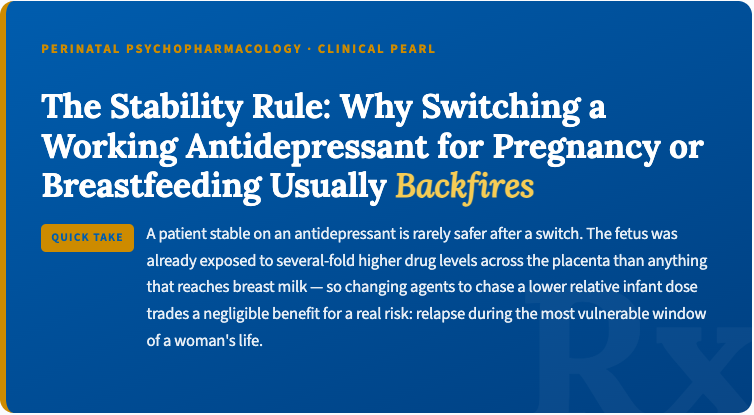
If a TCA is needed in pregnancy, nortriptyline is the preferred agent.
A familiar clinical scenario: A patient with treatment-resistant depression has not responded to SSRIs or SNRIs—and you’re considering a tricyclic antidepressant (TCA).
The hesitation is understandable:
- Side effect burden
- Safety concerns in pregnancy
- Lack of familiarity compared to SSRIs
But here’s the key issue:
👉 If you decide to use a TCA, choice of agent matters more than most clinicians realize.
💡Clinical Pearl:
Not all TCAs are equal in pregnancy.
If a TCA is indicated:
👉 Nortriptyline should be your default choice.
In Practice (What Should You Actually Do?)
- Prefer nortriptyline over amitriptyline, imipramine, or clomipramine
- Avoid tertiary amines when possible
- Use therapeutic drug monitoring (TDM) to guide dosing
- Consider breastfeeding safety early in decision-making
Start with a Free Preview:
See how we approach medication decisions in pregnancy using a structured, step-by-step framework in the SSRI chapter (free preview).

Why Nortriptyline? (What Makes It Different)
1. Better Tolerability Profile
Nortriptyline is a secondary amine TCA, which means:
- Fewer anticholinergic side effects
- Less sedation
- Better overall tolerability
Compared to tertiary amines:
- Amitriptyline
- Imipramine
- Clomipramine
👉 These agents tend to have:
- More dry mouth
- More constipation
- More cognitive side effects
2. Therapeutic Drug Monitoring (TDM) Advantage
Nortriptyline has well-established therapeutic ranges, allowing:
- Objective dose optimization
- Safer titration
- Better control in pregnancy (where pharmacokinetics can change)
👉 This is a major advantage over many other antidepressants.
3. Breastfeeding Safety Matters
If you’re thinking ahead (you should be):
👉 Nortriptyline is considered one of the safest TCAs in breastfeeding
This makes it:
- A more continuous treatment option
- Easier to maintain across pregnancy → postpartum
💡Clinical Pearl:
If you’re using a TCA in pregnancy, you’re already in a higher-complexity case—don’t choose the agent casually.
Nortriptyline offers:
- Better tolerability
- Measurable drug levels
- Safer breastfeeding profile
Why This Matters in Real Practice?
TCAs are not first-line—but they are:
- Still used in treatment-resistant cases
- Still relevant in complex patients
And in those cases:
👉 Small decisions (like agent selection)
👉 Have disproportionately large impact on tolerability and adherence
Want the Full Clinical Framework?
This is just one decision point.
Inside the full Pregnancy & Breastfeeding Psychopharmacology Guide, you’ll get:
- Side-by-side comparison of antidepressants
- Pregnancy vs breastfeeding risk breakdowns
- Therapeutic drug monitoring guidance
- Clinical decision flowcharts
- Patient counseling scripts
- EMR-ready documentation templates
Explore the Full Series:
This is part of the Pregnancy & Breastfeeding Psychopharmacology series.
👉 View all upcoming chapters here:

Pregnancy & Breastfeeding Psychopharmacology
We continue to review and summarize clinically relevant research to support your daily practice.
INTERESTED IN ACCESS TO THIS & OTHER CLINICALLY RELEVANT LECTURE SERIES?
JOIN ACADEMY MEMBERSHIP
DISCOUNTS AVAILABLE FOR: Residents & Students ONLY.
Email us your student information (program information and way to confirm your student status) to: [email protected]
© 2026 All Rights Reserved.