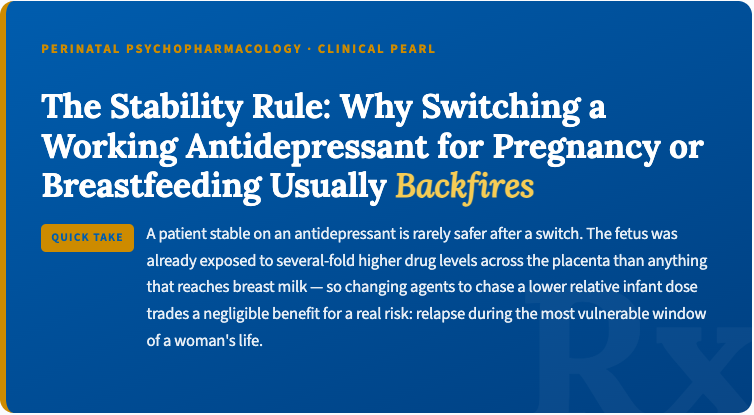

Should You Taper SSRIs Before Delivery? What the Data on PNAS Actually Says


Quick Take:
Tapering SSRIs before delivery does not clearly reduce neonatal risk for Poor Neonatal Adaptation Syndrome (PNAS)—but may increase maternal relapse.
A familiar clinical scenario: A pregnant patient on an SSRI approaches the third trimester—and the question comes up:
“Should we taper the medication before delivery to protect the baby?”
This decision is often driven by concern about Poor Neonatal Adaptation Syndrome (PNAS).
But here’s the problem:
the instinct to taper is not strongly supported by evidence—and may create more harm than benefit.
💡Clinical Pearl:
Don’t taper SSRIs before delivery just to “protect” the baby.
PNAS is typically mild and self-limited.
Postpartum relapse is not.
👉 Notify the neonatal team instead.
In Practice (What Should You Actually Do?)
- Continue the effective SSRI in most cases
- Avoid routine third-trimester taper
- Notify the pediatric/neonatal team prior to delivery
- Use shared decision-making—not fear-based decisions
See how this decision is handled step-by-step in the SSRI chapter:
Our academy’s first chapter on SSRIs is available as a free preview:

What is PNAS? (And How Serious Is It?)
Evidence Level:
Common—but transient and typically mild
Clinical Features:
- Irritability
- Jitteriness
- Weak cry
- Respiratory distress
- Feeding difficulties
Most cases:
- Resolve within 2–4 weeks
- Require supportive care only
Severe outcomes:
- Rare (~1 in 300 term infants)
- May include seizures, dehydration, or need for intubation
- No neonatal deaths have been attributed to SSRI exposure
Not All SSRIs Are Equal
Emerging data suggests medication-specific differences:
- Escitalopram and fluoxetine → higher risk of delayed neonatal adaptation
- Dose-dependent relationship observed (Cornet et al., 2024; n=280,090)
Why Fluoxetine Stands Out
- Long half-life
- Active metabolite (norfluoxetine)
- Half-life: 7–15 days
This leads to:
- Prolonged neonatal serotonin exposure
- Reduced clearance due to immature neonatal hepatic metabolism
The Tapering Question: Does It Help?
This is where most clinicians get stuck.
What the Evidence Shows:
- Small case series (n=38): ↓ NICU admissions with tapering
- Larger analyses (including a Journal of the American Medical Association review):
→ No clear evidence that tapering improves neonatal outcomes - American Academy of Family Physicians guidance:
→ Discontinuation in 3rd trimester does NOT improve outcomes
The Risk You Might Be Underestimating
Tapering is not a neutral intervention.
It can lead to:
- Relapse of maternal depression
- Increased risk of postpartum depression
- Functional decline during a high-risk period
And unlike PNAS—
these risks are not transient.
💡Clinical Pearl — Don’t Taper to “Protect” the Baby
The reflex to taper SSRIs before delivery is understandable—but not evidence-based.
- PNAS is usually mild, self-limited, and manageable
- Postpartum relapse is not
A better strategy:
- Continue the effective medication
- Inform the pediatric/neonatal team in advance
- Allow for appropriate monitoring after delivery
This approach:
- Maintains maternal stability
- Addresses neonatal risk proactively
Why This Matters in Real Practice?
This is not just a pharmacology question—it’s a risk framing problem.
If you focus only on medication exposure, you will:
- Overestimate neonatal risk
- Underestimate maternal relapse
The goal is not eliminating risk.
The goal is choosing the lower-risk path overall.
👉 That’s exactly what our acdemy’s new guide fixes.
Want the Full Clinical Framework?
This is just one clinical decision point.
Inside the full guide, you’ll get:
- Antidepressants-specific risk comparisons
- Most updated evidence tables
- Dosing and pharmacokinetic insights
- Patient counseling scripts
- EMR-ready documentation templates
- Medication selection flowcharts
Explore the Full Series:
This is part of the Pregnancy & Breastfeeding Psychopharmacology series.
👉 View all upcoming chapters here:

Pregnancy & Breastfeeding Psychopharmacology
We continue to review and summarize clinically relevant research to support your daily practice.
INTERESTED IN ACCESS TO THIS & OTHER CLINICALLY RELEVANT LECTURE SERIES?
JOIN ACADEMY MEMBERSHIP
DISCOUNTS AVAILABLE FOR: Residents & Students ONLY.
Email us your student information (program information and way to confirm your student status) to: [email protected]
© 2026 All Rights Reserved.