
First-Generation Antipsychotics in Pregnancy: Still the Most Underrated Option?

PERINATAL PSYCHOPHARMACOLOGY

First-Generation Antipsychotics in Pregnancy:
Still the Most Underrated Option?

A Practical, Evidence-Based Guide for Clinicians

Why FGAs Still Matter in Pregnancy?

First Generation Antipsychotics (FGAs) have been around for decades. That’s not a weakness—it’s their biggest strength.

  • Large cumulative exposure data across decades
  • No consistent signal for major teratogenicity
  • Predictable pharmacology
  • Lower metabolic burden compared to many SGAs

Start with a Free Preview: First Generation Antipsychotics use in Pregnancy

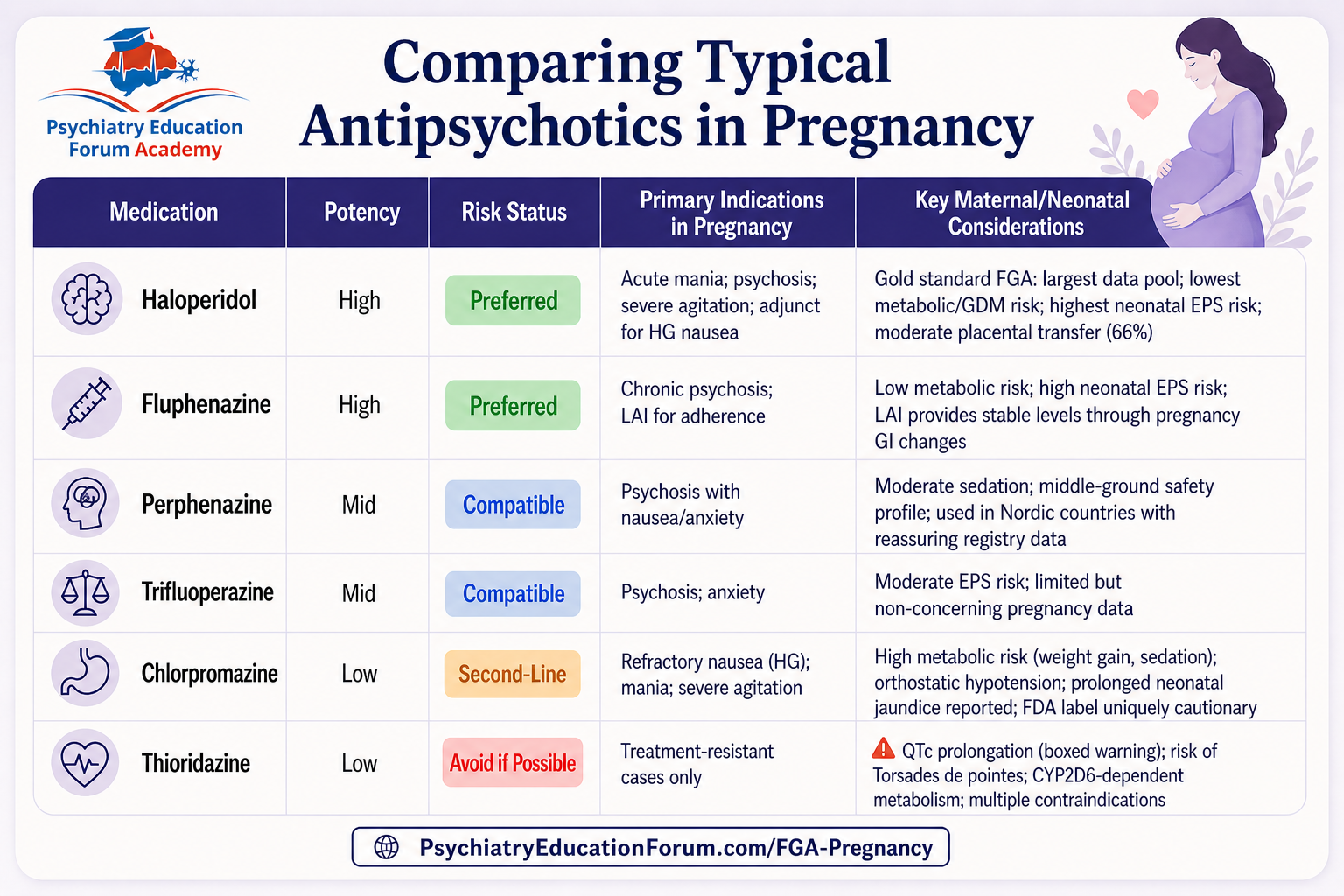
High-Potency FGAs: The Preferred Tier

1. Haloperidol — The Gold Standard

  • Indications: Acute mania, psychosis, severe agitation, hyperemesis-related nausea
  • Why it stands out:
    • Largest reproductive safety database among antipsychotics
    • Lowest risk of weight gain and gestational diabetes
    • Widely used in acute inpatient and emergency settings

Clinical reality:
If you need something fast, effective, and well-studied → Haloperidol is often the safest bet

Trade-off:

  • Higher risk of neonatal extrapyramidal symptoms (EPS)

2. Fluphenazine — The Adherence Solution

  • Indications: Chronic psychosis, non-adherence
  • Unique advantage: Long-acting injectable (LAI)

Why this matters in pregnancy:

  • GI changes in pregnancy → erratic oral absorption
  • LAI provides stable plasma levels
  • Reduces relapse risk from missed doses

Trade-off:

  • Similar to haloperidol → higher neonatal EPS risk

Mid-Potency FGAs: The “Middle Ground”

3. Perphenazine

  • Useful when:
    • Psychosis + nausea/anxiety overlap
  • Moderate sedation → can be beneficial in selected patients

Data note:

  • Used extensively in Nordic registries → reassuring safety signals

4. Trifluoperazine

  • Indications: Psychosis, anxiety
  • Limited pregnancy data—but no major safety signals

Clinical positioning:
👉 Reasonable option when others are not tolerated

Low-Potency FGAs: Use with Caution

5. Chlorpromazine

  • Indications:
    • Severe agitation
    • Refractory hyperemesis gravidarum (HG)

Key concerns:

  • High metabolic burden (weight gain, sedation)
  • Orthostatic hypotension
  • Reports of prolonged neonatal jaundice

Bottom line:
👉 Not first-line—but useful in very specific scenarios

6. Thioridazine — Avoid if Possible

  • Reserved for:
    • Treatment-resistant cases only

Why to avoid:

  • ⚠️ QTc prolongation (boxed warning)
  • Risk of Torsades de pointes
  • Complex CYP2D6 metabolism
  • Multiple contraindications

Clinical stance:
👉 There are almost always better alternatives

Want the Full Clinical Framework?

This post gives you the overview.

But real clinical decision-making requires more than that.

Inside our Pregnancy & Breastfeeding Psychopharmacology: Rapid Decision Guide, every medication is broken down into a standardized, clinic-ready format:

  • Executive summaries (rapid decision support)
  • Teratogenicity and safety data
  • Maternal vs fetal risk stratification
  • Monitoring protocols
  • Comparative tables across medications
  • Patient counseling scripts
  • EMR-ready documentation templates
  • Clinical decision flowcharts

👉 And this FGA chapter is currently available as a FREE preview

🔗 Access below:

Explore the Full Series:

This is part of the Pregnancy & Breastfeeding Psychopharmacology series.

👉 View all upcoming chapters here:

Pregnancy & Breastfeeding Psychopharmacology

ACADEMY

We continue to review and summarize clinically relevant research to support your daily practice.

INTERESTED IN ACCESS TO THIS & OTHER CLINICALLY RELEVANT LECTURE SERIES?

JOIN ACADEMY MEMBERSHIP

MONTHLY PLAN

$ 39 Per Month
  • Flexible Access
  • Monthly Billing
  • Cancel Anytime
  • Start Today

YEARLY PLAN

$ 150 Per Year
  • Best Value
  • Maximum Saving
  • Committed Learners
  • Most Popular
POPULAR

STUDENT PLAN

$ 99 Per Year
  • For Residents
  • For Students
  • Career Growth
  • Affordable Learning

DISCOUNTS AVAILABLE FOR: Residents & Students ONLY.

Email us your student information (program information and way to confirm your student status) to: [email protected]

© 2026 All Rights Reserved.

Related Articles

Responses

Your email address will not be published. Required fields are marked *