
SSRIs in Breastfeeding: A Practical Comparative Guide for Clinicians

Why This Matters?
Managing postpartum depression in breastfeeding patients is not just about choosing an effective antidepressant—it’s about making a risk–benefit decision in real time.
Clinicians are often faced with:
- A symptomatic mother who needs treatment
- A desire to continue breastfeeding
- Uncertainty about medication safety
The good news: SSRIs remain the most studied and safest class in this setting.
The challenge: not all SSRIs are equal.
Key Concept: Relative Infant Dose (RID)
Before comparing agents, remember:
- RID <10% → generally considered compatible with breastfeeding
- Most SSRIs fall well below this threshold
- Infant exposure via breast milk is significantly lower than in utero exposure
This is why SSRIs remain first-line for postpartum depression in breastfeeding patients.
Comparative Lactation Table: SSRI Pharmacokinetics
| SSRI | RID (Approx.) | Peak Milk Level | Infant Serum Levels | Clinical Recommendation |
|---|---|---|---|---|
| Sertraline | 0.5% – 3% | 7–9 hours | Undetectable | Gold Standard. Preferred for new initiations; lowest transfer and most robust data |
| Paroxetine | 1% – 3% | 8–10 hours | Undetectable | First-Line for Lactation. Excellent safety profile; high protein binding limits transfer |
| Escitalopram | 3% – 5% | 4–5 hours | Low / Detectable | Highly Compatible. Safe; newer data supports no long-term developmental impact |
| Citalopram | 3% – 9% | 2–4 hours | Detectable | Compatible. Monitor for irritability or sleep disturbance |
| Fluoxetine | 7% – 12% | 6–8 hours | Highest | Use with Caution. Prefer continuation if stable; monitor due to long half-life |
Start with a Free Preview: Full SSRI Chapter
This blog only scratches the surface.
Inside the full chapter, you’ll get:
- Detailed pharmacokinetics for each SSRI
- Infant monitoring strategies
- Clinical decision frameworks
- High-yield “clinic-ready” counseling points

Clinical Interpretation (What Actually Matters in Practice)
1. Sertraline and Paroxetine = Your Default Choices
If you’re starting a new antidepressant:
- Sertraline → best overall data, minimal infant exposure
- Paroxetine → equally strong option, especially with high protein binding
These are your go-to agents when initiating treatment.
2. “Detectable” Does NOT Mean Unsafe
Escitalopram and citalopram:
- May show low detectable infant serum levels
- Still fall within safe RID range
Clinical takeaway:
👉 Detectable ≠ harmful
👉 Focus on clinical symptoms in the infant, not lab values alone
3. Fluoxetine Is the Outlier
Fluoxetine stands apart because:
- Higher RID
- Active metabolite (norfluoxetine)
- Long half-life → accumulation risk in infants
But here’s the nuance most clinicians miss:
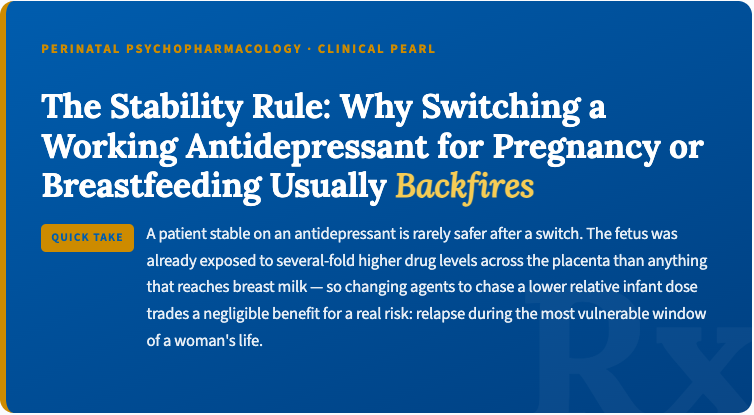
👉 Do NOT reflexively switch if the patient is stable from pregnancy
Switching increases relapse risk during the highest vulnerability period (postpartum).
Want the Full Clinical Framework?
This is just one decision point.
Inside the full Pregnancy & Breastfeeding Psychopharmacology Guide, each breastfeeding chapter is structured in a standardized, clinic-focused format to support rapid decision-making:
- Executive Summary – rapid, high-yield clinical takeaways
- Lactation Safety & Infant Risk – relative infant dose (RID), milk transfer, and infant exposure data
- Infant Monitoring & Adverse Effects – what to watch for in real-world practice
- Pharmacokinetics in Lactation – milk-to-plasma ratios, protein binding, and timing considerations
- Comparative Lactation Table – key data across medications with clear clinical interpretation
- Treatment Positioning – first-line vs. second-line vs. avoid during breastfeeding
- Clinic-Ready Tools – patient counseling scripts and practical decision frameworks
- Clinical Pearls – high-yield insights for real-world decision-making
Goal: Move from uncertainty → confident, evidence-based decisions in minutes, not hours
Explore the Full Series:
This is part of the Pregnancy & Breastfeeding Psychopharmacology series.
👉 View all upcoming chapters here:

Pregnancy & Breastfeeding Psychopharmacology
We continue to review and summarize clinically relevant research to support your daily practice.
INTERESTED IN ACCESS TO THIS & OTHER CLINICALLY RELEVANT LECTURE SERIES?
JOIN ACADEMY MEMBERSHIP
DISCOUNTS AVAILABLE FOR: Residents & Students ONLY.
Email us your student information (program information and way to confirm your student status) to: [email protected]
© 2026 All Rights Reserved.