
Which Antidepressant Is Safest in Severe COPD

Which Antidepressant Is Safest in Severe COPD — and Why Is the Obvious Choice Sometimes the Wrong One?

Your patient has severe COPD and needs an antidepressant. The reflex answer — reach for something sedating and appetite-stimulating to help them sleep and eat — is exactly the choice that can quietly worsen their airway. Here is the short version of how to think about it, and the one trap the "obvious" pick walks straight into.
- Most SSRIs are respiratory-safe and are the reasonable default — the airway is rarely the reason to choose between them.
- The obvious choice is often mirtazapine — and that is the trap. Its sedation and weight gain are precisely the combination that worsens the sleep-apnea that so often rides alongside COPD. You can manufacture an airway problem while trying to treat mood.
- Fluvoxamine is the one SSRI to avoid in anyone on theophylline: it is a potent CYP1A2 inhibitor and drives theophylline toward toxicity.
- Bupropion is tempting because it is non-sedating and doubles as a cessation aid — but that is a smoking-cessation decision with its own interaction, not a free lunch.
- The honest caveat: even the "clean" SSRIs are not perfectly clean in pulmonary populations — the safest move is a respiratory-neutral agent plus attention to the whole sedative picture, not a single named winner.
So what is the safest default?
A respiratory-neutral SSRI — something without meaningful sedation or a CYP1A2 problem — is the reasonable starting point.
The good news for a busy clinician is that most antidepressants do not directly threaten the lung. The choice in COPD is rarely made on respiratory grounds at all; it is made on the things that ride alongside — sedation, weight, and drug interactions. That reframes the question. You are not looking for the one magic pulmonary antidepressant. You are looking for the agent that treats the depression without importing a second problem into a patient who has no respiratory margin to spare.
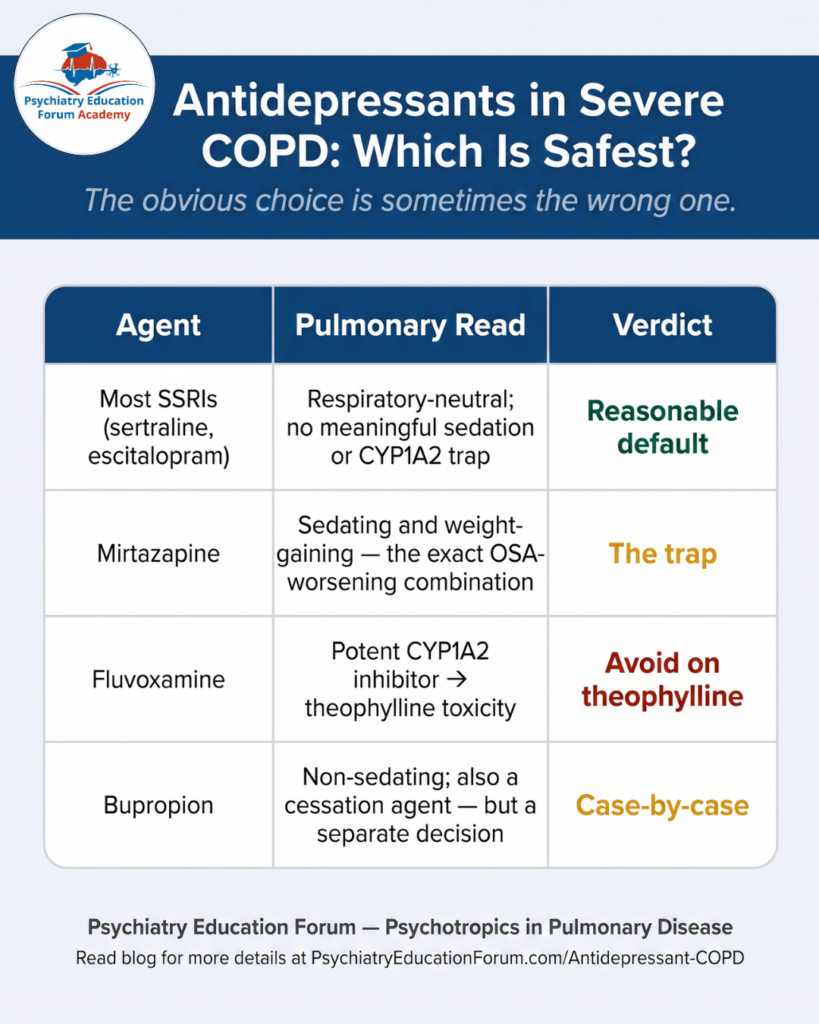
| Agent | Pulmonary read | Verdict |
|---|---|---|
| Most SSRIs (e.g. sertraline, escitalopram) | Respiratory-neutral; no meaningful sedation or CYP1A2 trap | Reasonable default |
| Mirtazapine | Sedating and weight-gaining — the exact OSA-worsening combination | The trap |
| Fluvoxamine | Potent CYP1A2 inhibitor → theophylline toxicity | Avoid on theophylline |
| Bupropion | Non-sedating; also a cessation agent — but a separate decision | Case-by-case |
Why is mirtazapine — the "obvious" COPD pick — sometimes the wrong one?
Because the very features that make it appealing in a frail, breathless, poor-sleeping patient — sedation and appetite — are the two things most likely to worsen the sleep apnea that so commonly coexists with COPD.
It is easy to see the appeal. A patient with advanced lung disease is often underweight, anxious, and sleeping badly, and mirtazapine seems to solve all three at once. But sedation blunts the ventilatory response and adds to the depressant load, and weight gain feeds obstructive sleep apnea — and OSA and COPD together (the "overlap syndrome") carry worse outcomes than either alone. You can end up treating the mood and manufacturing an airway problem in the same prescription. That does not make mirtazapine forbidden; it makes it a drug whose two headline benefits are, in this specific population, also its two headline risks.
Which antidepressant is the outright trap?
Fluvoxamine — in any patient on theophylline — because it is a potent CYP1A2 inhibitor and pushes theophylline toward its narrow toxic threshold.
This is the one genuinely dangerous SSRI in the pulmonary space, and it is dangerous for a purely pharmacokinetic reason rather than a respiratory one. Theophylline is cleared largely by CYP1A2; fluvoxamine is one of the most powerful CYP1A2 inhibitors in the formulary. Put them together and theophylline levels climb toward the tremor, tachycardia, and seizure end of the range. This is the same enzyme lever that runs through the entire course — only here it is being pulled by an antidepressant instead of by cigarettes.
What about bupropion — two birds with one stone?
Tempting, and reasonable in the right patient — but treat it as a smoking-cessation decision with its own interaction profile, not as the default COPD antidepressant.
Bupropion is non-sedating (a genuine advantage over mirtazapine here) and doubles as a cessation aid, which is why it looks like an elegant single answer for the smoking patient with depression. But choosing it commits you to the cessation conversation — and stopping smoking is itself a CYP1A2 event that can move other drugs the patient is taking. That is a decision to make deliberately, with the interactions in view, not a shortcut you reach for because one drug seemed to solve two problems.
Is there a catch with the "safe" SSRIs?
Yes — an honest one. The population data on SSRIs in COPD are not spotless, so "respiratory-neutral" is a reason to feel comfortable, not a reason to stop thinking.
It would be easy to end on "just use an SSRI," and that is roughly the right instinct. But the fuller picture is that observational data in COPD populations have raised questions even about the agents we reflexively call clean — and intellectual honesty means holding that alongside their pharmacologic safety rather than dismissing it because it is inconvenient. The practical upshot does not change: pick a respiratory-neutral agent, mind the whole sedative stack, and reassess. But the reasoning behind the pick is what separates a safe prescriber from a lucky one — and that reasoning is exactly what the full chapter lays out.
The full decision — agent by agent — is in the course.
Chapter 4 of Psychotropics in Pulmonary Disease works through every antidepressant class against the airway, the smoking lever, and the sedative stack — with the dosing cautions, the interaction magnitudes, and the honest caveats laid out for point-of-care use.
Read the Full Chapter →
Psychotropics in Pulmonary Disease — all 14 chapters
Two chapters are free to read. Chapters 3–14 are included with Academy membership.
- The Pulmonary Decision FrameworkFree
- The Smoking–CYP1A2 LeverFree
- Respiratory Depression & CNS-Depressant StackingMembers
- Antidepressants in Pulmonary DiseaseThis chapter
- Antipsychotics Under the Smoking LeverMembers
- Mood Stabilizers in Pulmonary DiseaseMembers
- Anxiolytics & the Dyspnea–Anxiety OverlapMembers
- Pulmonary Drugs That Cause Psychiatric SymptomsMembers
- Obstructive Sleep ApneaMembers
- Smoking-Cessation PharmacotherapyMembers
- COPD & the Hypercapnic CO₂ RetainerMembers
- Psychotropic-Induced Pulmonary ToxicityMembers
- Advanced Disease & Palliative DyspneaMembers
- Rapid-Reference Decision TableMembers
Want every chapter? View Academy membership options →
Educational content only. Dosing and interaction cautions reflect current FDA labeling and primary literature at the time of writing; they support, and do not replace, individual clinical judgment and current prescribing information. Verify against the current label before prescribing.