

The Stability Rule: Why Switching a Working Antidepressant for Pregnancy or Breastfeeding Usually Backfires

Perinatal Psychopharmacology · Clinical Pearl
The Stability Rule: Why Switching a Working Antidepressant for Pregnancy or Breastfeeding Usually Backfires
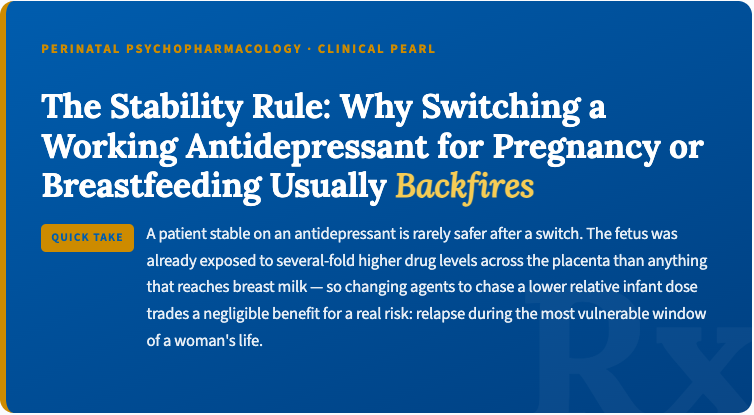
A patient stable on an antidepressant is rarely safer after a switch. The fetus was already exposed to several-fold higher drug levels across the placenta than anything that reaches breast milk — so changing agents to chase a lower relative infant dose trades a negligible benefit for a real risk: relapse during the most vulnerable window of a woman's life.
It's one of the most common scenarios in perinatal care, and one of the most commonly mishandled. A woman who has been well for two years on sertraline learns she's pregnant — or has just delivered and wants to breastfeed — and the instinct, often from more than one member of the care team, is to "switch to something safer for the baby," taper down, or stop altogether.
The intention is good. The reasoning is usually backwards. Across an entire course of antidepressant chapters in pregnancy and breastfeeding, the single principle that does the most clinical work is also the one most often overridden: if a patient is stable, the default is to stay.
Infant exposure through breast milk is typically 5–10 times lower than transplacental exposure during pregnancy. An infant who was carried to term on an antidepressant has, in effect, already "tolerated" that drug at a higher dose than breastfeeding will ever deliver. Switching postpartum to lower the relative infant dose optimizes the smaller of the two exposures — while introducing a brand-new variable at the worst possible time.
What a Switch Actually Costs
The downside of an unnecessary switch is rarely a single event — it's a stack of compounding risks that a stable regimen simply doesn't carry:
| The hidden cost | Why it matters in the perinatal window |
|---|---|
| Efficacy lag | A new antidepressant takes 4–6 weeks to reach full effect — weeks of unprotected time during the highest-risk period for relapse. |
| No guarantee it works | The new agent may not match the response the patient already had. You're trading a known responder for an unknown one. |
| Discontinuation effects | Tapering the old agent can trigger withdrawal/discontinuation symptoms that mimic or precipitate relapse and confuse the picture. |
| Relapse itself is a fetal/infant exposure | Untreated perinatal depression carries its own risks — to maternal safety, attachment, infant development, and feeding — that a stable medication was preventing. |
| Marginal benefit gained | Often a difference of a few percentage points of relative infant dose, virtually all of it well under the 10% compatibility threshold. |
Put plainly: the thing being optimized (a slightly lower milk level) is small and already safe; the thing being risked (relapse) is large and consequential. That is the arithmetic that makes the reflexive switch backfire.

Why This Matters at the Bedside
Four reasons this principle deserves to be a reflex rather than an afterthought:
- It reframes the whole conversation. The right question isn't "which antidepressant has the lowest relative infant dose?" but "is this patient already stable on something?" Stability is the first filter; the low-transfer hierarchy is only for genuinely new starts.
- It aligns with guideline consensus. Major bodies converge on the same advice: if a woman was successfully treated during pregnancy, the same medication should generally be continued postpartum while breastfeeding, because discontinuing or switching risks relapse.
- It protects the most vulnerable window. The postpartum period is the single highest-risk interval for depressive relapse and for new severe episodes. A working antidepressant is doing its most important job precisely when a switch is most dangerous.
- It is reassuring to the patient. Most mothers worry their medication is harming their baby. The honest, evidence-based message — very little reaches the milk, the data are reassuring, and staying the course is the safer plan — relieves real anxiety and improves adherence.
The Three Exceptions That Prove the Rule
"Stay the course" is the default, not an absolute. Exactly three antidepressants break it — and notably, they are the same three whose FDA labels carry directive "breastfeeding is not recommended" language, for reasons a low milk level does not neutralize:
| Agent | Why it's an exception | The move instead |
|---|---|---|
| Doxepin (TCA) | Active metabolite (nordoxepin) has been detected at near-adult-therapeutic levels in infant plasma in a classic case report — with reports of sedation, respiratory depression, poor feeding, and hypotonia. | Switch to nortriptyline (same class, safer) or sertraline. |
| Esketamine (Spravato) | NMDA-antagonist developmental-neurotoxicity signal in juvenile animals; FDA advises against breastfeeding. | Use breastfeeding-compatible options first — ECT, SSRI + therapy, or zuranolone (US label is non-directive with RID <1%, but PPD trials excluded breastfeeding, so ACOG endorses a shared-decision-making approach). |
| Auvelity (dextromethorphan–bupropion) | Same NMDA-antagonist concern as esketamine; label advises against breastfeeding during and for 5 days after. | As above — reserve for when breastfeeding can be set aside. |
The Stability Rule is about continuity of a working agent — not a reason to start one of the three directive-against drugs in a breastfeeding mother, and not a license to ignore genuine maternal safety concerns (e.g., overdose risk with TCAs). For these three agents, "stable from pregnancy" triggers a planned switch before delivery, ideally, rather than a hold.
In Practice: A 30-Second Decision Path
- Ask first: Is she stable on an antidepressant from pregnancy?
- If yes → continue it, unless it's doxepin, esketamine, or Auvelity → then plan a switch to a compatible agent.
- If no (new start) → default to sertraline; for breastfeeding-only new starts, paroxetine is an equivalent first choice; in pregnancy, prefer sertraline or escitalopram and avoid initiating paroxetine because of its first-trimester cardiac-malformation signal. Then let any comorbidity (pain → duloxetine; insomnia/appetite → mirtazapine; energy → bupropion — keeping in mind rare postmarketing reports of infant seizures, so prefer alternatives when there's a comparable option) refine the pick.
- Either way → counsel with the four pillars: the 10% rule, feed-and-dose timing, the reassuring cognitive-outcome data, and the infant "Big 3" (sedation · irritability · feeding change).
Want the Full Clinical Framework?
This post gives you the overview. But real clinical decision-making requires more than that. Inside our Perinatal Psychopharmacology: Rapid Decision Guide, each Antidepressant Pregnancy & Breastfeeding Chapter is structured for rapid clinical decision-making:
Each Antidepressant Chapter Is Structured for Rapid Clinical Decision-Making
- 60-Second Brief — the whole chapter for the time-pressed clinician
- Executive summary with the agent's defining lactation/pregnancy issue
- Relative infant dose, protein binding, and metabolite behavior, fact-checked against FDA labels
- The stay-or-switch (Stability Rule) decision for that specific agent
- Clinical pearls drawn from primary sources and guideline consensus
- Comparison tables ranking agents by transfer and data quality
- Maternal safety considerations (overdose, cardiac, anticholinergic, QT)
- Infant monitoring guidance and the age thresholds that change it
- Ready-to-use patient scripts for the hardest conversations
- EMR-ready documentation templates
Goal: Move from uncertainty → confident, evidence-based decisions in minutes, not hours.
Full Clinical Guide
Antidepressants in Pregnancy & Breastfeeding — 24 chapters + selection frameworks →
Explore the Full Series
This is part of the Pregnancy & Breastfeeding Psychopharmacology series.

Lecture Series
See what's published and what's coming next →
We continue to review and summarize clinically relevant research to support your daily practice.
Interested in Access to This & Other Clinically Relevant Lecture Series?
Join Psychiatry Education Forum
Academy Membership

Discounts available for Residents & Students only. Email us your student information to our support team.
This post is for educational purposes for qualified healthcare professionals and does not replace clinical judgment, current guidelines, or individualized assessment. Infant-exposure comparisons and the 10% relative-infant-dose threshold apply to healthy, full-term infants; premature or medically ill infants and certain agents warrant added caution. Relative infant dose is a screening tool and does not capture metabolite accumulation or developmental concerns. The stay-or-switch decision, maternal safety assessment, and infant monitoring should be individualized, and all dosing and label information verified against current primary sources.



Responses