

What actually works for antidepressant sexual dysfunction — and what only works in open-label trials.

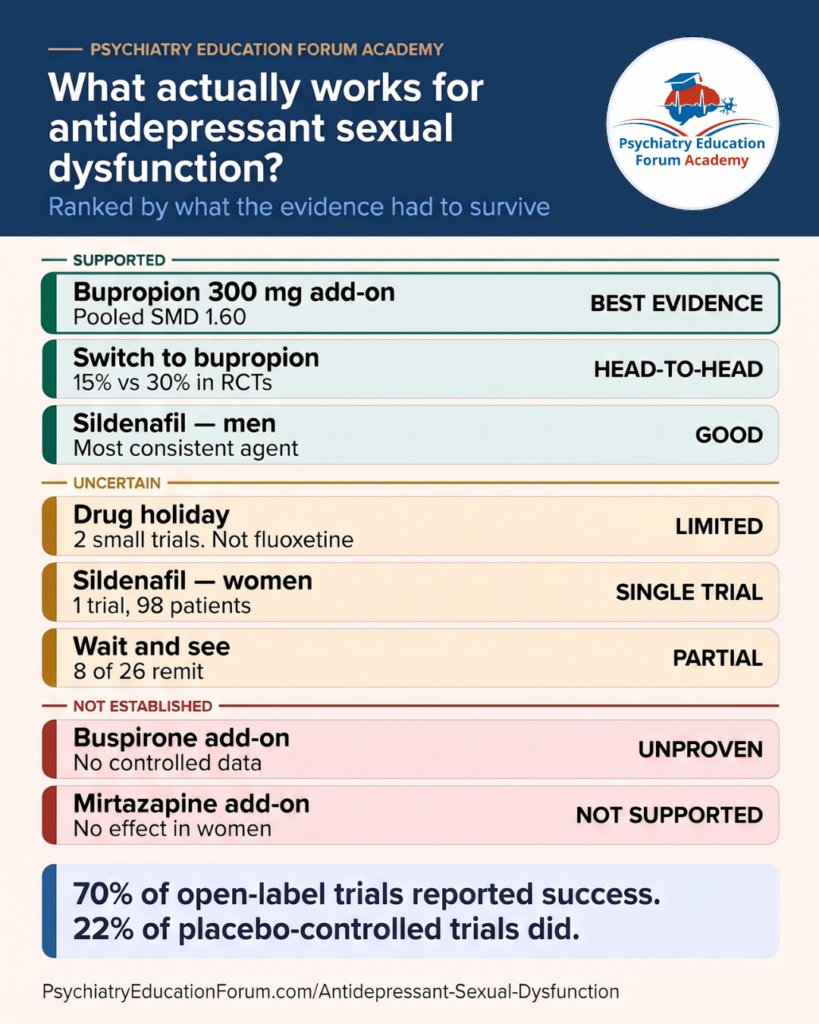
What actually works for antidepressant sexual dysfunction?
And why open-label trials of these treatments report success three times as often as placebo-controlled ones.
Your patient is four months into sertraline and doing well. At the end of the visit, hand on the door, he mentions that orgasm now takes half an hour or does not happen at all.
The reflex is to switch him to something else. Switching is the least evidenced thing on the list, and there is no trial in which it was tested for this indication. What follows is what has actually been tried, ranked by how hard the evidence had to work.
The 30-second version
- Bupropion augmentation is the best-supported option, and 300 mg a day is the dose to aim for — but that threshold is inferred across separate trials, and one twice-daily trial still missed its primary endpoint.
- Switching is the most common response and the least tested. No trial has ever used sexual dysfunction as the switch indication.
- Bupropion is the one agent whose sexually sparing reputation survives a head-to-head randomised comparison: 15% against escitalopram's 30% and placebo's 9%.
- Sildenafil is solid in men. In women it rests on a single positive trial of 98 patients.
- Waiting works for about a third — and roughly a sixth are still severely affected at six months, with the worst-affected least likely to improve.
- Mirtazapine augmentation is negative. Buspirone has no controlled data at all, despite appearing on every list.
- Across this whole literature, 70% of open-label trials reported success against 22% of placebo-controlled ones.
- And none of it matters if you do not ask. Spontaneous reporting in the fluoxetine registration trials found 4%; a structured interview in 1,022 outpatients found 59%.
Are you finding it in the first place?
And asking is only half of it. The instruments the entire quantitative literature rests on — ASEX, CSFQ and PRSexDQ — were built around the desire, arousal and orgasm cycle. Three of the complaints patients actually describe are not in any of them.
| Ask about | Captured by the standard instruments? |
|---|---|
| Desire | Yes |
| Erection or lubrication | Yes — though ASEX folds both sexes into a single arousal item |
| Time to orgasm | Yes. This is the domain that separates most clearly from placebo |
| Pleasure at orgasm | No — the instruments measure whether orgasm happens, not whether it felt like anything |
| Genital sensation | No — and it is the defining symptom of persistent post-treatment dysfunction |
| Nipple or skin sensitivity | No — absent from all three instruments |
The three the instruments miss are the three that most distinguish persistent dysfunction from ordinary treatment-emergent dysfunction. A patient describing genital numbness is describing something the literature has no denominator for — which is a reason to ask about it by name, not a reason to doubt it.
What has actually been tested?
The Cochrane review of strategies for antidepressant-induced sexual dysfunction enumerates watchful waiting, behaviour change, dose reduction, delayed dosing, switching, drug holidays, and adjuvant bupropion, buspirone or a PDE5 inhibitor — and notes that most of them have never been tested in a trial. Sorting them by what has been is the useful exercise.
| Strategy | What the evidence actually is | Verdict |
|---|---|---|
| Bupropion augmentation 300 mg/day | Cochrane pooled standardised mean difference 1.60 (95% CI 1.40–1.81) across three trials, 482 patients. But I² is 86% and the pooled figure mixes doses | Best supported |
| Switch to bupropion | Two identically designed randomised trials: orgasm dysfunction 15% on bupropion against 30% on escitalopram and 9% on placebo at week 8. Bupropion did not differ from placebo (p = 0.067 pooled) | The only sparing agent with head-to-head data |
| Sildenafil — men | The most consistently positive agent across a network meta-analysis of 33 interventions | Good |
| Drug holiday | Two small trials. A Thursday-to-Sunday holiday improved orgasm and satisfaction on sertraline and paroxetine — but not fluoxetine | Small, and agent-specific |
| Sildenafil — women | One randomised trial, 98 women. Clinical global impression endpoint difference 0.8 (0.6–1.0), p = 0.001, against a wider literature that rates PDE5 evidence in women as limited | Single positive trial |
| Dose reduction | First-line by rationale. Limited randomised data, and it carries relapse risk, so only after remission and continuation are complete | Weak, but low cost |
| Watchful waiting | Of 26 patients who developed clinically relevant orgasm delay, 8 remitted fully by six months and 4 improved markedly — but 4 were still severely affected | Partial — see below |
| Switch to vortioxetine or agomelatine | Placebo-controlled monotherapy and cross-trial data. No head-to-head superiority trial | Weaker designs |
| Buspirone augmentation | Listed as a proposed adjuvant. No controlled efficacy data attached to it | Proposed, not demonstrated |
| Mirtazapine augmentation | A placebo-controlled study found no efficacy in women. Yohimbine was also negative. The network meta-analysis signal did not reach significance | Negative |
Why does bupropion work in some trials and not others?
Four data points, and they do not line up as neatly as the usual summary suggests.
| Trial | Dose | Patients | Instrument | Result |
|---|---|---|---|---|
| DeBattista 2005 | 150 mg once daily | 41 | ASEX | No benefit |
| Clayton 2004 | 150 mg twice daily | 42 | CSFQ | Missed its primary endpoint. Global function no different from placebo; only desire and frequency improved |
| Safarinejad | 150 mg twice daily | 218 women | FSFI | Positive |
| Cochrane pooled | Both doses mixed | 482 across 3 trials | — | SMD 1.60 (1.40–1.81), but I² = 86% |
So once-daily failed — but one twice-daily trial failed its primary endpoint too, and it is the modest trend that drives the heterogeneity in the pooled estimate. A meta-analysis of 859 women found the twice-daily regimen improved desire, arousal and orgasm, at low GRADE quality.
So 300 mg a day is the reasonable target. But be clear with yourself about what that inference is: it comes from comparing separate trials, not from a dose-ranging study. No dose-ranging randomised trial and no dose meta-regression exists. The Cochrane pooled figure of 1.60 itself mixes both doses across three trials, with heterogeneity of 86% driven by two large effect sizes against one modest trend.
Reaching for 300 mg is defensible. Telling a patient that 300 mg is the proven threshold is not.
Should you switch the antidepressant?
That said, if you are going to switch, one target is better supported than the rest — not by switching trials, but by head-to-head comparison. Two identically designed eight-week double-blind trials randomised patients with normal baseline sexual function to bupropion XL, escitalopram or placebo.
A second randomised trial of 360 patients found significantly more orgasmic dysfunction on sertraline than on either bupropion or placebo. And a placebo-controlled imaging study in 18 healthy men found paroxetine both increased subjective dysfunction and blunted reward-region response, while bupropion did not.
Worth knowing before you quote those trials: both were funded by bupropion's manufacturer. That does not undo them. What randomisation buys here is not independence from sponsorship — it is protection against the specific bias that makes observational comparisons of these drugs unreadable, because bupropion is preferentially prescribed to patients who already have sexual problems.
Does sildenafil work in women?
| Men | Women | |
|---|---|---|
| Evidence base | Most consistently positive agent across a network meta-analysis of 33 interventions | One randomised trial, 98 patients |
| Effect | Consistent across trials | CGI sexual-function 1.9 (1.6–2.3) vs 1.1 (0.8–1.5); endpoint difference 0.8 (0.6–1.0), p = 0.001 |
| Wider literature | Supportive | Rates PDE5 evidence in women as limited |
| Verdict | Good | Single positive trial |
It is also one trial. Broader reviews of female sexual dysfunction rate PDE5 inhibitor evidence in women as limited, and practice in this area is largely extrapolated from men. Offering it is reasonable. Presenting it as established is not.
Will it settle on its own?
The usual reassurance is that these effects settle with time. The study behind that claim followed 108 patients started on SSRIs, of whom 26 developed clinically relevant orgasm delay. Here is where those 26 were at six months.
| At six months | Patients | Share of the 26 |
|---|---|---|
| Complete remission | 8 | 30.8% |
| Marked improvement | 4 | 15.4% |
| Still severely affected | 4 | 15.4% |
| Not separately reported | 10 | 38.5% |
High baseline severity significantly predicted failure to remit. Note the bottom row: the report characterises 16 of the 26, so the commonly quoted "about a third get better" rests on a study that does not account for the rest.
So the honest version is not that it settles. It is that it settles fully for about a third, partly for another sixth, and not at all for a sixth — and the patients whose symptoms are worst at the outset are the ones least likely to be in the first group. That last clause is the part the standard reassurance leaves out, and it is the part that changes what you tell the person in front of you.
Why does so much of this look better than it is?
A network meta-analysis pulled together 57 citations covering 27 randomised trials, 27 open-label trials and 3 crossover studies — 66 treatment arms, 33 interventions, 3,108 patients.
Note what that is and is not. It counts two different sets of trials across all 33 interventions; it does not track the same treatments from one design into the other, so it does not give you a conversion rate for any particular drug. What it does give you is a calibration: in this field, open-label results should be read as provisional until a placebo arm has had a go at them.
The honest caveat
None of the numbers above come from large trials. The best-supported option in the table rests on three studies totalling 482 patients with 86% heterogeneity. Two entries rest on a single trial each. And the whole literature under-measures women — administrative datasets record sexual dysfunction in women more than thirty-fold less often than in men, which the researchers attribute to how the question gets asked rather than to any real difference.
This is a field where the treatments are plausible, the mechanisms are sensible, and the trials are small. Act on it, but do not oversell it.
So what do you actually do?
- Ask, with the symptoms named. In the fluoxetine registration trials, where patients had to volunteer it, decreased libido was reported by 4%. A structured interview using a validated questionnaire, in 1,022 outpatients with previously normal function, found 59%. Name the domains out loud — desire, erection or lubrication, time to orgasm, pleasure at orgasm, and genital sensation. The last two are not captured by any standard instrument and patients almost never volunteer them.
- Work out whether it is the drug. Delayed orgasm separates clearly from placebo in randomised data. Reduced desire does not — in trials it is not cleanly distinguishable from the depression itself.
- Exclude the rest. Testosterone and prolactin if indicated, thyroid, glycaemic status, alcohol, co-prescribed antipsychotics — and a cardiovascular assessment in a man with new erectile dysfunction, which is the item most likely to matter to his life expectancy.
- Reduce the dose if the depression is fully remitted and the continuation phase is complete. Lowest-cost move, reversible, and it carries relapse risk, which is why the sequence matters.
- Augment before switching if the antidepressant is working. Bupropion at 300 mg a day; sildenafil in men.
- If you switch, switch to bupropion — and say that you are acting on head-to-head comparison rather than on a switching trial, because no switching trial for this indication exists.
- Do not promise that stopping fixes it. Ordinary treatment-emergent dysfunction is expected to improve after stopping, but no controlled study gives a percentage resolved by any timepoint, and a small minority report symptoms that persist.
Sexual Dysfunction & PSSD
This post covers the treatments. The chapter covers everything that comes before that decision — the seven complaints patients describe and the three that no validated instrument measures, why the reported incidence runs from 4% to 59% in the same class of drug, what separates a drug effect from the depression, and PSSD set out in full: what the evidence actually consists of, what three regulators have done about it, and how to answer a frightened patient honestly.
Plus the differential, special populations, a nine-step action ladder, a counselling script and a copy-paste EMR note.
Read the full chapter →The complete series
Thirty-one point-of-care chapters across seven parts, publishing through September. Every chapter opens with the bottom line, works the differential, and closes with an action ladder, a counselling script, and a copy-paste EMR note.
- 1Serotonin SyndromeMembers
- 2Activation Syndrome & Treatment-Emergent SuicidalityMembers
- 3Antidepressant-Induced AkathisiaMembers
- 4Treatment-Emergent Mania & the Bipolar SwitchFree
- 5Tremor & MyoclonusMembers
- 6Bruxism & Jaw ClenchingMembers
- 7Dystonia, Parkinsonism & Tardive DyskinesiaMembers
- 8Nausea, Dyspepsia, Diarrhea & Dry MouthMembers
- 9Insomnia, Vivid Dreams & REM Sleep EffectsMembers
- 10Sedation & Daytime SomnolenceMembers
- 11Emotional Blunting, Apathy & Cognitive EffectsFree
- 12Weight Gain & Appetite ChangeMembers
- 13Sexual Dysfunction & PSSDMembers
- 14Falls, Fractures & Bone HealthMembers
- 15QTc Prolongation, Tachycardia & Cardiac ConductionMembers
- 16SNRI-Associated HypertensionMembers
- 17Orthostatic Hypotension & DizzinessMembers
- 18Antidepressant-Induced Excessive SweatingMembers
- 19Urinary Retention & IncontinenceMembers
- 20Bleeding Risk: GI, Perioperative & AnticoagulantMembers
- 21Hyponatremia & SIADHMembers
- 22Transaminitis & Drug-Induced Liver InjuryMembers
- 23Discontinuation Syndrome & Hyperbolic TaperingMembers
- 24Switching & Cross-Taper SafetyMembers
- 25The Bupropion Set: Seizure Risk & Lowered Seizure ThresholdMembers
- 26The Mirtazapine Set: Sedation, Appetite & Rare NeutropeniaMembers
- 27The Serotonin Modulator Set: Trazodone, Vilazodone & VortioxetineMembers
- 28The TCA Set: Anticholinergic Burden, Conduction Delay & Overdose LethalityMembers
- 29The MAOI Set: Hypertensive Crisis, Tyramine & Washout WindowsMembers
- 30Rare but Serious: Angle-Closure Glaucoma, SJS/TEN, Blood DyscrasiasMembers
- 31Quick-Reference Matrix: Antidepressant Adverse Event GridMembers
Join the Academy
One membership covers this series and the entire Academy library — psychopharmacology lessons, case discussions and clinical pearls, with new content added monthly.
- All 31 chapters of Managing Antidepressant Adverse Events, complete by 30 September
- The finished Managing Antipsychotic Adverse Events series — 21 chapters
- Counselling scripts and copy-paste EMR notes in every chapter
- Every future rapid-decision course at no additional cost
Selected references
- Taylor MJ, Rudkin L, Bullemor-Day P, et al. Strategies for managing sexual dysfunction induced by antidepressant medication. Cochrane Database Syst Rev. 2013.
- Clayton AH, Croft HA, Horrigan JP, et al. Bupropion extended release compared with escitalopram: effects on sexual functioning and antidepressant efficacy in 2 randomized, double-blind, placebo-controlled studies. J Clin Psychiatry. 2006.
- Croft H, Settle E, Houser T, et al. A placebo-controlled comparison of the antidepressant efficacy and effects on sexual functioning of sustained-release bupropion and sertraline. Clin Ther. 1999.
- DeBattista C, Solvason B, Poirier J, Kendrick E, Loraas E. A placebo-controlled, randomized, double-blind study of adjunctive bupropion sustained release in the treatment of SSRI-induced sexual dysfunction. J Clin Psychiatry. 2005.
- de Aquino ACQ, Sarmento ACA, Teixeira RLA, et al. Pharmacological treatment of antidepressant-induced sexual dysfunction in women: a systematic review and meta-analysis of randomized clinical trials. Clinics. 2024.
- Luft MJ, Dobson ET, Levine A, Croarkin PE, Strawn JR. Pharmacologic interventions for antidepressant-induced sexual dysfunction: a systematic review and network meta-analysis of trials using the Arizona Sexual Experience Scale. CNS Spectr. 2021.
- Nurnberg HG, Hensley PL, Heiman JR, et al. Sildenafil treatment of women with antidepressant-associated sexual dysfunction: a randomized controlled trial. JAMA. 2008.
- Rothschild AJ. Selective serotonin reuptake inhibitor-induced sexual dysfunction: efficacy of a drug holiday. Am J Psychiatry. 1995.
- Alipour-Kivi A, Eissazade N, Shariat SV, et al. The effect of drug holidays on sexual dysfunction in men treated with selective serotonin reuptake inhibitors other than fluoxetine: an 8-week open-label randomized clinical trial. BMC Psychiatry. 2024.
- Haberfellner EM, Rittmannsberger H. Spontaneous remission of SSRI-induced orgasm delay. Pharmacopsychiatry. 2004;37:127–30.
- Montejo AL, Llorca G, Izquierdo JA, Rico-Villademoros F. Incidence of sexual dysfunction associated with antidepressant agents: a prospective multicenter study of 1022 outpatients. J Clin Psychiatry. 2001.
- Dagostin Ferraz S, Kuyunga L, Rech P, et al. Sexual dysfunction associated with selective serotonin reuptake inhibitors in adults with depression: a systematic review and meta-analysis. Eur J Clin Pharmacol. 2026.
- Isung J, Karlsson P, Tankaya O, et al. Patterns and treatment of sexual dysfunction in major depressive disorder: a cohort and case-control study in Sweden. J Affect Disord. 2026.
The full chapter carries the complete reference list.



Responses