
Centanafadine Approved for ADHD: What Prescribers Need to Know


Point-of-care reference · Psychopharmacology
The FDA has approved Simtriyo (centanafadine) extended-release capsules for ADHD in adults and pediatric patients 6 years of age and older weighing at least 20 kg. It is the first norepinephrine–dopamine–serotonin reuptake inhibitor (NDSRI) approved for ADHD.
Four things the early coverage is getting wrong
A rapid myth-versus-label reality check
Mechanism
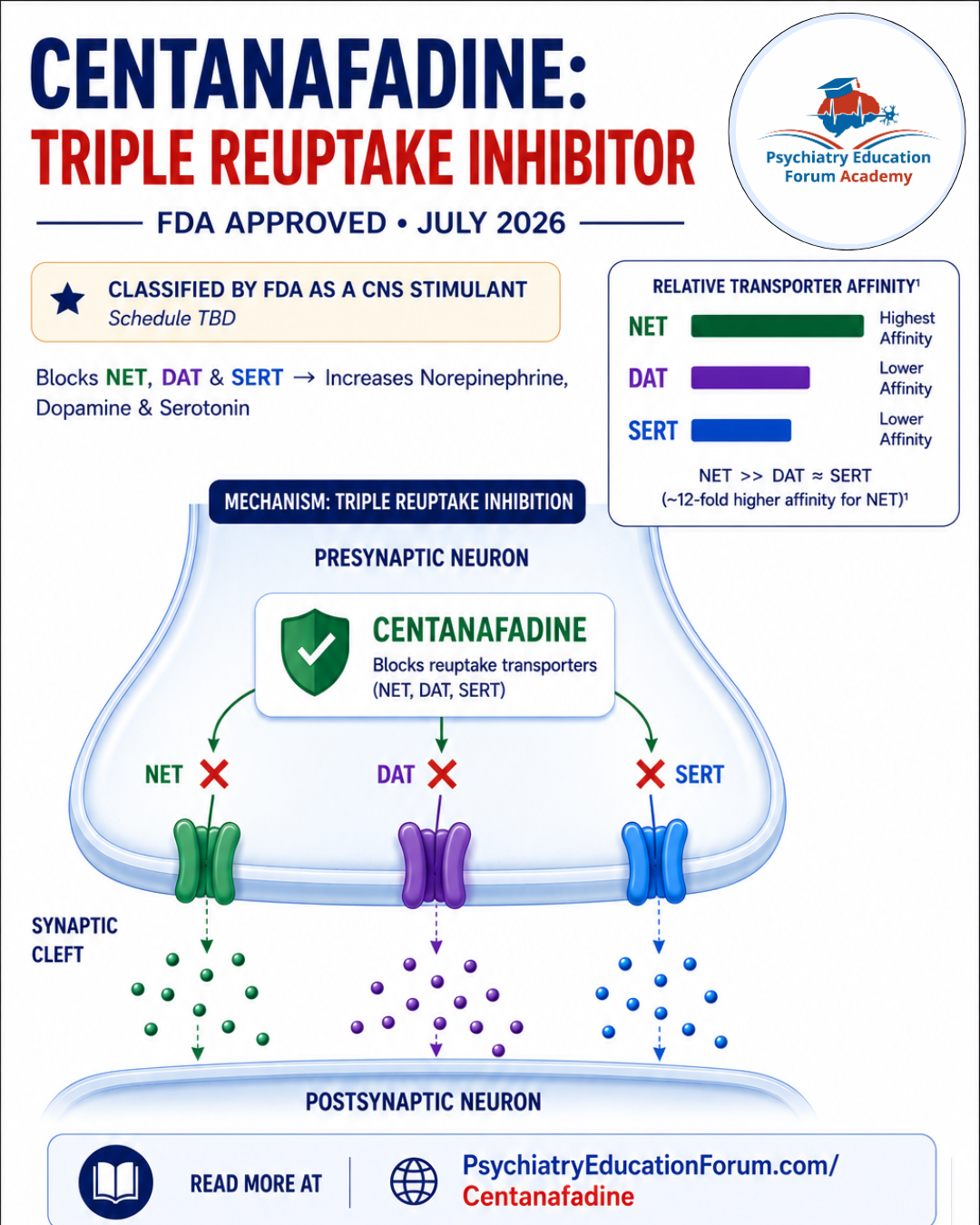
The label groups all three transporters together, but the pharmacology does not.
| Transporter | In vitro IC50 | In vivo affinity ratio vs NET |
|---|---|---|
| NET (norepinephrine) | 6 nM | reference |
| DAT (dopamine) | 38 nM | NET/DAT 11.9 ± 6.0 |
| SERT (serotonin) | 83 nM | NET/SERT 13.3 ± 7.0 |
| DAT and SERT are essentially equipotent to each other (1.1 ± 0.2). High NET occupancy and only moderate DAT and SERT occupancy were seen at peak concentrations after 400 mg/day. IC50 values are preclinical in vitro figures3; ratios and occupancy are from the phase 1 PET study2. | ||
So this is a NET-preferring agent with meaningful secondary dopamine and serotonin engagement, not a balanced triple blocker. That single fact reconciles two things that otherwise look contradictory: efficacy in the atomoxetine range, and an abuse signal that behaved like a stimulant's. The norepinephrine dominance explains the first; the residual dopamine engagement explains the second.
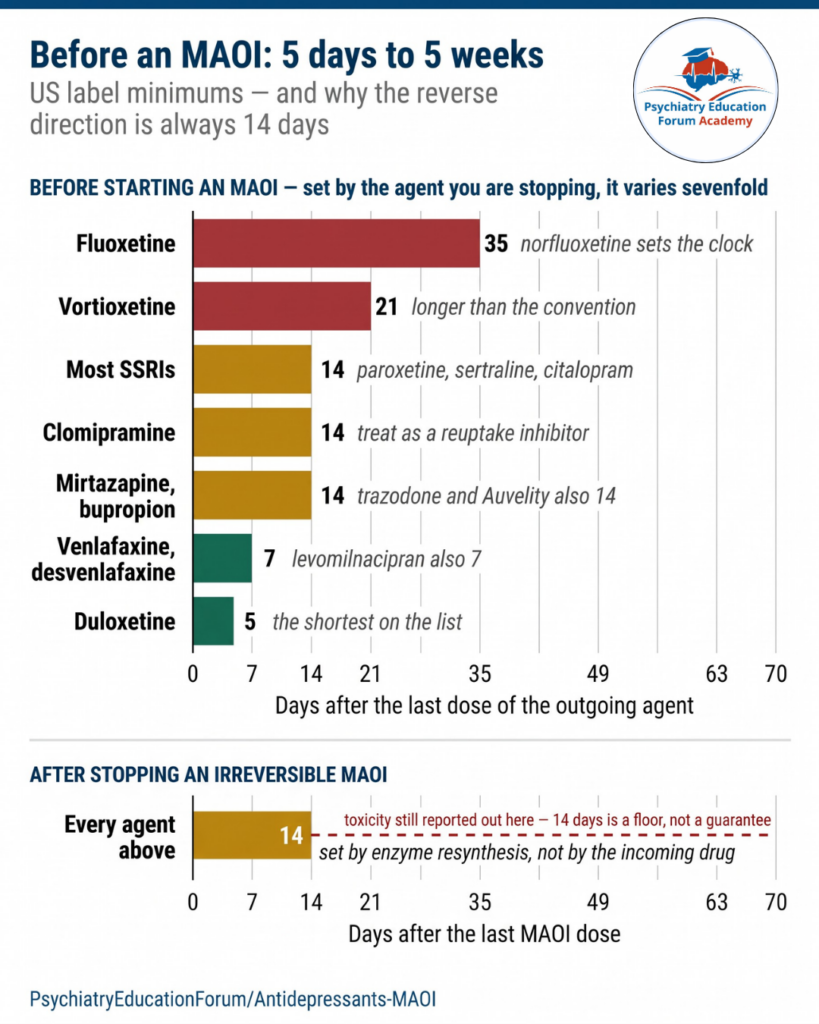
Centanafadine is primarily metabolized by monoamine oxidase A. That is why the MAOI contraindication and 14-day washout are absolute rather than precautionary — you are blocking the drug's primary clearance pathway while simultaneously stacking monoamine load.
| Pharmacokinetic parameter | Value |
|---|---|
| Primary metabolic pathway | Monoamine oxidase A |
| Half-life | 5.2 hours |
| Tmax | 5 hours |
| Steady state | Day 2 (accumulation 1.2–1.3×) |
| Plasma protein binding | Unbound fraction <0.01 |
| Excretion | 88% urine as metabolites, 7% feces |
Indication and limitations of use
| Element | Label |
|---|---|
| Indication | ADHD in adults and pediatric patients 6 years of age and older weighing at least 20 kg |
| Not recommended: age | Under 6 years — higher incidence of weight loss than patients 6 and older |
| Not recommended: weight | Under 20 kg — lack of data and risk of weight loss |
| Formulation | Extended-release capsule combining immediate-release, extended-release, and delayed-release beads |
| Availability | Controlled substance schedule to be determined by the DEA; the label's Initial U.S. Approval field is blank pending scheduling |
Study 1 enrolled children from age 4, but efficacy is reported only for ages 6 and up. The growth signal in the youngest cohort is why the floor exists.
| Signal at week 6 | Ages 4 to <6 | Placebo |
|---|---|---|
| Weight z-score fell by ≥0.5 | 8.5% | 0% |
| BMI z-score fell by ≥0.5 | 25.5% | 4.2% |
| Heart rate fell ≥10% to below the 1st percentile for age | Higher proportion than in patients 6 and older | |
Two boxed warnings
In a 6-week study, higher rates of suicidal ideation and behavior were reported in treated patients aged 6 to 12 than in placebo. Monitor all pediatric patients closely for suicidal ideation and behaviors, clinical worsening, or unusual behavior change, especially during the initial months. Advise families of the need for close observation. Consider stopping Simtriyo in patients with emergent suicidal ideation or behavior.
| Signal | Simtriyo | Placebo |
|---|---|---|
| Suicide attempt, Study 1 (ages 6–12, 6 weeks) | 0.7% (2/304) | 0% (0/153) |
| Suicidal ideation, long-term open-label (ages 6–17) | 0.8% (5/620); led to discontinuation in 0.6% | — |
Atomoxetine and viloxazine both carry pediatric suicidality boxed warnings. Centanafadine is the third noradrenergically active ADHD agent to do so. If you already run a monitoring workflow for Qelbree or Strattera, reuse it.
Simtriyo has a potential for abuse and misuse. Abuse of CNS stimulants can lead to substance use disorder including addiction; misuse and abuse can result in overdose and death, and the risk rises with higher dosage or unapproved routes such as snorting or injection. Assess each patient's risk before prescribing. Educate patients and families about risks, storage, and disposal. Advise storing in a safe place, preferably locked. Reassess risk and monitor for signs of abuse throughout treatment.
The label reports two human abuse-potential studies in people with a history of recreational stimulant use.
| Abuse-potential study | Dose (immediate-release) | Drug Liking VAS | Mood reaction |
|---|---|---|---|
| Study 1 | 400 mg and 800 mg | Greater than placebo; not statistically significantly less than amphetamine 40 mg. 800 mg also not significantly less than lisdexamfetamine 150 mg | Elevated mood 9–12% (amphetamine 7%, lisdexamfetamine 12%) |
| Study 2 | 200, 400 and 800 mg | Greater than placebo but less than amphetamine 15 mg and 30 mg | Euphoric mood 17–30% (amphetamine 19–35%) |
The label's conclusion: these data demonstrate that centanafadine has abuse potential. Otsuka's pre-approval materials described "low potential for abuse and dependence." Read the label, not the press release.
In the two adult Phase 3 studies, abrupt discontinuation after chronic administration produced a very low degree of withdrawal symptoms, indistinguishable from placebo. The label states directly that even though Simtriyo is a CNS stimulant, it does not produce physical dependence. So: real abuse liability, minimal withdrawal. Counsel accordingly — patients do not need a taper, but they do need a locked cabinet.
Dosing and administration
Required screening before you write the first prescription
Section 2.1 makes five assessments a labeled step, not a courtesy:
- Risk of abuse, misuse, and addiction
- Presence of cardiac disease — history, family history of sudden death or ventricular arrhythmia, physical exam
- Heart rate and blood pressure
- Risk factors for a manic episode — history of depressive symptoms, family history of suicide, bipolar disorder, or depression
- Family history of tics or Tourette's syndrome, plus clinical evaluation for motor or verbal tics
Recommended dosage
| Population | Dosage |
|---|---|
| Children 6–12 years (≥20 kg) | Weight-based, once daily: • 20 to <35 kg → 140 mg • 35 to 50 kg → 210 mg • >50 kg → 280 mg |
| Adolescents 13–17 years (≥20 kg) | 280 mg once daily. No titration. |
| Adults | Start 210 mg once daily; may increase to a maximum of 280 mg once daily based on response and tolerability |
Trap 1 — the same number means different things at different ages. The pediatric weight bands are all equivalents of the 280 mg adult dose. So 140 mg in a 25-kg eight-year-old is the effective, approved dose. But 140 mg in a 15-year-old is the dose that failed its primary endpoint and is not an approved regimen.
Trap 2 — 210 mg has never been studied in anyone under 18. The label states 210 mg once daily and its weight-based equivalents have not been studied in patients aged 6 to 17 and are not recommended. It exists as an adult starting dose only.
Capsule identification and the salt-versus-base problem
| Label strength (centanafadine base) | Equivalent HCl (as reported in trial papers) | Capsule | Imprint |
|---|---|---|---|
| 140 mg | 164.4 mg | light orange cap / white body | C140 / Otsuka |
| 210 mg | 246.6 mg | yellow cap / white body | C210 / Otsuka |
| 280 mg | 328.8 mg | powder blue cap / white body | C280 / Otsuka |
Three different numbering systems are in circulation for this drug. You prescribe in one of them; the literature uses the other two.
| Where you see it | Numbers used | What they are |
|---|---|---|
| The label and your prescription | 140, 210, 280 mg | Centanafadine base, in the extended-release capsule |
| Pediatric trials (Studies 1 and 2) | 164.4, 246.6, 328.8 mg | The hydrochloride salt equivalents of those same three capsules67 |
| Adult trials (Studies 3 and 4) | 200 and 400 mg total daily dose, divided twice daily | A different sustained-release tablet. These figures map onto neither scale above5 |
So a journal club discussing "the 328.8 mg arm" is discussing the 280 mg capsule — but a paper describing "400 mg/day" is describing a twice-daily tablet you cannot prescribe, and that number does not equal 280 mg of anything.
Separately: the 210 mg capsule contains FD&C Yellow No. 5 (tartrazine), which can cause allergic-type reactions including bronchial asthma, most often in patients with aspirin hypersensitivity. The 140 mg and 280 mg capsules do not. This is the only strength-specific safety issue on the label, and it lands squarely on the adult starting dose.
Administration
| Item | Instruction |
|---|---|
| Timing | Morning, once daily, approximately the same time each day |
| Food | With or without. A high-fat meal raises Cmax 29% and delays Tmax by 1.5 h with no AUC change — not clinically meaningful |
| Swallowing difficulty | Open the capsule and sprinkle the entire contents onto 1 tablespoon (15 mL) of applesauce, yogurt, or orange juice. Consume immediately, follow with water, do not chew the granules, do not save for later. PK is comparable to the intact capsule |
| Do not | Cut, crush, or chew the capsule |
| Missed dose | Take as soon as remembered but no later than 4 hours after the normal dosing time. Never two doses in one day |
| After an MAOI | Wait at least 14 days after stopping the MAOI before starting |
Drug interactions
| Interaction | Effect | Management |
|---|---|---|
| MAOIs | Hypertensive crisis and serotonin syndrome. Includes linezolid and IV methylene blue | Contraindicated during use and within 14 days of stopping |
| Alcohol | Accelerated release — dose dumping. In vitro, 20% and 40% alcohol released ~85% and ~100% of drug within 1.5 h versus 23% in control. Even 5% alcohol accelerated release after 2 h | Avoid alcohol at the same time as, and for at least 2 hours after, each dose. Raises exposure-related adverse reactions and may reduce late-day efficacy |
| CYP1A2 substrates | Centanafadine is a moderate CYP1A2 inhibitor. Caffeine AUC doubled with concomitant use | Monitor for adverse reactions; consider reducing the substrate dose |
| Other CNS stimulants | Additive increases in blood pressure and heart rate | Monitor cardiovascular reactions; reduce the concomitant stimulant or stop one agent if they occur |
| Serotonergic drugs | Serotonin syndrome | Counsel on symptoms and monitor; discontinue one or both immediately if it occurs |
CYP1A2 inhibition. Doubling caffeine AUC is the headline, and it matters for a population that self-medicates with caffeine. But the same pathway carries clozapine, olanzapine, duloxetine, theophylline, tizanidine, and melatonin. Adding centanafadine to a patient on clozapine is not a neutral act. Check every co-prescribed 1A2 substrate before you start.
Alcohol dose dumping. "Don't drink for two hours after your morning dose" is an easy instruction that will be ignored by exactly the adult patients who need it heard. Say it explicitly, and note the mechanism: it is not an additive-sedation warning, it is the capsule releasing its whole payload at once.
Reassuring by comparison: no clinically meaningful PK change with ciprofloxacin, quinidine, or smoking.
Warnings and precautions
| Warning | What to do |
|---|---|
| Serious cardiac disease | Sudden death has been reported with CNS stimulants at recommended ADHD doses in patients with structural cardiac abnormalities or serious cardiac disease. Avoid use in these patients |
| Increased blood pressure and heart rate | Assess before initiating, after every dosage increase, and periodically on therapy |
| Psychiatric adverse reactions | May exacerbate pre-existing psychosis, induce mania in bipolar disorder, or cause new psychotic or manic symptoms. Screen for manic risk factors first; consider discontinuation if symptoms emerge |
| Hypersensitivity reactions | Angioedema and anaphylaxis requiring emergency treatment have been reported in trials. Discontinue immediately and treat |
| Growth suppression in pediatric patients | Associated with weight loss and slowing of linear growth, particularly ages 6–12. Monitor weight, BMI, and linear growth; consider interruption |
| Peripheral vasculopathy including Raynaud's | Usually intermittent and mild, but digital ulceration and soft-tissue breakdown have occurred. Assess digits; consider rheumatology referral |
| Serotonin syndrome | Altered mental status, hypertension, restlessness, myoclonus, hyperthermia, hyperreflexia, diaphoresis, shivering, tremor. Discontinue immediately and treat supportively |
| Motor and verbal tics, Tourette's worsening | Assess family history and evaluate before starting; monitor regularly; discontinue if clinically appropriate |
| FD&C Yellow No. 5 (210 mg capsule only) | Tartrazine may cause allergic-type reactions including bronchial asthma, frequently in patients with aspirin hypersensitivity |
What the vital-sign and growth numbers actually look like
| Measure | Simtriyo | Placebo |
|---|---|---|
| New-onset hypertension, ages 13–17, 6 weeks | 10.7% | 8.9% |
| Adults: HR increase ≥20 bpm supine at any visit | 15% (high dose) | 11% |
| Adults: SBP increase ≥20 mmHg supine at any visit | 9% (high dose), 12% (low dose) | 7% |
| Weight change at week 6, ages 6–12 | −0.6 kg | +0.8 kg |
| Weight change at week 6, ages 13–17 | −1.2 kg | +0.6 kg |
| Height z-score decrease ≥1 at week 88, ages 6–12 (open-label) | 15.6% | — |
Mean blood pressure changes are small — on the order of 1 to 3 mmHg. The growth signal is not. By week 88 of open-label treatment, 15.6% of children aged 6 to 12 had a height z-score decrease of at least 1. Roughly one in six. Plot growth at every visit and mean it. Adolescents fared far better on this measure at 1.5%. Also reassuring: no clinically significant QTc prolongation at twice the maximum recommended dose.
Adverse reactions
| Ages 6–12 (Study 1) | Simtriyo (n=157) | Placebo (n=153) |
|---|---|---|
| Rash | 9% | 0% |
| Decreased appetite | 8% | 3% |
| Fatigue | 4% | 0% |
| Abdominal pain | 4% | 2% |
| Nausea | 3% | 1% |
| Ages 13–17 (Study 2) | Simtriyo 280 mg (n=151) | Placebo (n=147) |
|---|---|---|
| Decreased appetite | 15% | 2% |
| Nausea | 10% | 3% |
| Rash | 8% | 1% |
| Headache | 7% | 6% |
| Abdominal pain | 5% | 0% |
| Somnolence | 4% | 3% |
| Insomnia / irritability / dizziness | 3% each | 1% / 1% / 0% |
| Adults (Studies 3 & 4, pooled) | High dose (n=292) | Low dose (n=294) | Placebo (n=290) |
|---|---|---|---|
| Headache | 8% | 5% | 7% |
| Decreased appetite | 7% | 5% | 2% |
| Insomnia | 7% | 5% | 4% |
| Nausea | 7% | 2% | 2% |
| Dry mouth | 6% | 3% | 0% |
| Diarrhea | 5% | 2% | 1% |
| Irritability | 4% | 3% | 2% |
| Rash | 4% | 2% | 2% |
| Parasomnia | 3% | 1% | 1% |
| Tachycardia | 2% | 1% | 1% |
| Burden | Simtriyo | Placebo |
|---|---|---|
| Discontinued for adverse reactions, ages 6–12 | 6% | 1% |
| Discontinued for adverse reactions, ages 13–17 | 8% | 0% |
| Discontinued for adverse reactions, adults (high dose) | 6% | 1% |
| Most common reason for discontinuation, all ages | Rash | |
| Psychiatric adverse reactions, ages 13–17 | 9% | 3% |
| Psychiatric adverse reactions, adults (high dose) | 16% | 8% |
| Psychiatric adverse reactions, adults, long-term open-label | 21% — insomnia 8%, anxiety 6%, irritability 3% | |
Counsel patients to report rash rather than watch it — angioedema and suspected anaphylaxis both occurred in trials. Psychiatric events led to discontinuation in 2% of children and 4% of adolescents in open-label follow-up.
Use in specific populations
| Population | What the label says |
|---|---|
| Pregnancy | Available human data are insufficient to evaluate drug-associated risk. In rats, decreased maternal and fetal body weight at exposures below the human exposure at 280 mg, and increased fetal skeletal variations at ~4× human exposure. Rabbits showed no embryo-fetal effects. A rat pre- and post-natal study showed a slight increase in early pup mortality at exposures below human exposure at 280 mg. Pregnancy registry: 1-866-961-2388 |
| Lactation | No data on presence in human or animal milk, effects on the breastfed infant, or effects on milk production. Weigh benefits of breastfeeding against maternal clinical need |
| Geriatric | No patients 65 years or older were studied. There is no guidance for older adults |
| Hepatic impairment | Not recommended in severe (Child-Pugh C) — not studied. Moderate (Child-Pugh B) exposures are similar to normal; mild (Child-Pugh A) not studied. Mild and moderate use the standard dosage |
| Renal impairment | No dosage adjustment is specified. In severe renal impairment (eGFR <30 mL/min, not on dialysis), exposures were lower — Cmax down 25%, AUC down 20% |
Lactation is a blank. Geriatrics is a blank. Mild hepatic impairment was never studied, which is odd given that moderate impairment was. If you practice in adult or geriatric psychiatry, you will be extrapolating.
What the trials actually showed
| Study | Population | Arm | LS mean change | Placebo | Difference (95% CI) |
|---|---|---|---|---|---|
| Study 1 NCT05428033 | Children 6–12 | 280 mg equivalent | −16.3 | −10.8 | −5.6 (−8.78, −2.33) |
| Study 1 | Children 6–12 | 140 mg equivalent | Did not separate from placebo — not an approved regimen | ||
| Study 2 NCT05257265 | Adolescents 13–17 | 280 mg | −18.5 | −14.2 | −4.4 (−6.83, −1.87) |
| Study 2 | Adolescents 13–17 | 140 mg | Did not separate from placebo — not an approved regimen | ||
| Study 3 NCT03605680 | Adults 18–55 | Low dose | −10.1 | −7.0 | −3.2 (−5.79, −0.51) |
| Study 3 | Adults 18–55 | High dose | −9.7 | −7.0 | −2.7 (−5.35, −0.14) |
| Study 4 NCT03605836 | Adults 18–55 | Low dose | −12.1 | −8.1 | −4.0 (−6.55, −1.46) |
| Study 4 | Adults 18–55 | High dose | −12.5 | −8.1 | −4.4 (−7.02, −1.82) |
| On precision. Every figure above is as printed in the Prescribing Information, which reports one decimal place throughout. The trial publications report two — the adolescent paper gives −18.50 versus −14.15, a difference of −4.356. These are the same numbers at different precision: the midpoint of each confidence interval above rounds to the difference the label prints, in all six arms. Note also that the rounded LS means will not reproduce the rounded difference by subtraction (−18.5 minus −14.2 gives −4.3), because both means are themselves rounded. Adult trials5; children7. | |||||
The adult efficacy data come from "another formulation of centanafadine" — a twice-daily product, not the marketed once-daily capsule. The label says there are no expected differences between the low and high doses of that formulation and Simtriyo 210 mg and 280 mg respectively. That is a pharmacokinetic bridging assumption, not a demonstrated result. No adult efficacy trial has been run on the capsule you will actually prescribe. The pediatric trials, by contrast, used the marketed formulation.
Reading it honestly
The low dose failed in both pediatric trials. That is why the pediatric label has no titration and no low-dose option — the approved pediatric dose is the high dose from the start. If an adolescent is not responding to 280 mg, there is nowhere to go.
The adult effect is small. A 2.7- to 4.4-point advantage on an 18-item scale, with confidence intervals reaching −0.14 in one arm. That is in atomoxetine and viloxazine territory, not stimulant territory. And in Study 3 the high dose did numerically worse than the low dose — a flat, arguably non-monotonic dose-response that should temper any assumption that pushing to 280 mg buys much.
The pediatric effect is larger than the adult effect. −5.6 in children and −4.4 in adolescents versus −2.7 to −4.4 in adults. If you practice child psychiatry, this is a more interesting drug than if you treat adults — which is the reverse of the marketing emphasis.
There are no head-to-head trials — but there is one indirect comparison, and it agrees. A matching-adjusted indirect comparison pooled patient-level data from the two adult trials and propensity-weighted it against published trials of comparators. Centanafadine produced a 6.58-point smaller reduction in AISRS/ADHD-RS than lisdexamfetamine (p < 0.05), and was not statistically different from atomoxetine (2.02 points, p = 0.38). It did show significantly lower rates of several adverse events than all three comparators.9
Read it with the caveats it deserves: a MAIC is not randomization, the analysis was industry-funded, and its own authors note that short-term trials favor faster-onset agents. But it is the best comparative evidence in existence, and it lands exactly where the placebo-subtracted numbers pointed — atomoxetine territory, not stimulant territory.
Where this fits in your algorithm
A practical placement
Editorial, not label-mandated. There are no head-to-head trials supporting any sequence.
Reasonable candidates
- Children and adolescents who have failed adequate trials of both stimulant classes
- Patients who have failed or cannot tolerate atomoxetine and viloxazine
- Patients for whom a novel mechanism is worth a modest expected effect
- Patients who need a once-daily capsule that can be sprinkled
Poor candidates
- Structural cardiac abnormalities or other serious cardiac disease
- Current MAOI use or within 14 days of stopping
- Patients on clozapine, olanzapine, theophylline, or other CYP1A2 substrates without a plan
- Severe hepatic impairment
- Adults 65 and older — no data
- Breastfeeding patients — no data
- Children under 6 or under 20 kg
- Anyone referred specifically to avoid a controlled substance
- Aspirin-hypersensitive adults, at the 210 mg strength
Decreased appetite, insomnia, weight loss, elevated heart rate and blood pressure, tics, Raynaud's, and psychiatric activation all appear on this label. If those were why a stimulant failed, centanafadine is not an obvious rescue. What it does offer that stimulants do not is a different receptor profile and, per the label, no meaningful physical dependence on discontinuation.
Monitoring checklist
Before the first prescription
- Cardiac history, family history of sudden death or ventricular arrhythmia, physical exam
- Baseline heart rate and blood pressure
- Baseline weight, height, and BMI plotted on a growth chart for pediatric patients
- Screen for manic risk factors — depressive history, family history of suicide, bipolar disorder, or depression
- Family history and clinical evaluation for tics or Tourette's syndrome
- Documented abuse, misuse, and addiction risk assessment; PDMP check
- Reconcile every serotonergic agent, MAOI, CNS stimulant, and CYP1A2 substrate
- Ask about aspirin hypersensitivity if prescribing 210 mg
- Counsel: locked storage, no sharing, no alcohol within 2 hours of dosing, take-back disposal
At every follow-up
- Heart rate and blood pressure after each dose increase and periodically thereafter
- Weight, BMI, and linear growth at every pediatric visit
- Suicidality re-screen, especially in the first months and after dose changes
- Ask directly about rash, digital color or temperature changes, tics, and new psychotic or manic symptoms
- Reassess abuse, misuse, and diversion risk
Bottom line
Centanafadine is a genuinely novel mechanism carrying two boxed warnings, nine warnings and precautions, a moderate CYP1A2 interaction, an alcohol dose-dumping warning, and human abuse-potential data that in one study were not statistically distinguishable from amphetamine.
Adult efficacy is modest, bridged from a formulation that is not the marketed product, shows a flat dose-response, and in the only comparative analysis available falls significantly below lisdexamfetamine while matching atomoxetine. Pediatric efficacy is somewhat stronger and was studied in the actual capsule, but the approved pediatric dose is the maximum dose with nowhere to escalate, and 15.6% of children showed a height z-score drop of at least 1 by week 88.
It is a reasonable option after stimulants and after atomoxetine or viloxazine have failed. It is not a nonstimulant, it is not a first-line agent, and it cannot be dispensed until the DEA schedules it.
References
Everything not individually cited comes from the Prescribing Information1 — the indication, all dosing and administration, contraindications, warnings, adverse reactions, drug interactions, special populations, abuse and dependence, pharmacokinetics, and every efficacy figure in the results table. Superscript numbers mark the claims taken from the peer-reviewed literature instead.
Prescribing information
- SIMTRIYO (centanafadine) extended-release capsules, for oral use. US Prescribing Information, revised 7/2026. Otsuka Pharmaceutical Co., Ltd. Includes Medication Guide.
Mechanism of action and pharmacology
- Matuskey D, Gallezot JD, Nabulsi N, et al. Neurotransmitter transporter occupancy following administration of centanafadine sustained-release tablets: a phase 1 study in healthy male adults. J Psychopharmacol. 2023;37(2):199–209.
- Bymaster FP, Golembiowska K, Pania M, et al. Centanafadine (CTN, formerly EB-1020): a novel norepinephrine, dopamine and serotonin reuptake inhibitor. Poster presented at: American College of Neuropsychopharmacology Annual Meeting; 2012.
Phase 2 trials (adults)
- Wigal SB, Wigal T, Hobart M, et al. Safety and efficacy of centanafadine sustained-release in adults with ADHD: results of phase 2 studies. Neuropsychiatr Dis Treat. 2020;16:1551–1562. doi:10.2147/NDT.S242084
Phase 3 pivotal trials
- Adler LA, Adams J, Madera-McDonough J, et al. Efficacy, safety, and tolerability of centanafadine sustained-release tablets in adults with ADHD: results of 2 phase 3, randomized, double-blind, multicenter, placebo-controlled trials. J Clin Psychopharmacol. 2022;42(5):429–439. doi:10.1097/JCP.0000000000001580
- Ward CL, Childress AC, Jin N, et al. Centanafadine for ADHD in adolescents: a randomized clinical trial. J Am Acad Child Adolesc Psychiatry. 2026;65(6). doi:10.1016/j.jaac.2025.04.022
- Wilens TE, Oberdhan D, Jin N, et al. Efficacy of centanafadine for executive functioning and learning problems in children and adolescents with ADHD. J Child Adolesc Psychopharmacol. 2026;36(3). doi:10.1089/cap.2025.0032
Long-term safety
- Mattingly GW, Turkoglu O, Chang D, et al. 52-week open-label safety and tolerability study of centanafadine sustained release in adults with ADHD. J Clin Psychopharmacol. 2024;44(6):527–536. doi:10.1097/JCP.0000000000001920
Comparative analyses
- Schein J, Cloutier M, Gauthier-Loiselle M, et al. Assessment of centanafadine in adults with ADHD: a matching-adjusted indirect comparison vs lisdexamfetamine dimesylate, atomoxetine hydrochloride, and viloxazine extended-release. J Manag Care Spec Pharm. 2024;30(6):528–540.
- Schein J, Catillon M, Xu C, et al. A matching-adjusted indirect comparison of centanafadine versus methylphenidate hydrochloride in adults with ADHD: short-term safety and efficacy outcomes. Can J Psychiatry. 2025;70(8). doi:10.1177/07067437251348413
Meta-analyses and reviews
- Muneer MA, Naveed M, Amjad M, et al. Efficacy and safety of centanafadine in ADHD: a systematic review and meta-analysis of randomized controlled trials. Psychopharmacol Bull. 2026;56(2).
- Veronesi GF, Gabellone A, Tomlinson A, et al. Treatments in the pipeline for ADHD in adults. Neurosci Biobehav Rev. 2024;163:105764. doi:10.1016/j.neubiorev.2024.105764
- Fusetto Veronesi G, Tarantino F, Pirolo D, Cortese S. The evolving pharmacological landscape for paediatric and adult ADHD. CNS Drugs. 2026;40(7). doi:10.1007/s40263-026-01145-3
- Ferahkaya H, Bilgic A. Potential treatments for ADHD: a focus on phase III trials. Expert Opin Pharmacother. 2025;26(12). doi:10.1080/14656566.2025.2488123
- Gonda X, Dome P, Balogh L, et al. Pharmacological, neuromodulatory, and psychotherapeutic interventions for the complex treatment of adult ADHD. Pharmacol Ther. 2026;270:108821. doi:10.1016/j.pharmthera.2026.108821
Clinical trial registrations
- ClinicalTrials.gov NCT05428033 — Study 1, children 6–12
- ClinicalTrials.gov NCT05257265 — Study 2, adolescents 13–17
- ClinicalTrials.gov NCT03605680 — Study 3, adults
- ClinicalTrials.gov NCT03605836 — Study 4, adults