
Single-Day Psychedelic Treatment for TRD: GH001 Shows Rapid and Remarkable Antidepressant Effects
Want the latest research insights delivered straight to your inbox?
Treatment-resistant depression (TRD) remains one of the most challenging conditions in psychiatry. Despite multiple pharmacologic and neuromodulatory options, remission rates remain low, and many patients cycle through treatments without meaningful recovery.
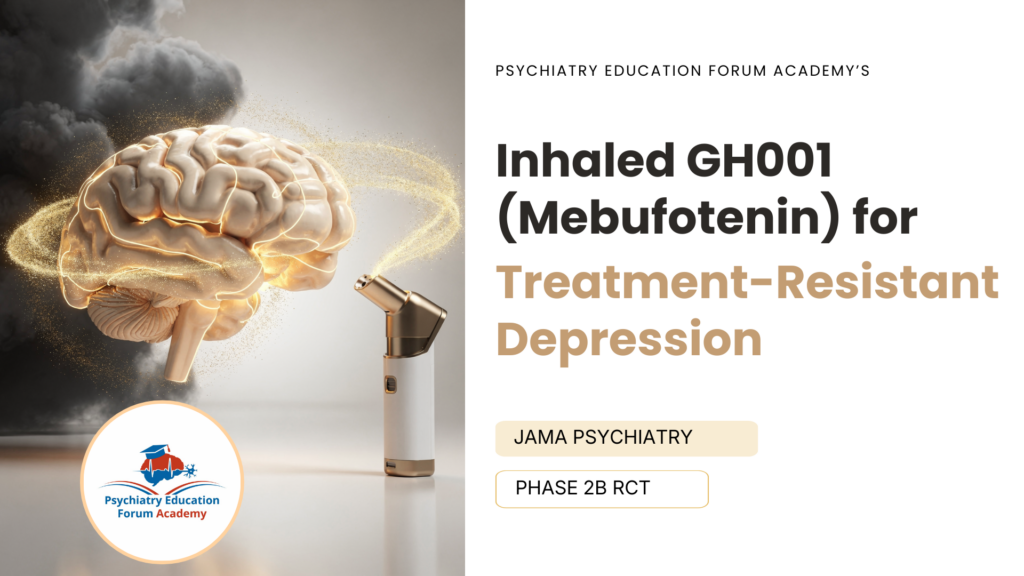
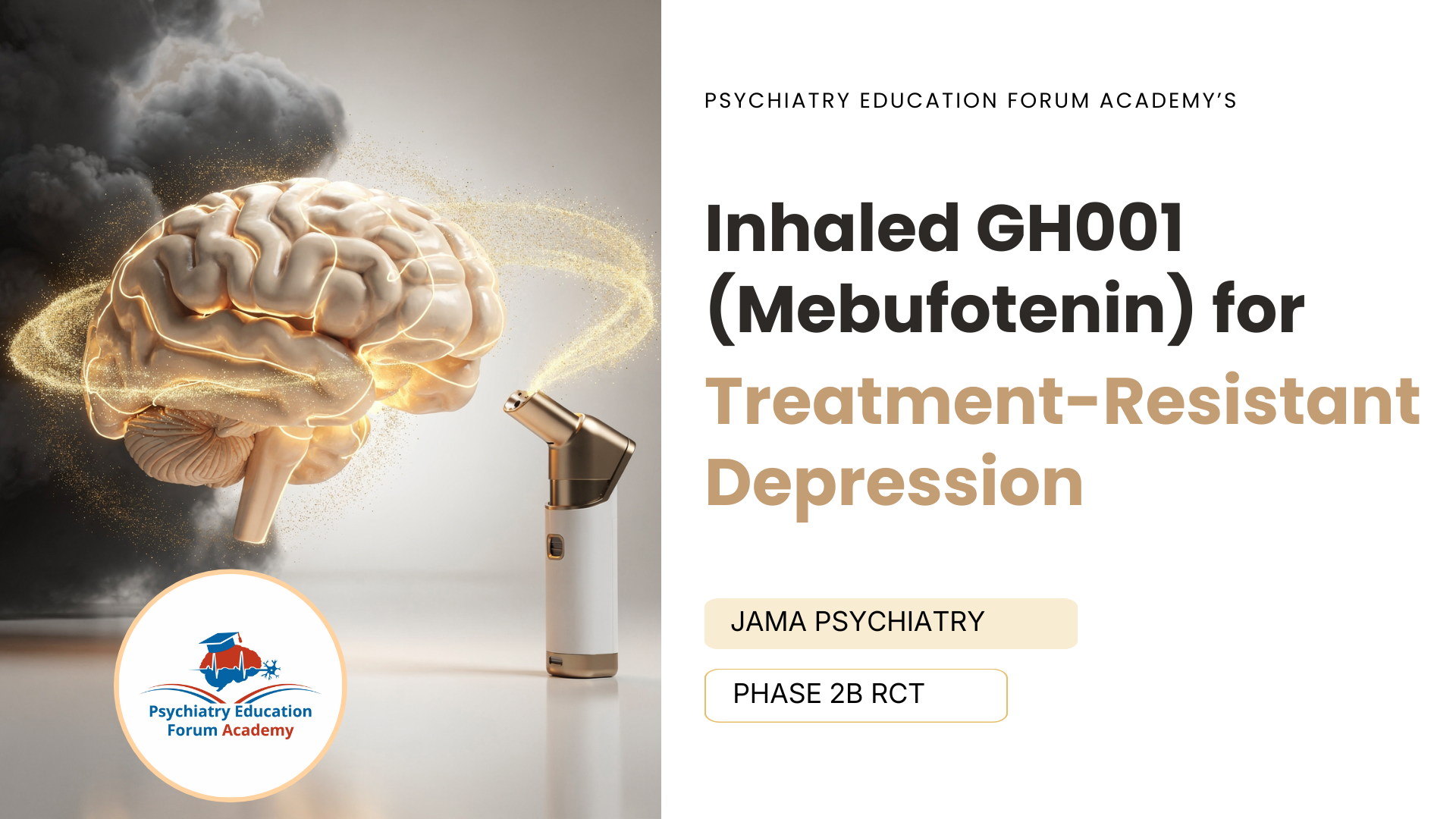
A newly published randomized clinical trial in JAMA Psychiatry (March 2026) evaluates a novel approach:
Single-day treatment with inhaled mebufotenin (GH001)
This study introduces a rapid-acting psychedelic intervention with potentially transformative implications for TRD management.
What is GH001?
GH001 acts primarily as a serotonergic agent with strong affinity for 5-HT1A receptors.
Proposed mechanisms include:
- Rapid modulation of neuroplasticity
- Disruption of rigid depressive network activity
- Resetting maladaptive emotional processing patterns
While still theoretical, this aligns with broader models of psychedelic-assisted neurobiological change.
Study Overview
Design
- Phase 2b, randomized, double-blind, placebo-controlled trial
- Conducted across 16 sites in Europe
- Duration: 7-day blinded phase + 6-month extension
Participants
- N = 81 adults with TRD
- Defined as failure of 2–5 adequate antidepressant trials
- Moderate-to-severe depression (HAM-D ≥20)
Intervention
- GH001 (synthetic inhaled mebufotenin) vs placebo
- Administered on a single day (Day 1)
- Individualized dosing:
- 6 mg → 12 mg → 18 mg (up to 3 doses, spaced 1 hour apart)
Primary Outcome
- Change in Montgomery-Ã…sberg Depression Rating Scale (MADRS) from baseline to Day 8
Key findings
(1) A large antidepressant effect
The difference in MADRS scores between GH001 and placebo at Day 8 was:
- −15.5 points (P < .001)
- Effect size: Cohen’s d = −2.0
For perspective, most antidepressant trials report effect sizes in the range of 0.3–0.5.
(2) Remission rates that are hard to overlook
- 57.5% remission in the treatment group
- 0% in placebo
This is after a single treatment day.
(3) Very short psychoactive duration
Each inhaled dose produced:
- Psychoactive effects lasting approximately 10 minutes
This is notably different from other psychedelic approaches:
- Psilocybin: several hours
- Ketamine: roughly 45–60 minutes
The shorter duration has important implications for real-world feasibility.
Safety and tolerability
- No serious adverse events reported
- No discontinuations due to side effects
Common adverse effects included:
- Nausea
- Increased salivation
- Paresthesia
These were generally mild to moderate and transient.
What makes this different
This study does not simply introduce another medication. It suggests a different treatment model.
Instead of:
- Continuous pharmacotherapy with incremental benefit
It points toward:
- Intermittent, high-impact interventions with rapid effects
That shift, if validated, could be clinically meaningful.
Clinical perspective
There are several reasons this study is generating attention:
- The magnitude of effect is unusually large
- The speed of response is clinically relevant
- The brief treatment window may improve scalability
At the same time, caution is necessary.
Limitations to keep in mind
- Sample size is relatively small (n = 81)
- Primary endpoint at Day 8 limits understanding of durability
- Blinding is inherently difficult in psychedelic studies
- Administration occurred in controlled settings
These factors limit immediate translation into routine clinical practice.
Expert commentary
This is one of the more compelling early-phase studies in the evolving field of psychedelic therapeutics.
The findings suggest that:
- Rapid, meaningful symptom improvement is possible in TRD
- Treatment may not need to rely on continuous daily dosing
- Short-duration psychedelic experiences may offer practical advantages over longer sessions
However, the key question remains:
Will these results hold in larger, longer-term studies?
Until then, this should be viewed as promising but preliminary.
Bottom line
A single-day inhaled psychedelic intervention (GH001) produced:
- Rapid antidepressant effects
- A large effect size
- Remission in over half of patients with treatment-resistant depression
If replicated, this approach could represent a meaningful shift in how we think about treating depression.
Reference: Cubała WJ, Bajbouj M, Bauer M, et al. GH001 vs Placebo in Patients With Treatment-Resistant Depression: A Randomized Clinical Trial. JAMA Psychiatry. Published online March 25, 2026. doi:10.1001/jamapsychiatry.2026.0096
DEEP DIVE FOR ACADEMY MEMBERS:
(1) Psilocybin for Treatment-Resistant Depression
This discussion will focus on following clinically relevant topics:
- Psilocybin sessions: Administrative and Integration sessions.
- Results: (a) Response; (b) Remissions; (3) Sustained Response
- Comparing Psilocybin Response to: (q) Antidepressants; (b) STAR*D
- Common and Serious Adverse Events with Psilocybin.
(2) Psilocybin for Treatment-Resistant Bipolar 2 Depression
This discussion will be summarized in the following sections:
- Study Discussion: Design, Results and Conclusions.
- How Early was the Response seen with psilocybin?
- Did Response and Remission persisted till week 12?
- Risk of manic switches with psilocybin trial?
- Risk of worsening suicidality with psilocybin trial?
- What is the predictor of long-term antidepressant response with psilocybin?
- Common adverse events with psilocybin.
We continue to review and summarize clinically relevant research to support your daily practice.
INTERESTED IN ACCESS TO THIS & OTHER CLINICALLY RELEVANT LECTURE SERIES?
JOIN ACADEMY MEMBERSHIP:
This is a closed membership for medical professionals only.
- 400+ Clinically Relevant Chapters: Each chapter within these sections is of direct clinical relevance for your daily practice. (Table of Content)
- Journal Club: we will post the most recently published psychiatry articles relevant to your daily clinical practice. (Read Content)
- Clinical Case Discussion: Dr. Singh (Psychiatry) and Dr. Kaur (Family Medicine) discuss clinical cases to integrate the clinical cases from Psychiatry and Medicine. (Read Content)
- Psychiatry Insights: Gain access to Insights featuring the latest on recent publications, new medication approvals, FDA updates, and more.Â
- Discussion Forum & Community: Connect with other medical professionals and discuss your difficult-to-treat clinical cases. (Academy Network)
- Goal: is to have all important clinically relevant topics in one place for ease of access.
JOIN ACADEMY MEMBERSHIP
DISCOUNTS AVAILABLE FOR: Residents & Students ONLY.
Email us your student information (program information and way to confirm your student status) to: [email protected]
© 2026 All Rights Reserved.
Responses