


Mastering Antipsychotics and Hyperprolactinemia

Evidence-Based Clinical Course
Mastering Antipsychotics & Hyperprolactinemia
Hyperprolactinemia is more than a lab abnormality — it impacts sexual health, fertility, bone density, and treatment adherence. This course distills the what, why, and how of prolactin changes with antipsychotics into concise, evidence-based, case-driven chapters for busy clinicians.
5 Chapters Case-Based Evidence Reviewed Academy Members Only
5
Focused Chapters
Case
Based Lessons
All
Special Populations
About This Course

Most antipsychotics raise prolactin, yet routine monitoring is rarely standard practice. The downstream consequences — amenorrhea, sexual dysfunction, infertility, osteopenia, and reduced adherence — carry real clinical weight and are too often missed. This course gives you a practical framework to evaluate, monitor, and manage prolactin elevation in patients receiving antipsychotics.

Through case-based lessons and evidence-based reviews, each chapter is concise and clinically oriented — built to translate directly into decisions you can apply at the next visit. Work through the five chapters in order.
What You'll Cover
1
Neuroendocrine Pathophysiology
Normal prolactin physiology & regulation, dopamine control of secretion, and how antipsychotics cause hyperprolactinemia
2
Evaluation & Differential Diagnosis
Working up elevated prolactin, separating antipsychotic-induced from secondary causes, correct sampling, when to image, and risk factors for severe elevation
3
Antipsychotics & Prolactin: Ranking of Medications
Comparing elevation profiles, the AVOID / CAUTION / PREFERRED classification, breast cancer risk, and applying the ranking in daily practice
4
Management Strategies
Pharmacological & non-pharmacological interventions, treating symptomatic vs. asymptomatic patients, augmentation options, and a summary algorithm
5
Special Populations
Children & adolescents, women of reproductive age, pregnancy & postpartum, men, postmenopausal women, breast cancer risk, and practical tips across groups
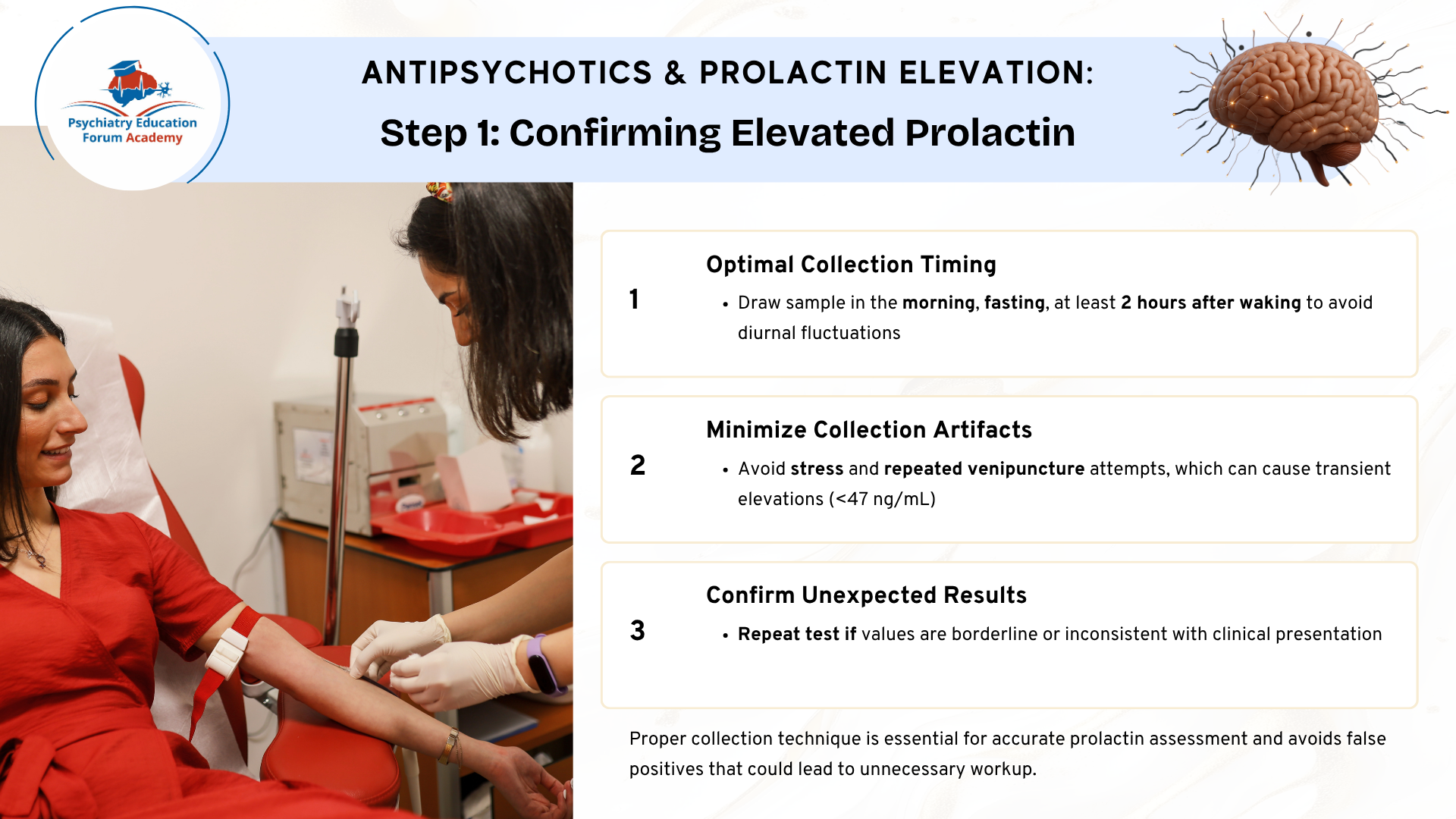
Step 1: Confirming Elevated Prolactin
A slide from Chapter 2 — Evaluation & Differential Diagnosis
Course slide showing Step 1, confirming elevated prolactin with practical guidance for accurate laboratory assessment
Who Should Enroll
Physicians, Residents & Fellows — Psychiatry, Family & Internal Medicine
Nurse Practitioners
Physician Assistants
Pharmacists
Any clinician involved in prescribing antipsychotics

Included with Academy Membership

This course is part of your Academy Membership — alongside 470+ clinical chapters, Journal Club, Clinical Case Discussions, the CME Academy, and the Academy Network community.

TABLE OF CONTENT:

Responses

Your email address will not be published. Required fields are marked *