


INTRODUCTION VIDEO:
COURSE INFORMATION:
Hyperprolactinemia is more than a lab abnormality—it impacts sexual health, fertility, bone density, and treatment adherence. This course distills the what/why/how of prolactin changes with antipsychotics into 5 concise, evidence-based chapters designed for busy clinicians.
This course is designed exclusively for Physicians, Psychiatric Nurse Practitioners, Physician Assistants and Pharmacists. Through case-based lessons and evidence-based reviews, you’ll learn how to evaluate, monitor, and manage prolactin elevation in patients receiving antipsychotics.
Course Syllabus: What You’ll Learn?
Chapter 1 — Neuroendocrine Pathophysiology
- Understand the normal physiology of prolactin and its regulation
- Describe how dopamine controls prolactin secretion
- Explain how antipsychotics cause hyperprolactinemia
Chapter 2 — Evaluation & Differential Diagnosis
- Learn how to evaluate elevated prolactin levels
- Differentiate antipsychotic-induced from secondary causes
- How to correctly collect the blood sample
- When is imaging indicated?
- What are Risk Factors for severe hyperprloctinemia?
Chapter 3 — Antipsychotics & Prolactin: Ranking of Medications
- Compare prolactin elevation profiles among different antipsychotics
- Antipsychotics classification: AVOID, CAUTION & PREFERRED
- Correlation with Breast Cancer Risk and Clinical Outcomes
- Clinical Application of Ranking in Daily Practice
Chapter 4 — Management Strategies
- Identify evidence-based strategies to manage hyperprolactinemia
- Apply pharmacological and non-pharmacological interventions
- When to Treat: Symptomatic vs. Asymptomatic
- Comparing Augmentation options
- Summary Algorithm for Clinical Practice
Chapter 5 — Special Populations
- Understand how hyperprolactinemia impacts specific groups
- Children & Adolescents
- Women of Reproductive Age
- Pregnancy & Postpartum Considerations
- Men
- Postmenopausal Women
- Patients with Breast Cancer Risk
- Practical Tips Across Groups
Who Should Enroll?
- Physicians, Residents & Fellows: Psychiatry, Family Medicine & Internal Medicine.
- Nurse Practitioners
- Physician Assistants
- Pharmacists
- Any Medical Professional involved in antipsychotics prescriptions.
Instructor
- Harvinder Singh, MD — Board-certified psychiatrist and founder of Psychiatry Education Forum Academy. Dr. Singh creates concise, clinically relevant learning for busy professionals, integrating evidence syntheses, meta-analyses, and real-world cases.
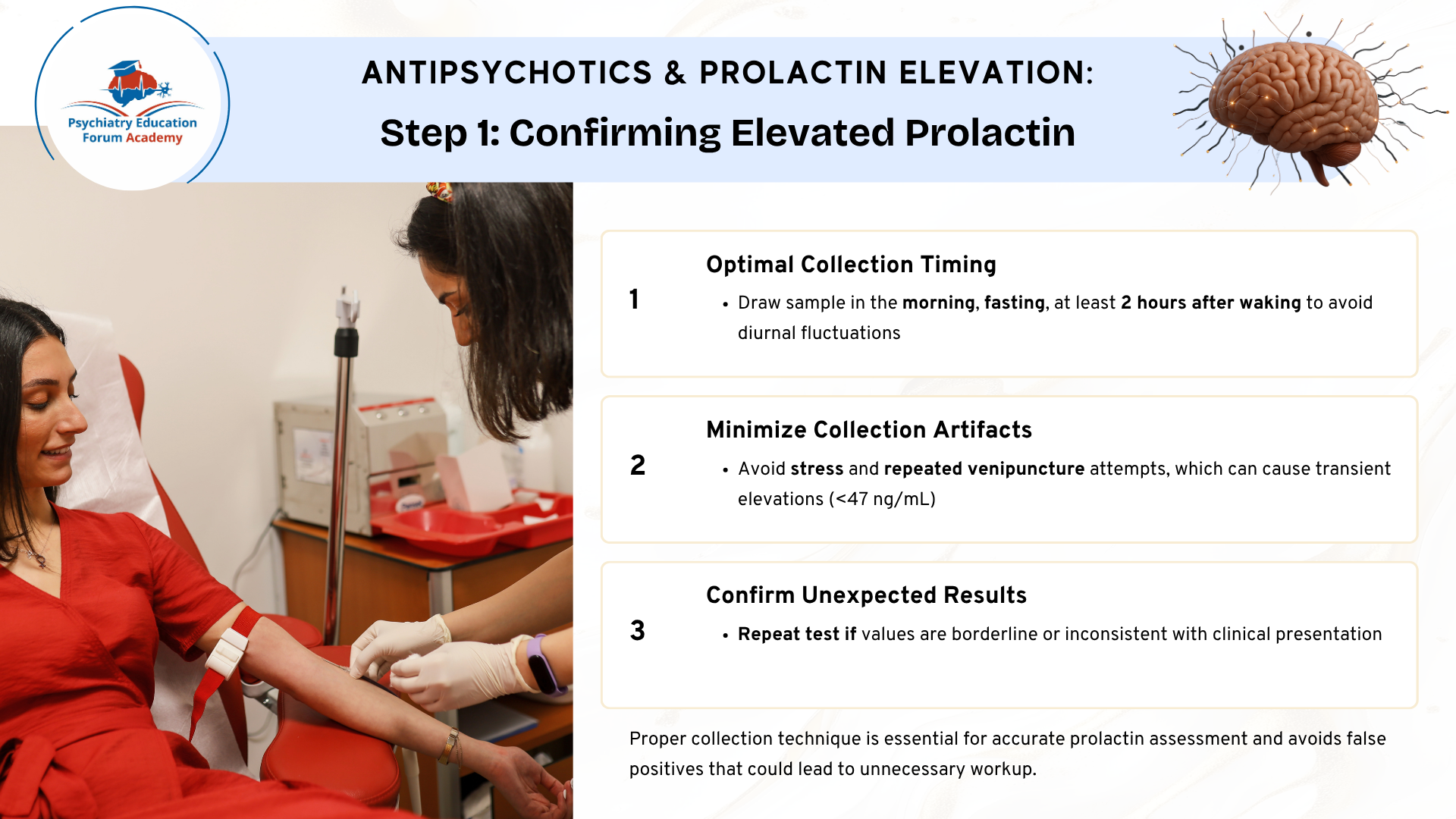
Here’s an example slide from Chapter 2: Evaluation & Differential Diagnosis, where we discuss Step 1 — Confirming Elevated Prolactin with practical guidance for accurate laboratory assessment.
Step 1: Confirming Elevated Prolactin
COURSE PRICING:
Non-Member Access
Enroll NowAcademy-Member Access
Academy Members: You are automatically enrolled in this course as part of your membership—no need to subscribe separately.
Responses