
Top 10 Viewed Posts of 2025

As we approach the end of 2025, I want to wish you all a safe and Happy New Year. Hope this new year makes all your dreams come true, and your wishes fulfilled. Happy New Year to all our dear students and followers. 

We continue our tradition of summarizing top viewed post for this year. You can access our top viewed posts for past years here:

– Dr. Harvinder Singh, MD
Creator of Psychiatry Education Forum

On this last week of 2025, let’s review our top 10 viewed posts of this year:

PSYCHOPHARMACOLOGY ADVERSE EVENT MANAGEMENT:

(1) Antipsychotics-Induced Akathisia: 6 Evidence-Based Treatment Options

Akathisia, a distressing side effect of antipsychotic medications, can significantly impact an individual’s quality of life. Characterized by an intense inner restlessness and the inability to sit still, it’s crucial to address this condition effectively to enhance patient well-being. Akathisia can result in poor adherence and worsening of psychiatric symptoms.

In our Live Discussions for Academy Members, Dr. Harvinder Singh breaks down the findings of a 2024 meta-analysis published in JAMA Psychiatry, which examined treatment options for antipsychotic-induced akathisia.

📽️ The following 12-minute video is an excerpt from our live session, summarizing six medications shown to be effective for antipsychotic-induced akathisia.

FDA APPROVAL:

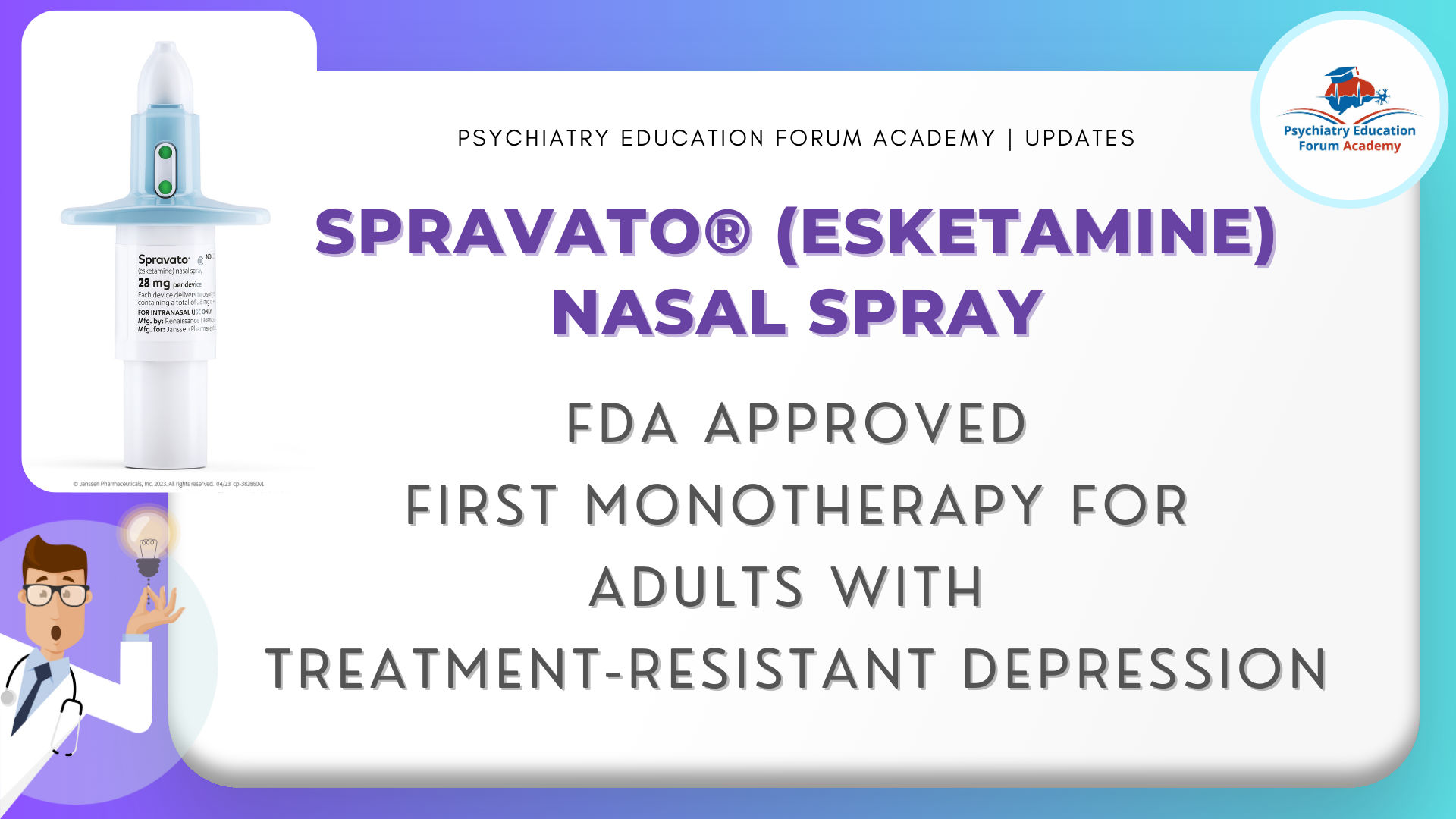
(2) Spravato: First Monotherapy FDA Approved for Treatment-Resistant MDD

SPRAVATO® was initially approved by the FDA in March 2019 as an adjunct therapy for adults with TRD. In 2025, the FDA extended its approval to include monotherapy for adults with TRD, based on robust clinical evidence demonstrating its efficacy and safety. This marked a pivotal moment, as SPRAVATO® became the first monotherapy specifically designed for TRD.

Dr. Harvinder Singh has summarized this topic in following sections:

  1. Esketamine FDA Approval History.
  2. FDA Indications
  3. When to Avoid?
  4. How to Dose?
  5. Clinical Study Supporting the Approval.
  6. Common Adverse Events

PSYCHOPHARMACOLOGY ADVERSE EVENT MANAGEMENT:

(3) Can Metformin Prevent Antipsychotic-Induced Weight Gain?

Are you prescribing antipsychotics and wondering how to manage or prevent weight gain in your patients? This was our academy’s 475th chapter & we’ve decided to publish this 475th chapter on YouTube for free access to all! 🎉 This is a great opportunity for everyone to check out the type of high-quality, clinically relevant content we produce for our membership students inside the Academy Membership.

Dr. Harvinder Singh has summarized this topic in following sections:

  1. Should Metformin be used to prevent Antipsychotic-Induced Weight Gain (AIWG)?
  2. Key predictors, parameters, and thresholds for intervention
  3. Does the antipsychotic class matter in decision-making?
  4. Recommended doses of Metformin for AIWG prevention
  5. Monitoring and managing adverse events with Metformin
  6. When to avoid or stop Metformin treatment
  7. Indications for GLP-1 agonists

PSYCHOPHARMACOLOGY UPDATE: ASAM GUIDELINES

(4) Evidence Based Benzodiazepine Tapering: 2025 ASAM Guidelines in Practice

Join us for a structured course designed to equip you with the most current, evidence-based approaches to benzodiazepine tapering—based on the newly released 2025 ASAM Clinical Practice Guideline. Whether you’re supporting patients with long-term benzodiazepine use, navigating challenging withdrawal symptoms, or balancing risk-benefit decisions, this course will provide the tools and clarity you need.

  • Module 1: Clinical Foundations of BZD Tapering
  • Module 2: Designing & Monitoring the Taper
  • Module 3: Adjunctive Strategies & Complication Management
  • Module 4: Special Populations & Complex Clinical Scenarios

NOTE: This is included in academy memberhip and available to non-members at low one time price

CHILD & ADOLESCENT PSYCHIATRY:

(5) Ranking Antidepressants for Adolescent Depression Based on New Meta-Analysis

This blog post reviews findings from a large network meta-analysis and systematic review involving 15 randomized controlled trials and over 12,000 adolescents, comparing the efficacy and safety of various antidepressants in treating Major Depressive Disorder (MDD) in adolescents.

BIPOLAR DISORDER:

(6) Maintenance Treatment in Bipolar Depression: What Recent Data Reveals

  • When managing bipolar disorder, much of the available research focuses on the acute treatment of depressive and manic episodes.
  • However, long-term management is just as critical, especially for bipolar depression, which accounts for the majority of the illness burden.
  • Understanding the effectiveness of maintenance treatments in reducing depression-related hospitalizations is essential for improving patient outcomes and preventing recurrent episodes.

This post has summarized the recent data published in Lancet Psychiatry (March 2025), shedding light on the risk of depression-related hospitalization associated with specific maintenance monotherapies.

MANAGING PSYCHOPHARMACOLOGY ADVERSE EVENTS:

(7) Mastering Antipsychotics and Hyperprolactinemia

  1. Neuroendocrine Pathophysiology: Explains normal prolactin physiology, dopamine regulation, and how antipsychotics disrupt this balance to cause hyperprolactinemia.
  2. Evaluation & Differential Diagnosis: Teaches accurate prolactin evaluation, differentiation of causes, proper testing, imaging criteria, and key risk factors.
  3. Antipsychotics & Prolactin Ranking: Compares prolactin effects across antipsychotics, classifies them by risk, and connects findings to clinical outcomes and breast cancer risk.
  4. Management Strategies: Outlines evidence-based interventions, treatment thresholds, augmentation options, and a practical algorithm for managing hyperprolactinemia.
  5. Special Populations: Highlights how hyperprolactinemia affects distinct groups and provides tailored guidance for children, women, men, older adults, and high-risk patients.

WOMEN’S MENTAL HEALTH:

(8) SSRI New Safety & Lactation Data: on Long-Term Cognitive Outcomes in Preschool Children

istorically, data on the long-term neurodevelopmental effects of SSRI exposure via breast milk has been sparse. Most guidelines rely on the “Relative Infant Dose” (RID) and short-term safety data (sedation, poor feeding). 

A new prospective cohort study published in JAMA Network Open provides critical data on preschool-aged outcomes (approx. age 5), specifically looking at IQ and cognitive development.

ADDICTION PSYCHIATRY:

(9) Naltrexone-Bupropion Shows Promise for Methamphetamine Use Disorder with Depression

Methamphetamine use disorder is a challenging condition with no FDA-approved pharmacological treatments. Many patients also present with comorbid depressive symptoms, which can worsen prognosis and complicate recovery efforts.
The ADAPT-2 trial (Accelerated Development of Additive Pharmacotherapy Treatment for Methamphetamine Use Disorder) previously demonstrated that naltrexone-bupropion can significantly reduce methamphetamine use. This secondary analysis explores whether early improvements in depression also play a role in treatment success.

PSYCHIATRY & NEUROLOGY:

(10) Understanding Hoover Test: to Differentiate Functional vs. Organic Limb Weakness

Motor Functional Neurological Disorders (FND) present a unique clinical challenge, often characterized by limb weakness or abnormal movements that are incongruent with known neurological diseases. Differentiating functional motor symptoms from organic neurological conditions is critical to providing the right treatment pathway—and bedside examination plays a crucial role.

One simple yet powerful tool in this evaluation is the Hoover Test.

INTERESTED IN ACCESS TO THIS & OTHER CLINICALLY RELEVANT LECTURE SERIES?

JOIN ACADEMY MEMBERSHIP:

This is a closed membership for medical professionals only.

  • 490+ Clinically Relevant Chapters: Each chapter within these sections is of direct clinical relevance for your daily practice. (Table of Content)
  • Journal Club: we will post the most recently published psychiatry articles relevant to your daily clinical practice. (Read Content)
  • Clinical Case Discussion: Dr. Singh (Psychiatry) and Dr. Kaur (Family Medicine) discuss clinical cases to integrate the clinical cases from Psychiatry and Medicine. (Read Content)
  • Monthly Insights: Gain access to our monthly sessions featuring the latest on recent publications, new medication approvals, FDA updates, and more. (Monthly Insights)
  • Discussion Forum & Community: Connect with other medical professionals and discuss your difficult-to-treat clinical cases. (Academy Network)
  • Goal: is to have all important clinically relevant topics in one place for ease of access.
GENERAL
$ 150/YR
  •  
STUDENTS
$ 99/YR
  •  

DISCOUNTS AVAILABLE FOR: Residents & Students ONLY.

Email us your student information (program information and way to confirm your student status) to: [email protected]

© 2026 All Rights Reserved.

Related Articles

Responses

Your email address will not be published. Required fields are marked *