
SSRI New Safety & Lactation Data: on Long-Term Cognitive Outcomes in Preschool Children

Want the latest research insights delivered straight to your inbox?
For clinicians treating postpartum depression and anxiety, the risk-benefit analysis of breastfeeding while on pharmacotherapy is a daily conversation. Patients frequently ask:
“I know breast milk is good for the baby, but won’t the medication damage their developing brain?”
Historically, data on the long-term neurodevelopmental effects of SSRI exposure via breast milk has been sparse. Most guidelines rely on the “Relative Infant Dose” (RID) and short-term safety data (sedation, poor feeding).
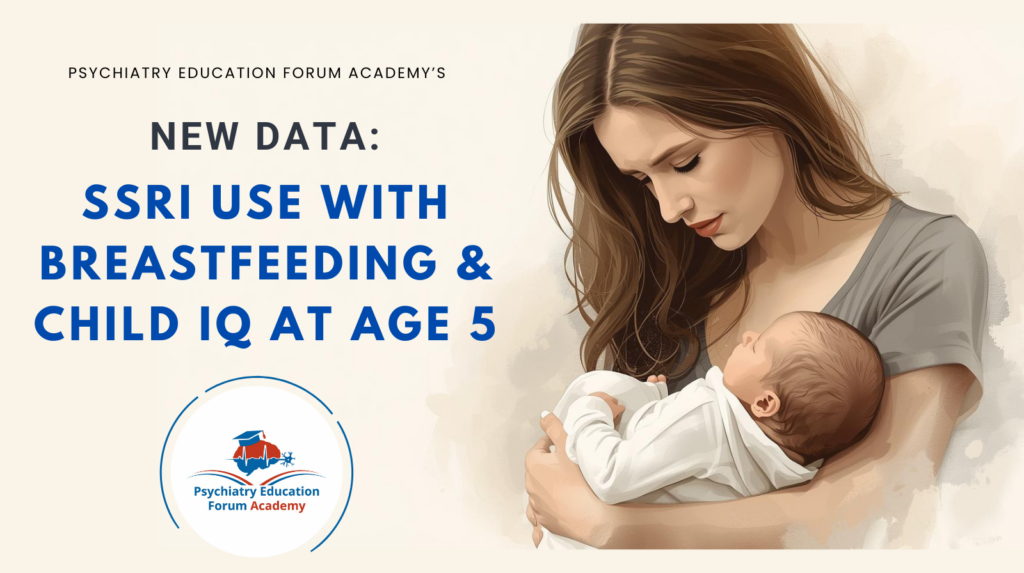
A new prospective cohort study published in JAMA Network Open provides critical data on preschool-aged outcomes (approx. age 5), specifically looking at IQ and cognitive development.
⚙️ Methodology
Study Design:
- Type: Prospective cohort study.
- Participants: 97 mother-child pairs.
- Age of Assessment: Mean age 4.9 years (range 3-6 years).
- Control for Confounders: Crucially, ALL groups had prenatal SSRI exposure. This controls for the in-utero drug effect, isolating the variable of breast milk exposure.
The Three Cohorts:
- Breastfed + SSRI: Mother took SSRIs during pregnancy and during breastfeeding.
- Breastfed + No SSRI: Mother took SSRIs during pregnancy but stopped during breastfeeding.
- Not Breastfed: Mother took SSRIs during pregnancy; child was formula-fed.
📌 Key Findings: Cognitive Outomes
The study utilized the Wechsler Preschool and Primary Scale of Intelligence (WPPSI-III) to measure Full-Scale IQ (FSIQ), Verbal IQ (VIQ), and Performance IQ (PIQ).
Result #1: Medication via Milk Did Not Lower IQ
- There were no significant differences in FSIQ, Verbal IQ, or Performance IQ between children who were breastfed with SSRI exposure and those breastfed without it.
Result #2: Breastfeeding (Even with Meds) Was Protective
- Children who were breastfed while exposed to SSRIs had significantly higher Full-Scale and Performance IQs compared to children who were not breastfed at all.
| Measure | Group A: Breastfed + SSRI (n=22) | Group B: Breastfed / No SSRI (n=37) | Group C: Not Breastfed (n=38) | Significance |
| Full-Scale IQ | 109.4 (SD 13.0) | 106.1 (SD 11.2) | 103.1 (SD 11.3) | A > C (p=.04) |
| Verbal IQ | 106.6 (SD 11.4) | 104.9 (SD 11.0) | 101.4 (SD 10.9) | NS |
| Performance IQ | 112.3 (SD 14.5) | 106.7 (SD 10.6) | 104.2 (SD 11.6) | A > C (p=.03) |
Note: While the “Breastfed + SSRI” group scored higher than the “Not Breastfed” group, this difference was largely attributed to the benefits of breastfeeding itself and maternal factors, rather than the medication acting as a cognitive enhancer.
The critical takeaway is the lack of deficit.
🔬 Clinical Implications for Practice:
1. Do Not Advise Stopping Breastfeeding to “Wash Out” Meds
- The data indicates that the benefits of breastfeeding persist even in the presence of SSRIs.
2. Do Not Advise Stopping Meds to Breastfeed
Untreated maternal depression is a well-established independent risk factor for poor child cognitive and behavioral outcomes.
In this study, maternal depressive symptoms (measured by BDI-II) were controlled.
Key takeaway: A stable mother breastfeeding on medication is clinically preferable to a relapsing mother breastfeeding off medication.
3. Reassuring Patients
Use this specific verbiage:
“New research looking at children up to age 5 shows that taking these medications while breastfeeding does not lower a child’s IQ. In fact, children who were breastfed while their mothers took medication did better developmentally than children who were not breastfed at all.”
Limitations & Nuance:
While promising, Academy members should note:
Sample Size: N=97 is relatively small; subgroup analysis power is limited.
Maternal IQ: The mothers in the “Breastfed + SSRI” group had slightly higher education levels/IQ, which is a strong predictor of child IQ. However, even after statistical adjustment, the lack of negative impact from the SSRI remained consistent.
Drug Specifics: The study pooled “SSRIs.” It did not parse out differences between Sertraline vs. Fluoxetine vs. Escitalopram, though previous pharmacokinetic data generally supports the safety of the class (with Sertraline often preferred for its low excretion).
Reference:
- Heinonen EW, Kao K, Mattson SN, Chambers CD. Cognitive Outcomes of Children Exposed to Selective Serotonin Reuptake Inhibitors Through Breast Milk. JAMA Netw Open. 2025;8(11):e2544989. (JAMA)
DEEP DIVE FOR FOR ACADEMY MEMBERS:
Antidepressants of Choice during Lactation

Unlock the full clinical detail by joining the Psychiatry Education Forum Academy:
This chapter is summarized in the following sections:
- Understanding Risk: Relative Infant Dose & Key Pharmacokinetic Factors.
- Antidepressant Classification: Low Risk, Moderate Risk & High Risk.
- Ranking Antidepressants based on RID (Relative Infant Dose)
- Integrating Long-Term Cognitive Data
- Infant Monitoring and Clinical Risk Mitigation
We continue to review and summarize clinically relevant research to support your daily practice.
INTERESTED IN ACCESS TO THIS & OTHER CLINICALLY RELEVANT LECTURE SERIES?
JOIN ACADEMY MEMBERSHIP:

This is a closed membership for medical professionals only.
- 400+ Clinically Relevant Chapters: Each chapter within these sections is of direct clinical relevance for your daily practice. (Table of Content)
- Journal Club: we will post the most recently published psychiatry articles relevant to your daily clinical practice. (Read Content)
- Clinical Case Discussion: Dr. Singh (Psychiatry) and Dr. Kaur (Family Medicine) discuss clinical cases to integrate the clinical cases from Psychiatry and Medicine. (Read Content)
- Monthly Insights: Gain access to our monthly sessions featuring the latest on recent publications, new medication approvals, FDA updates, and more. (Monthly Insights)
- Discussion Forum & Community: Connect with other medical professionals and discuss your difficult-to-treat clinical cases. (Academy Network)
- Goal: is to have all important clinically relevant topics in one place for ease of access.
DISCOUNTS AVAILABLE FOR: Residents & Students ONLY.
Email us your student information (program information and way to confirm your student status) to: [email protected]
© 2026 All Rights Reserved.