
Lithium Induced Hypercalcemia: Key Steps for Diagnosis, Monitoring, and Management.
Lithium is a widely used medication for the treatment of bipolar disorder and other mood-related psychiatric conditions. While it is highly effective, long-term use of lithium has been associated with various endocrine side effects, including hypercalcemia. As a clinician, it is essential to understand the mechanisms, risks, and appropriate monitoring strategies for lithium-induced hypercalcemia to ensure patient safety and optimal therapeutic outcomes.
Lithium-induced hypercalcemia occurs due to its effects on parathyroid gland regulation. Lithium increases the set point for calcium-sensing receptors on the parathyroid gland, leading to increased parathyroid hormone (PTH) secretion, even in the presence of normal calcium levels. This condition is often referred to as “Lithium-induced Hyperparathyroidism“. The first case of Lithium induced hyperparathyroidism was first reported in 1973.Â
At Psychiatry Education Forum Academy, we believe that it is critical to periodically remind oneself of how to tackle the common as well as serious side effects of lithium. When it comes to side effects, we have seen among our colleagues, knowing what to look for and how to tackle each side effect, imparts a great deal of confidence that enables effective use of Lithium.
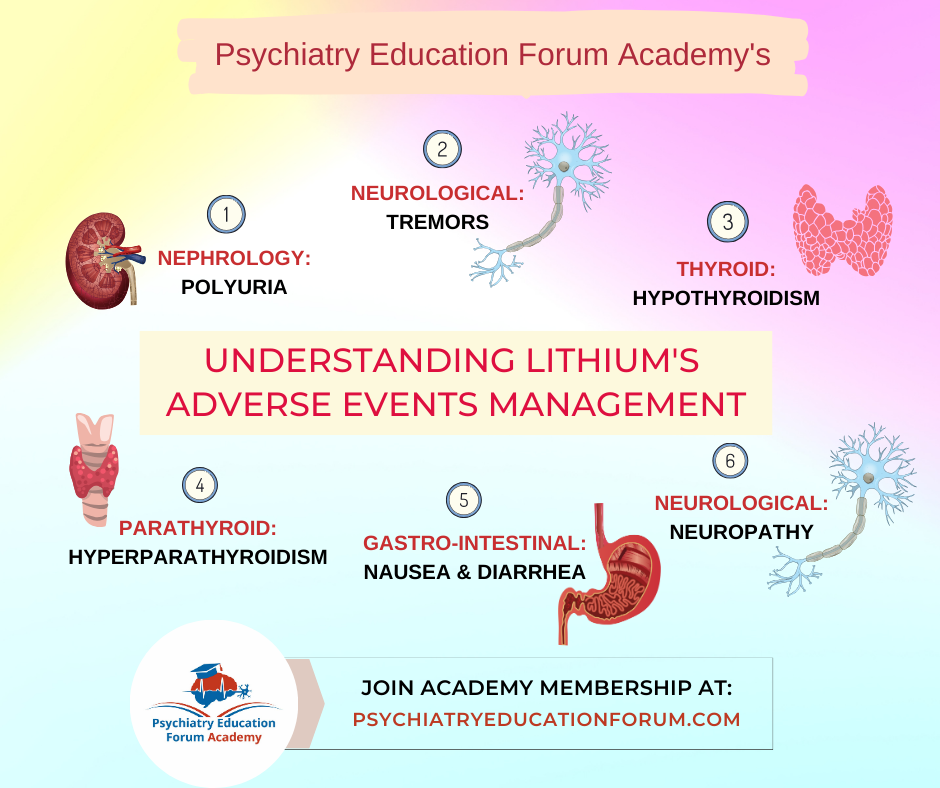
We have explored this clinically relevant topic in detail in our Academy’s lecture series on “Understanding Lithium’s Adverse Events Management“.
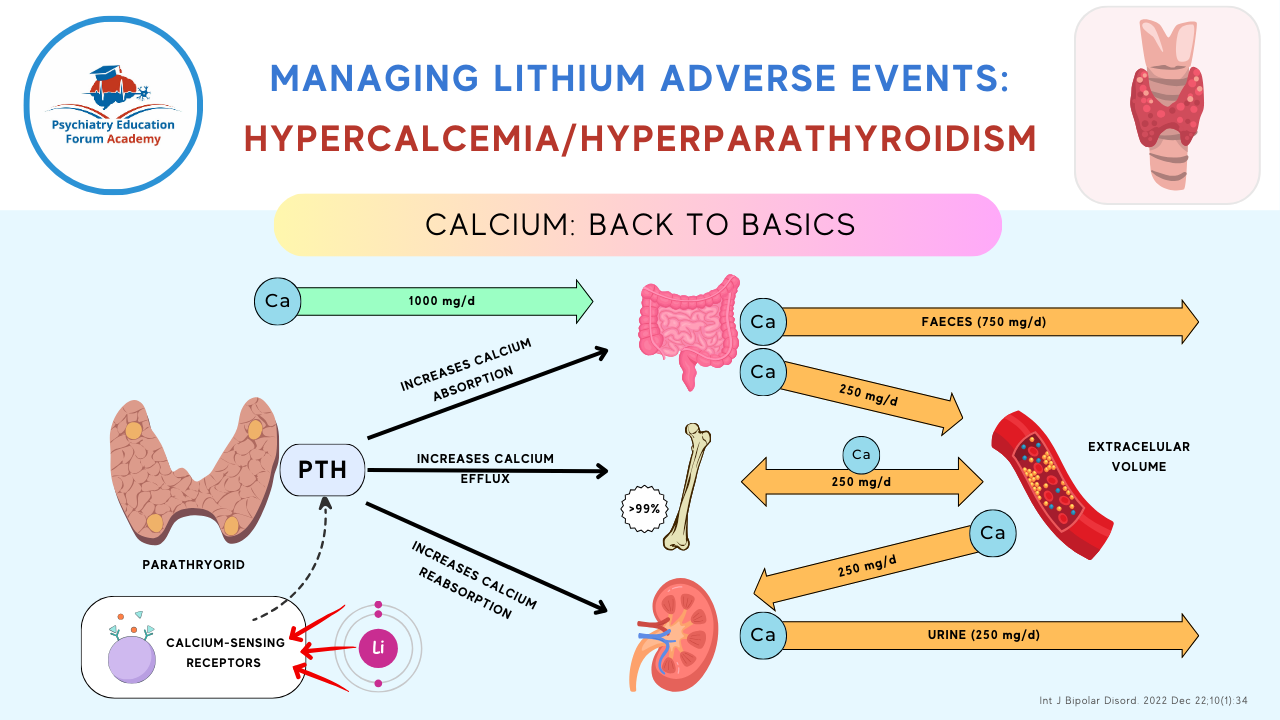
Below is a slide from the presentation illustrating the likely mechanism behind lithium-induced hyperparathyroidism:
- The likely mechanism behind lithium-induced hypercalcemia involves its effect on the parathyroid gland’s calcium-sensing receptor (CaSR).
- Ionized lithium (Li+) resembles ionized calcium (Ca + +) and act by antagonizing the CaSR.
- Lithium reduces the sensitivity of CaSR to extracellular calcium, causing the parathyroid gland to misinterpret calcium levels as being lower than they actually are.
- This reduced sensitivity leads to increased secretion of parathyroid hormone (PTH), which, in turn, promotes calcium reabsorption from the kidneys, increased calcium release from bones, and enhanced calcium absorption from the intestines.
- The resulting elevation in serum calcium levels can lead to hypercalcemia.
- This effect is often gradual and may be asymptomatic initially, but chronic hypercalcemia can have significant clinical consequences.
[FOR ACADEMY MEMBERS]
Watch the complete video where Dr. Harvinder Singh has summarized this topic in the following sections:
- Lithium Induced Hypercalcemia: Likely Mechanism?
- Hypercalcemia Symptoms: How to Diagnose?
- Monitoring Guideline
- Management Guideline: Understanding the role of PTH & Calcium level.
INTERESTED IN ACCESS TO THIS & OTHER CLINICALLY RELEVANT LECTURE SERIES?
JOIN ACADEMY MEMBERSHIP:
This is a closed membership for medical professionals only.
- 400+ Clinically Relevant Chapters: Each chapter within these sections is of direct clinical relevance for your daily practice. (Table of Content)
- Journal Club: we will post the most recently published psychiatry articles relevant to your daily clinical practice. (Read Content)
- Clinical Case Discussion: Dr. Singh (Psychiatry) and Dr. Kaur (Family Medicine) discuss clinical cases to integrate the clinical cases from Psychiatry and Medicine. (Read Content)
- Discussion Forum & Community: Connect with other medical professionals and discuss your difficult-to-treat clinical cases. (Academy Network)
- Goal: is to have all important clinically relevant topics in one place for ease of access.
DISCOUNTS AVAILABLE FOR: Residents & Students ONLY.
Email us your student information (program information and way to confirm your student status) to: [email protected]
© 2025 All Rights Reserved.