
Understanding Hoover Test: to Differentiate Functional vs. Organic Limb Weakness


Motor Functional Neurological Disorders (FND) present a unique clinical challenge, often characterized by limb weakness or abnormal movements that are incongruent with known neurological diseases. Differentiating functional motor symptoms from organic neurological conditions is critical to providing the right treatment pathway—and bedside examination plays a crucial role.
One simple yet powerful tool in this evaluation is the Hoover Test.
What is the Hoover Test?
The Hoover Test is a clinical maneuver designed to distinguish between organic and functional leg weakness. It assesses involuntary hip extension effort during contralateral hip flexion.
Here’s how it works:
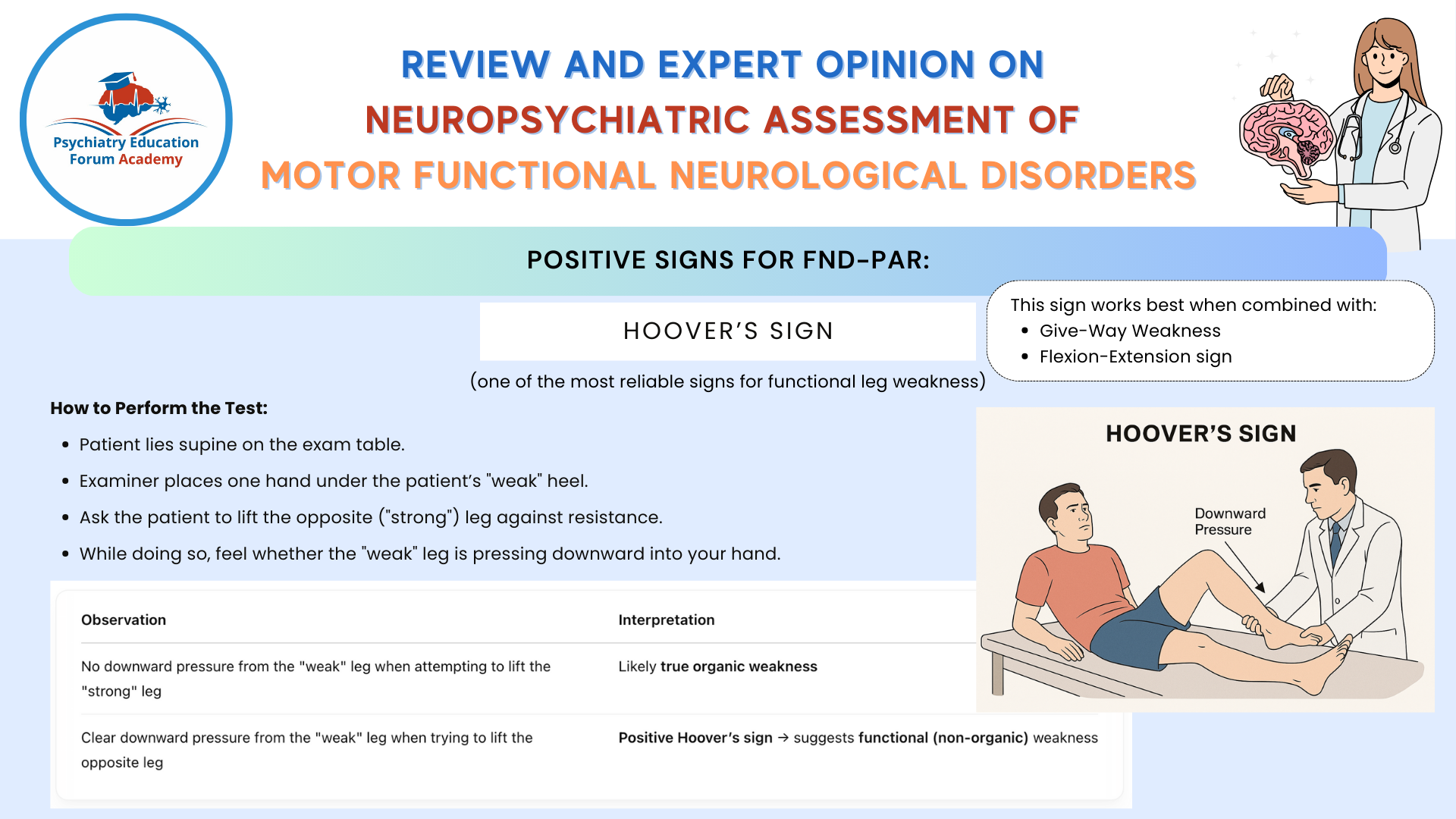
The patient lies supine (on their back) with both legs extended.
The examiner places one hand under the heel of the “weak” leg and asks the patient to lift the opposite (“strong”) leg against resistance.
Normally, when a patient tries to flex one hip against resistance, there is an involuntary extension of the opposite hip, pressing the heel downward into the examiner’s hand.
In Functional Weakness: Despite a claimed inability to extend the “weak” hip voluntarily, involuntary extension occurs when the opposite side is engaged.
In Organic Weakness: There is absent or reduced downward pressure from the “weak” side even during contralateral hip flexion.
SUMMARY SLIDE FROM ACADEMY COURSE
Why is the Hoover Test Important in FND?
High Specificity: A positive Hoover sign (involuntary extension) strongly suggests functional (non-organic) weakness.
Quick and Bedside-Friendly: It requires no special equipment and can be done rapidly in clinical settings.
Reduces Misdiagnosis: Helps avoid unnecessary tests, hospitalizations, and treatments intended for organic diseases.
Guides Therapeutic Conversations: Identifying functional weakness early allows for a more empathetic explanation to patients, validating their symptoms while introducing evidence-based treatments like physical therapy tailored for FND.
Tips for Performing the Hoover Test Accurately
Ensure the patient understands the task (lifting the opposite leg strongly).
Apply consistent resistance.
Observe carefully for the subtle but definitive downward pressure.
Limitations to Consider
Not useful in patients with bilateral lower limb weakness.
May be affected by severe pain syndromes or malingering, although FND is distinct from intentional feigning of symptoms.
Interested in learning more about how to assess motor symptoms in Functional Neurological Disorders?
We just released a detailed course on this topic:
Neuropsychiatric Assessment of Motor Functional Neurological Disorders
COURSE INFORMATION:
WHAT WILL YOU LEARN?
[Module 1] Clinical Interview
- [Total Lecture Duration: 60 min]
(a) Structured approach to identify factors relevant to FND-movement and FND-paralysis.
(b) Core areas:
- Illness Onset & Course
- Clinical Presentation
- Medical & Family Histories
- Psychosocial Factors
- Past Maltreatment & Stressors
- Psychiatric Comorbidities (Categorical & Dimensional)
- Illness Perceptions
- Suicidality & Self-Harm
- Personality Disorders & Dimensional Assessments
(c) Expert recommendations on how to conduct and structure the interview
[Module 2] Physical Examination
- [Total Lecture Duration: 50 min]
(a) Learn to identify positive signs suggestive of motor FND, such as:
- Hoover’s sign, Abductor sign
- Tremor entrainment, Co-contraction
- Collapsing weakness, Dragging gait
- Functional jerks and movement disorders
(b) Understand how to perform each exam step-by-step
(c) Differentiate functional symptoms from neurological mimic disorders
(c) Expert recommendations on how to perform physical examination.
[Module 3] Role of Adjunctive Tests
- [Total Lecture Duration: 50 min]
(a) Electrophysiological Testing: EMG & Accelerometry
(b) EEG in Functional Myoclonus
(c) Transcranial Magnetic Stimulation (TMS)
(d) Role of Neuroimaging
(b) Interpretation of Bereitschaftspotential, accelerometry, and other specialized diagnostics
(c) Recommendation on the use of adjunctive tests for FND assessment.
Neuropsychiatric Assessment of Motor Functional Neurological Disorders
We continue to review and summarize clinically relevant research to support your daily practice.
INTERESTED IN ACCESS TO THIS & OTHER CLINICALLY RELEVANT LECTURE SERIES?
JOIN ACADEMY MEMBERSHIP:

This is a closed membership for medical professionals only.
- 400+ Clinically Relevant Chapters: Each chapter within these sections is of direct clinical relevance for your daily practice. (Table of Content)
- Journal Club: we will post the most recently published psychiatry articles relevant to your daily clinical practice. (Read Content)
- Clinical Case Discussion: Dr. Singh (Psychiatry) and Dr. Kaur (Family Medicine) discuss clinical cases to integrate the clinical cases from Psychiatry and Medicine. (Read Content)
- Monthly Insights: Gain access to our monthly sessions featuring the latest on recent publications, new medication approvals, FDA updates, and more. (Monthly Insights)
- Discussion Forum & Community: Connect with other medical professionals and discuss your difficult-to-treat clinical cases. (Academy Network)
- Goal: is to have all important clinically relevant topics in one place for ease of access.
DISCOUNTS AVAILABLE FOR: Residents & Students ONLY.
Email us your student information (program information and way to confirm your student status) to: [email protected]
© 2026 All Rights Reserved.