
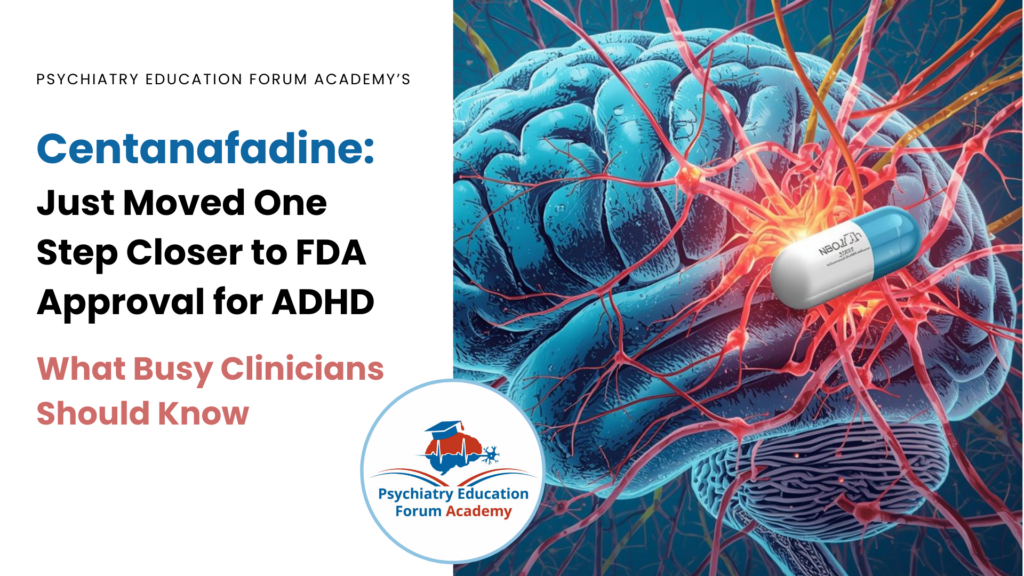
Centanafadine Just Moved One Step Closer to FDA Approval for ADHD: What Busy Clinicians Should Know

Want the latest research insights delivered straight to your inbox?
Otsuka has officially announced that the FDA has accepted the New Drug Application (NDA) for centanafadine and granted it Priority Review for the treatment of ADHD in children, adolescents, and adults.
This is a meaningful pipeline update because centanafadine may become a first-in-class non-stimulant ADHD option with a triple reuptake mechanism—and potentially a new alternative for patients where stimulants are not ideal.
We have summarized this post in the following sections:
- The Big Announcement (January 2026): FDA Acceptance + Priority Review
- What Exactly Is Centanafadine?
- The Evidence Base (What Supported the NDA?)
- What I Previously Highlighted in My 2025 Blog Post (And Why It Still Matters Now)
- Safety & Tolerability: What Clinicians Should Watch
- Where Centanafadine Could Fit in Clinical Practice (If Approved)
- Bottom Line for Busy Clinicians
The Big Announcement (January 2026): FDA Acceptance + Priority Review
According to Otsuka’s press release:
✅ FDA accepted the NDA for centanafadine
✅ Priority Review granted
✅ Target PDUFA decision date: July 24, 2026
✅ Indication requested: ADHD in children, adolescents, and adults
What Exactly Is Centanafadine?
Centanafadine is an investigational once-daily extended-release capsule and is being positioned as a first-in-class NDSRI, meaning:
NDSRI = Norepinephrine + Dopamine + Serotonin Reuptake Inhibitor
So unlike atomoxetine (NET-focused) and unlike stimulants (DA/NE release/reuptake effects), centanafadine is aiming at a multi-neurotransmitter approach.
This is the key differentiator and the reason many clinicians are watching it.
The Evidence Base (What Supported the NDA?)
Otsuka states the NDA is supported by four pivotal Phase 3 clinical trials, covering multiple age groups.
Outcomes used across trials:
Children + Adolescents: Improvement measured by ADHD Rating Scale-5 (ADHD-RS-5)
Adults: Improvement measured by ADHD Investigator Symptom Rating Scale (AISRS)
Across these studies, centanafadine reportedly showed:
✅ Statistically significant and clinically meaningful improvement vs placebo
What I Previously Highlighted in My 2025 Blog Post (And Why It Still Matters Now)
In the Psychiatry Education Forum blog post (Aug 2025), centanafadine was framed as a promising non-stimulant option for ADHD, particularly because:
1) It is not a classic stimulant
This matters for:
patients with substance use risk
patients who cannot tolerate stimulant adverse effects
patients with anxiety, irritability, insomnia sensitivity
families concerned about diversion/misuse
The 2026 FDA update reinforces that this is moving beyond “interesting study data” into a real possible near-term prescribing option (pending approval).
2) Mechanism may translate to practical benefits
Our Aug 2025 summary emphasized the “novel” mechanism (NE/DA/5-HT reuptake inhibition), which remains the defining feature that separates it from existing non-stimulants.
Centanafadine: Non-Stimulant Option for ADHD That Works in Just One Week?
Safety & Tolerability: What Clinicians Should Watch
Otsuka describes a favorable safety/tolerability profile and also notes low potential for abuse based on clinical + preclinical data.
While the press release doesn’t list side effects in detail, some clinical-news summaries have already highlighted commonly reported adverse effects in trials, including appetite and GI-related effects (and somnolence/fatigue signals).
Clinician takeaway: If approved, centanafadine will likely sit in the same real-world conversations we already have with atomoxetine/guanfacine/bupropion:
appetite/weight monitoring
sleep effects
tolerability and adherence with once-daily dosing
when to choose it over stimulants vs as adjunct/alternative
Where Centanafadine Could Fit in Clinical Practice (If Approved)
Centanafadine could become a strong candidate in patients who need:
✅ A non-stimulant option (but want something “stronger” than atomoxetine alone)
Especially when ADHD symptoms are functionally impairing and patients need robust symptom reduction.
✅ Once-daily extended-release simplicity
Better adherence potential, especially for adolescents and busy adults.
✅ A new mechanism when first-line options fail
In real practice, some patients cycle through:
stimulant 1 → stimulant 2 → atomoxetine/guanfacine/bupropion
and still have partial response or tolerability issues.
Bottom Line for Busy Clinicians
Centanafadine is now a high-priority ADHD pipeline medication:
FDA accepted the NDA
Priority Review granted
Could become first-in-class NDSRI
Once-daily ER capsule
Phase 3 program across pediatric + adult ADHD
Decision expected July 24, 2026
If approved, this could become a highly relevant option for clinicians looking for a non-stimulant ADHD treatment with a new mechanism and broad age-range applicability.
Reference: Otsuka Press Release (Jan 27, 2026)
FOR FOR ACADEMY MEMBERS:
CHILD & ADOLESCENT PSYCHIATRY

We continue to review and summarize clinically relevant research to support your daily practice.
INTERESTED IN ACCESS TO THIS & OTHER CLINICALLY RELEVANT LECTURE SERIES?
JOIN ACADEMY MEMBERSHIP:

This is a closed membership for medical professionals only.
- 400+ Clinically Relevant Chapters: Each chapter within these sections is of direct clinical relevance for your daily practice. (Table of Content)
- Journal Club: we will post the most recently published psychiatry articles relevant to your daily clinical practice. (Read Content)
- Clinical Case Discussion: Dr. Singh (Psychiatry) and Dr. Kaur (Family Medicine) discuss clinical cases to integrate the clinical cases from Psychiatry and Medicine. (Read Content)
- Monthly Insights: Gain access to our monthly sessions featuring the latest on recent publications, new medication approvals, FDA updates, and more. (Monthly Insights)
- Discussion Forum & Community: Connect with other medical professionals and discuss your difficult-to-treat clinical cases. (Academy Network)
- Goal: is to have all important clinically relevant topics in one place for ease of access.
JOIN ACADEMY MEMBERSHIP
DISCOUNTS AVAILABLE FOR: Residents & Students ONLY.
Email us your student information (program information and way to confirm your student status) to: [email protected]
© 2026 All Rights Reserved.