
Maintenance Treatment in Bipolar Depression: What Recent Data Reveals

❓Why Maintenance Treatment Matters?

  • When managing bipolar disorder, much of the available research focuses on the acute treatment of depressive and manic episodes.
  • However, long-term management is just as critical, especially for bipolar depression, which accounts for the majority of the illness burden.
  • Understanding the effectiveness of maintenance treatments in reducing depression-related hospitalizations is essential for improving patient outcomes and preventing recurrent episodes.

🔔 Depression-Related Hospitalization Risk: What the Data Shows

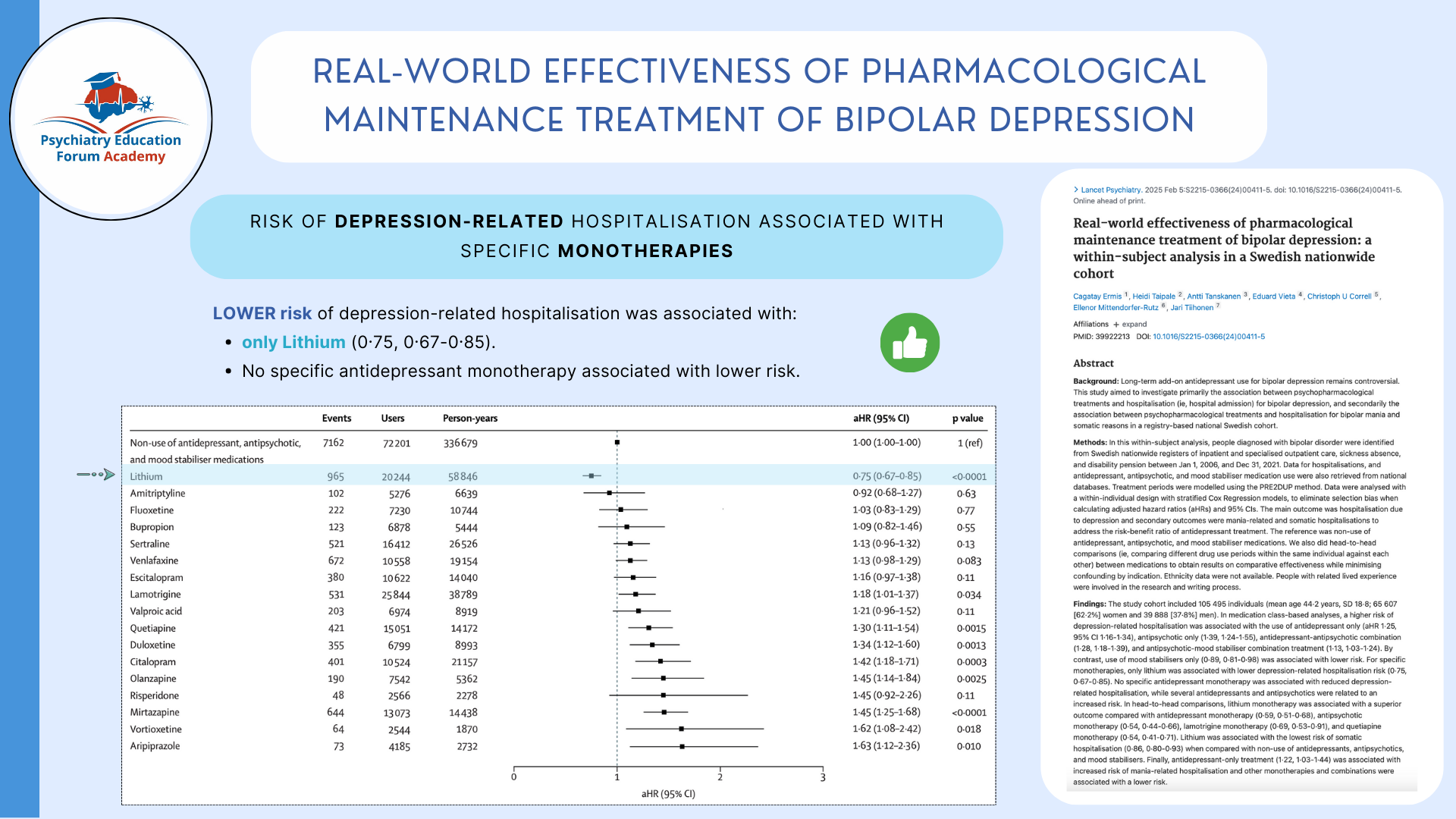
  • Recent data published in Lancet Psychiatry (March 2025) sheds light on the risk of depression-related hospitalization associated with specific maintenance monotherapies.

Below is one key slide from our academy presentation highlighting these findings:

🧠 Clinical Facts:

LOWER risk of depression-related hospitalization was associated with:
Lithium (HR 0.75, 95% CI: 0.67-0.85)
No specific antidepressant monotherapy was associated with a lower risk.

  • These findings reinforce lithium’s well-established role in bipolar disorder maintenance treatment, not only for mood stabilization but also in reducing depressive relapse risk.
  • In contrast, antidepressants, when used as monotherapy, did not show a significant benefit in lowering hospitalization rates, further highlighting the need for caution when prescribing them without a mood stabilizer or antipsychotic.

FOR ACADEMY MEMBERS:

🚀 New Academy Chapter: A Deep Dive into Bipolar Depression Maintenance Treatment

Our latest Academy Chapter provides an in-depth analysis of these findings and answers critical clinical questions, including:

Which medication class has the HIGHEST & LOWEST risk of depression-related hospitalization?
Which monotherapy can INCREASE or DECREASE the risk of depression-related hospitalization?
Which combination treatments can DECREASE the risk of depression-related hospitalization?
Which medication class has the HIGHEST risk of mania-related hospitalization?
Which monotherapy was associated with a DECREASED risk of somatic-related hospitalization?

By summarizing this recent data, we aim to equip clinicians with evidence-based guidance for optimizing maintenance treatment in bipolar depression and improving long-term patient outcomes.

FOR ACADEMY MEMBERS ONLY

ACADEMY

We continue to review and summarize clinically relevant research to support your daily practice.

INTERESTED IN ACCESS TO THIS & OTHER CLINICALLY RELEVANT LECTURE SERIES?

JOIN ACADEMY MEMBERSHIP:

This is a closed membership for medical professionals only.

  • 400+ Clinically Relevant Chapters: Each chapter within these sections is of direct clinical relevance for your daily practice. (Table of Content)
  • Journal Club: we will post the most recently published psychiatry articles relevant to your daily clinical practice. (Read Content)
  • Clinical Case Discussion: Dr. Singh (Psychiatry) and Dr. Kaur (Family Medicine) discuss clinical cases to integrate the clinical cases from Psychiatry and Medicine. (Read Content)
  • Monthly Insights: Gain access to our monthly sessions featuring the latest on recent publications, new medication approvals, FDA updates, and more. (Monthly Insights)
  • Discussion Forum & Community: Connect with other medical professionals and discuss your difficult-to-treat clinical cases. (Academy Network)
  • Goal: is to have all important clinically relevant topics in one place for ease of access.
GENERAL
$ 150/YR
  •  
STUDENTS
$ 99/YR
  •  

DISCOUNTS AVAILABLE FOR: Residents & Students ONLY.

Email us your student information (program information and way to confirm your student status) to: [email protected]

© 2025 All Rights Reserved.

Related Articles